
Arms of the First World War

This feature contains the standard rifles, machine guns, pistols and edged weapons of each fighting nation, together with any special types fielded during the war. You can read about the origins and use of these unique tools of war, as well as view modern and period photos. This is not an exhaustive list and more weapons and equipment will continue to be added.
While technology advanced rapidly in the 19th century, military strategy and tactics did not. When the empires of Europe clashed in 1914, the military commanders struggled to adapt to the new weapons available on an industrial scale. The result was an unprecedented death toll. One million British people alone were killed. Though the human cost was immense, tremendous effort was made by all sides to bring a decisive end to the fighting. Military technology was further developed, and new ways found to use it. From the bolt-action rifle to the submachine gun, these are the weapons that enabled modern warfare and defined the classes of weapon still in use today.
Entente Powers
Britain


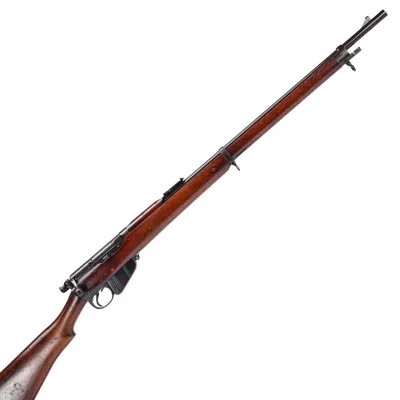
Magazine Lee-Enfield Rifle Mk.I and Pattern 1888 Bayonet
Development
Britain was the only nation to adopt the bolt-action mechanism developed by Scots-Canadian James Paris Lee, when it replaced the lever-operated Martini-Henry with the Lee-Metford rifle in 1888. 'Metford' referred to British engineer William Ellis Metford, who designed the original pattern of rifling for the weapon, which was fitted with an eight-round magazine.
Like all British infantry arms before it, the Metford was designed to fire black powder, in this case inside the new .303 cartridge. By 1895 however, it had been discovered that the fast-burning smokeless propellants coming in to use would rapidly wear out Metford's shallow, rounded grooves. This polygonal rifling system was actually ahead of its time, and thanks to advances in metallurgy, is back in use today, for example in the Glock pistol adopted by the Austrian and British armies. Nonetheless, at the time a replacement type of rifling was needed.
The pattern devised at the Royal Firearms Factory at Enfield reverted to conventional square grooves, and gave the weapon the Lee-Enfield name. Magazine capacity was also increased by widening the magazine to accommodate two columns of cartridges, and, later, a metal bridge over the action to allow five rounds at a time to be stripped from chargers (clips) carried in pouches on the soldier's web equipment.
Use and effect
Velocity was key to the power and accuracy of infantry rifles. Improvements to the Lee-Metford pushed muzzle velocity from 622 metres per second (2040 feet per second) up to 751 m/s (2460 fps). Nonetheless, this was still lower than the 878 m/s (2,881 fps) of the Mauser 98. The Metford's original black powder cartridge was loaded with a round-nosed bullet that did not 'tumble' (yaw) in human tissue. This resulted in less severe wounds than those caused by previous weapons. This was soon replaced by more lethal designs including the infamous 'Dum-Dum' and ultimately, the modern pointed bullet.
The Lee action was also not as strong nor as accurate as the Mauser, and whilst almost legendary today, was not well thought of by many officers and men when it was introduced. It did have the advantage of twice the magazine capacity of most of its rivals. It was also easier to use in combat. In the Mauser, the operator must overcome the pressure of the firing pin spring, as well as any resistance from the fired cartridge case, as the bolt handle is pulled upwards. In the Lee, the firing pin is cocked as the bolt is pushed forwards, allowing the user to apply more muscles to the task, and speeding up reloading.
The Lee-Enfield appears to be about the worst rifle in the hands of the troops of the great powers.
Major William Anstruther-Thompson, Royal Horse Guards, 1900
Statistics
- Date entered service - 1895
- Action / Operating system - Bolt-action
- Barrel length - 76.7 cm (30.2 in)
- Overall length - 1.257 m (49.5 in)
- Weight - 4.3 kg (9 lb 8 oz)
- Effective range - 550 m (600 yd)
- Maximum range - 3200 m (3500 yd)
- Feed - Box magazine
- Capacity (rounds) - 8
- Calibre / Bore - 7.7x56mmR (.303 in)
- Muzzle velocity - 625 m/s (2050 fps)
- Country of manufacture - Britain
- Manufacturer - Birmingham Small Arms Company
- Manufacturer - Royal Small Arms Enfield
- Manufacturer - Royal Small Arms Factory Sparkbrook
- Primary operator - Britain
- Other operators - Australia
- Other operators - Canada
- Other operators - New Zealand
- Other operators - Portugal
Mr. J. Curdie, Private, 6th Battalion, Highland Light Infantry
Rifles were standard issue to all infantry units during the First World War and volunteers would go through three months of physical and weapons training to turn from civilians into soldiers. Mr. Curdie joined the Highland Light Infantry in late 1914 and described the arduous training regime of a new recruit.
Training was intense in rifle practice, we went to the ranges at Derwent, we had skirmishes of a type designed to train us and extend our manoeuvres. We even had attempts at night manoeuvres, in difficult terrain.
Related Objects


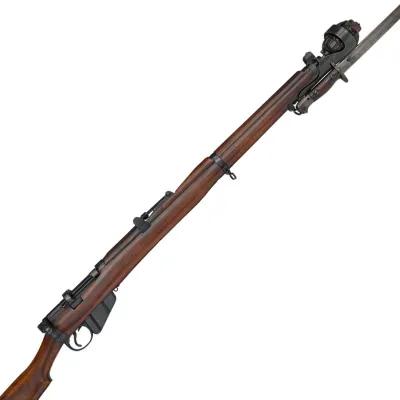
Short Magazine Lee-Enfield (SMLE) Rifle and Pattern 1907 Bayonet
Development
The key word in the SMLE's designation is 'Short', which refers to the length of the rifle relative to the old 'Long' Magazine Lee-Metford and Lee-Enfield rifles that it replaced. It was discovered at the end of the 19th century that more powerful smokeless propellant would allow long, cumbersome infantry rifles to be reduced in length without any loss in capability. This would make the weapon lighter and easier to manipulate, and also simplify production and logistics.
At the same time, the British Army was facing skilled Boer marksmen in the South African War (1899-1902), with their accurate, long-ranged Mauser rifles. This led to complaints against both British standards of marksmanship training and the Lee rifle. Some advocated that long range accuracy was the key, but the Indian Army, also experiencing real combat in the North West Frontier region (now Afghanistan), showed that an overhaul of traditional tactics was needed. Soldiers standing shoulder-to-shoulder in the open, and firing simultaneously on direct orders from their officers, were an easy target for any enemy that chose not to fight in this way.
Officers with the Indian Army were instrumental in changes to doctrine and training that would allow soldiers to fire independently and as rapidly as necessary, as targets became available. These changes are reflected in the Mark III* version of the SMLE, which did away with antiquated 'dial' sights for massed rifle fire at extreme range, and a cut-off plate, intended to keep the magazine in reserve, which reflected strict fire orders already out of use by 1914.
Use and effect
One standard short rifle for all troops meant that the traditional short carbines used by the cavalry and artillery could be abandoned. Further reflecting changes in fighting style, sighting arrangements were also changed on the SMLE. Front and rear sights were closer together, allowing the shooter to quickly align them for a 'snap' shot.
This new rifle and these new tactics, both geared toward the reality of close to medium-range combat, were vital in helping to halt the German advance in 1914. The shorter, handier rifle with its distinctive stubby appearance also went on to provide an edge in trench warfare, the extent of which its designers could not have predicted. The high rates of fire achieved in training also resulted in claims that the British 'Tommy' was able to deliver a greater volume of fire than his enemies or allies.
Our men have come to believe that every one of you carries a portable Maxim with him.
A German officer's comments on the high rate of British rifle fire at the Battle of Mons.
Statistics
- Date entered service - 1903
- Action / Operating system - Bolt-action
- Barrel length - 64 cm (25.2 in)
- Overall length - 1.118 m (44 in)
- Weight - 3.96 kg (8 lb 11 oz)
- Effective range - 503 m (550 yd)
- Maximum range - 2743 m (3000 yd)
- Feed - Box magazine
- Capacity (rounds) - 10
- Calibre / Bore - 7.7x56mmR (.303 in)
- Muzzle velocity - 744 m/s (2441 fps)
- Rate of fire (rounds per minute) - 25
- Country of manufacture - Britain
- Manufacturer - National Rifle Factory Manufacturer - Royal Small Arms Factory Enfield
- Manufacturer - Birmingham Small Arms Company
- Manufacturer - London Small Arms Company
- Manufacturer - Royal Small Arms Factory Sparkbrook
- Manufacturer - Standard Small Arms
- Primary operator - Britain
- Other operators - Australia
- Other operators - Canada
- Other operators - India
- Other operators - New Zealand
- Other operators - Portugal
Related Objects


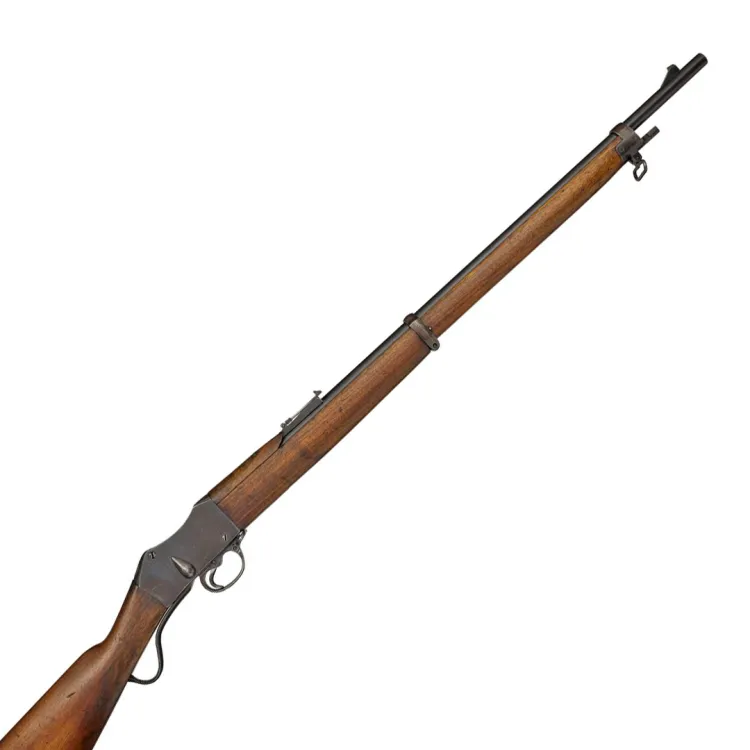
Martini-Enfield VTC Carbine
Development
The Martini-Enfield was a marriage of the aging Martini action of Martini-Henry fame, with a rifled barrel of the same pattern as that fitted to the Magazine Lee-Enfield and Short Magazine Lee-Enfield service rifles. As such, it was a single-shot weapon manually operated weapon by means of a long lever behind the trigger guard. This was an efficient system when the Martini-Henry was originally adopted in 1871; simpler and faster to operate than the early bolt-action weapons being adopted in Europe.
By the 1880s though, the internal magazine had given bolt-action rifles a great deal more firepower. Despite an impressive, if over-engineered, solution by Canadian army officer Captain C. Greville Harston, the Martini action proved incompatible with a magazine, and it became obsolete. All Martinis still in service after the introduction of the Lee-Metford (1888) and Lee-Enfield (1895) rifles were therefore converted to .303 calibre and relegated to reserve status.
Because the Volunteer Training Corps were not part of the British army's formal establishment however, their Lee-Enfield and Martini-Enfield rifles were purchased commercially from local gunmakers. For example, in the case of the Kings Lynn detachment, an order was placed with Agnew and Sons of Colchester, more usually known for their shotguns. This approach gave rise to a specific 'VTC' pattern of carbine, based upon existing 'trade' versions sold abroad to economically less well developed countries.
Use and effect
Like many nations, Britain lacked enough up-to-date weapons to equip every military unit. Priority went to front-line regular and territorial regiments. The unprecedented need for weapons meant that even some of these were equipped with older types.
The Volunteer Training Corps was a precursor of the Home Guard of the Second World War - a volunteer unit comprised of men too old or infirm for service abroad. It also included those in reserved occupations deemed essential to the war effort. With the technology and politics of the day, invasion of Great Britain by Germany was extremely unlikely, yet from 1915 Zeppelin and aeroplane attacks began to claim civilian lives. An armed presence on the 'Home Front' was therefore important, if only to reassure the population that they were protected. In fact, it was primarily the responsibility of the Royal Navy and Royal Artillery to respond to any attack.
The Martini-Enfields of the VTC were never called upon, but they certainly would have had the power to put up a rugged defence against enemy infantry. The weapon was a carbine in name only, sharing barrel length with the short SMLE rifle. Therefore, the power, accuracy, and overall weight of the two weapons were very similar. The lack of a magazine for rapid fire, however, would have been a disadvantage in pitched battle. Some VTC units had access to the Lee-Enfield, and early on, some had actually been provided by the War Office with the modern Pattern 1914 rifle.
Due to a shortage of rifles in 1914, the latter were withdrawn and reissued elsewhere, as this verse from a poem sent in to The National Guard Magazine in 1917 laments:
Nor is there room to write a trifle About the 1914 rifle. One day 'tis here, the next day gone, Our darling from our arms is torn, And "Old Martini" carried on!
Statistics
- Date entered service - 1914
- Action / Operating system - Lever-operated tilting block
- Barrel length - 64 cm (25.2 in)
- Overall length - 1.18 m (46.5 in)
- Weight - 3.71 kg (8 lb 3 oz)
- Effective range - 503 m (550 yd)
- Feed - Single shot
- Capacity (rounds) - 0
- Calibre / Bore - 7.7x56mmR (.303 in)
- Muzzle velocity - 744 m/s (2440 fps)
- Rate of fire (rounds per minute) - about 12
- Country of manufacture - Britain
- Manufacturer - Royal Small Arms Factory Enfield
- Primary operator - Britain
Related Objects


Short Magazine Lee-Enfield (SMLE) Rifle - Trench Adapted
Development
The SMLE rifle had been well suited to war in the trenches. In 1916, it was further refined as the Mark III* by eliminating redundant features, by which time fabric action covers and metal muzzle covers had been issued to limit ingress of mud and water. Work began too on dedicated sniper variants. A number of other adaptations were made specifically for trench warfare in the form of attachments or accessories. These could, in theory, be fitted to any service rifle.
'Overhead fire' devices were developed to permit a soldier to not only see above ground level by means of a periscope attachment, but also to continue firing from safety. The metal frame was collapsible and contained an auxiliary trigger linked to the rifle's trigger. Thrown hand grenades were limited in range by the strength of the soldier's arm.
It was realised in 1915 that the power of a rifle could be used to project 'bombs' to greater ranges, and potentially also improve accuracy. The rod was slightly smaller than the bore of the SMLE rifle, and could be slid into it. A blank cartridge fired behind the rod would propel this new 'rod grenade' out of the barrel.
At first, a series of dedicated designs were produced that could only be fired from a rifle. Later, the standard No.5 Mills 'bomb' was converted by means of a different screw-on baseplate to attach a copper rod, changing its designation to 'No.23' and permitting either hand throwing or rifle discharge. Under this system, a sheet metal bracket had to be fitted, held in place by a standard bayonet.
All of these rod systems tended to wear the SMLE's rifling, and so the 'cup' system was introduced in 1917. This used a detachable metal cup, actually a concept used with muzzleloading arms in the 18th and early 19th centuries. Again, a blank cartridge was inserted into the chamber prior to firing, and the new No.36 hand grenade prepared for rifle discharge by screwing a circular plate onto its base.
Use and effect
The overhead fire device successfully allowed soldiers to use several feet of earth as cover against enemy fire. Too few were available to give any great volume of fire, relegating the device to short range sniping at enemy soldiers who strayed into 'no man's land' or raised their heads above the parapet of their own trench. The British version was not as fully developed as the German equivalent, and lacked an auxiliary bolt handle. As such, it had to be brought down from the parapet for reloading.
It also took time to fit and detach these devices, which meant that a spare rifle would typically be found for use with the frame. It became, in effect, a specialist trench weapon in its own right. The same applied to grenade launching devices. Whilst capable of projecting a grenade many times further than the human hand, launching such heavy projectiles generating immense recoil.
Both rod and cup type systems had to be fired with the butt jammed into the ground. With practice, rough aim could be established simply by leaning the rifle at the correct angle, though support frames with clamps were also created. This harsh recoil however tended to crack the wooden stock of the rifle.
Rifle grenades were too useful to be abandoned, and development of a satisfactory standalone launcher would take too long (though it was attempted with the little-known Blanch-Chevallier launcher). Instead, rifles deemed to be in too poor a state for general issue were wrapped with reinforcing copper wire and designated as full-time grenade launchers. These rifles were already marked 'EY' for 'Emergency use only'.
Detachable wire-cutters were more successful as truly interchangeable accessories, and were often fitted prior to an attack. If time was short to remove them prior to actual combat, they could be left on the rifle and would not greatly interfere with its operation at trench fighting ranges. They would throw off a shooter's aim at ranges beyond 100 m (109 yd) however, as they added weight to the muzzle, changing the balance of the rifle.
Statistics
- Date entered service - 1916
- Action / Operating system - Bolt-action
- Barrel length - 64 cm (25.2 in)
- Overall length - 1.118 m (44 in)
- Weight - 3.96 kg (8 lb 11 oz)
- Effective range - 503 m (550 yd)
- Feed - Box magazine
- Capacity (rounds) - 10
- Calibre / Bore - 7.7x56mmR (.303 in)
- Muzzle velocity - 744 m/s (2441 fps)
- Rate of fire (rounds per minute) - 25
- Country of manufacture - Britain
- Manufacturer - Birmingham Small Arms Company
- Manufacturer - London Small Arms Company
- Manufacturer - National Rifle Factory
- Manufacturer - Royal Small Arms Factory Enfield
- Manufacturer - Royal Small Arms Factory Sparkbrook
- Manufacturer - Standard Small Arms
- Primary operator - Britain
- Other operators - Australia
- Other operators - Canada
- Other operators - India
- Other operators - New Zealand
Related Objects



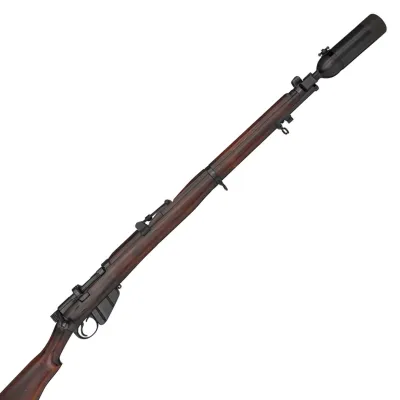

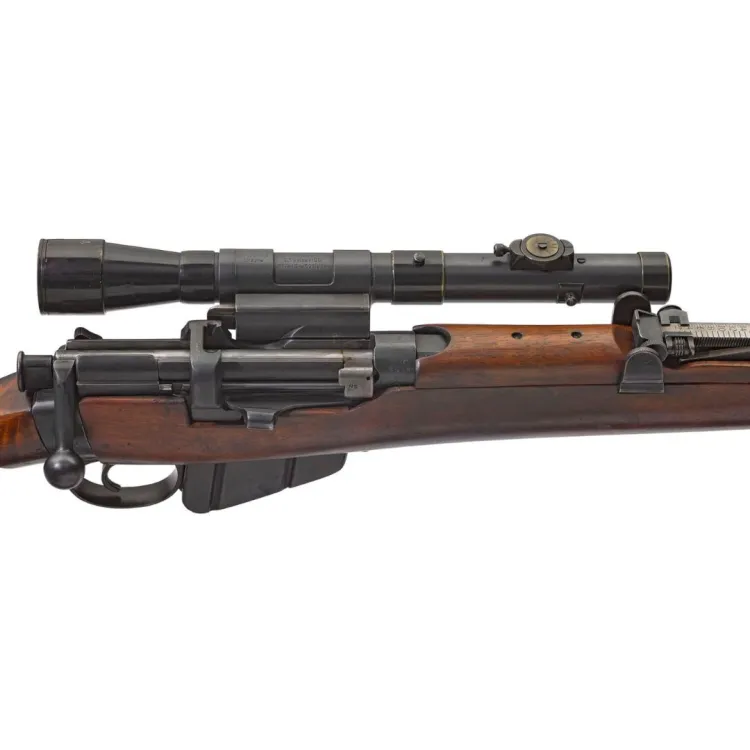
Short Magazine Lee-Enfield Sniper Rifle with Periscopic Prism Company (PPCo) Telescope Sight
Development
The centuries leading up to the First World War had seen the military use terms such as 'rifleman' and 'sharpshooter'. The birth of sniping as a military discipline, however, came of age during the First World War. The art of sniping was never embraced by soldiers of either side. Snipers often used trees, shell holes, and hollow logs in which to conceal themselves. Occasionally hollow metal trees were used, carefully put into place under cover of darkness.
Unpopular amongst their fellow comrades as well as the enemy, Frederick Sleath, a British sniping officer commented, 'there was something about them that set them apart from ordinary men and made soldiers uncomfortable.' The killing of individuals from a secret location was seen as deceptive and unsporting, whilst it was perfectly acceptable to bayonet an enemy to death in close-quarter combat. Ongoing developments in scope technology during the War allowed the sniper a clearer sight picture. Teamed with the ability of stalking and concealment, these scopes contributed to the overall efficiency of snipers.
In early 1915, realising that the list of casualties caused by enemy snipers needed to be reduced, the British began their search for a rifle to counteract the enemy. Most of these were hunting rifles and although they could pierce enemy sniper plates, they were only available in non-standard calibres. Their recoil also made them difficult to shoot from the prone position. It was suggested that the Enfield Pattern 1914 might be suited to the task, however the need to convert it from .276 inch to .303 inch was thought to be a lengthy and costly operation. Instead the standard issue infantry Short Magazine Lee-Enfield (SMLE) rifle Mark III, was chosen for sniper conversion.
Manufacturing a telescopic sight for the SMLE was even more problematic. Most optical glass was being used to manufacture artillery gun sights, telescopes, and binoculars, and a set pattern for mounting sights on rifles didn't exist. Eventually, after a rush decision in May 1915, three primary patterns were agreed on. These were the British PPCo, the British Aldis and the American commercial Winchester A5. Other British manufactures such as Evans and Watts, and even German and French scopes, were also used.
Use and effect
Used by both British and Commonwealth snipers, the PPCo, although robust enough for life on the Western Front, had only 2x magnification. The German Goertz scope, which was attached to the Mauser Gewher 98 rifle, provided its user with 3x magnification. Higher magnification resulted in a clearer, brighter and larger sight image. The PPCo scope was also offset, forcing the sniper to either raise their head from the stock when aiming, or to shoot with the left eye. Both would compromise accuracy.
In contrast, the Mauser's design provided two available platforms for scope mounts to be fitted. The scope was mounted in a more central position, allowing the snipers head to become more naturally aligned with the barrel thus providing greater accuracy. It was not purely the scope which determined the efficiency of a sniper.
Despite the British scopes not being as sharp as their German counterparts, the capability of the German snipers on the Western front was due to a combination of abilities. Many German soldiers had experience of marksmanship, observation and stalking, due to their game-keeping heritage and with these basic skills already in place, the German army could quickly train skilled snipers. The existence of superior scope technology was a bonus.
Early teams of British snipers were referred to as 'The Suicide Squad', due to their lack of training and the technology available to them. Although by 1915 scoped rifles started to appear on the Western front, many had no idea how to use them effectively. This was observed first hand by Major Hesketh-Pritchard:
I had gone down on duty and there found a puzzled looking private with a beautiful new rifle with an Evans telescopic sight. I examined the elevating drum and saw that it was set for 100 yards. "Look here," I said, "You have got this sight set for a hundred. The Hun trenches are four hundred yards away." The private looked puzzled. "Have you ever shot with this rifle?" I asked. "No Sir." "Do you understand it?" "No Sir."
Realising the need for 'trained' snipers to accompany their enhanced sniper rifles, Sniper Schools were set up in late 1915 /early 1916. Teaching students how to determine range, the effect of windage, correct manipulation of the rifle and the importance of camouflage, the British sniper finally became a force to be reckoned with.
Statistics
- Date entered service - about 1915
- Action / Operating system - Bolt
- Barrel length - 73.7 cm (29 in)
- Overall length - 1.125 m (44.5 in)
- Weight - 4.960 kg (10 lb 15 oz)
- Effective range - 503 m (550 yd)
- Feed - Internal Magazine
- Capacity (rounds) - 10
- Calibre / Bore - 7.7x56mmR (.303 in)
- Muzzle velocity - 744 m/s (2441 fps)
- Country of manufacture - Britain
- Manufacturer - PPCo
- Primary operator - Britain
Mr. Gadsby, Private, 6th Battalion, Border Regiment and Machine Gun Corps
At Gallipoli, Allied soldiers were at severe risk from local Ottoman snipers. The hilly terrain offered marksmen excellent vantage points. In response, Allied forces raised sniping teams from soldiers who were skilled shooters prior to the war. Mr. Gadsby of the Border Regiment describes his experience of sniping in the Dardanelles.
We stopped and dug in. A big plain at the front, we were on top of that hill, then at back it was just like going up that wall. They were dug out in front of it, our sniper from the trenches and I think I got one or two.
Related Objects


Webley-Fosbery Model 1902 Automatic Revolver
Development
By the First World War, most revolvers were double-action. That is, pulling the trigger both cocks and releases the hammer. This allowed rapid fire, but required a great deal of force to perform both of these actions. This caused the weapon to shake as it fired, reducing accuracy. For aimed fire therefore, the shooter could manually cock the hammer as he would a single-action revolver. This reduced the weight of the trigger pull, but took precious time and deliberate effort to perform in a high stress situation.
Early self-loading pistols also had light triggers and could be fired rapidly, but were often perceived as being less reliable than revolvers. This opened up a very short period at the beginning of the twentieth century during which there was a gap in the pistol market for an alternative. The Webley-Fosbery revolver was an ingenious solution from British designer George Vincent Fosbery.
Fosbery had a distinguished Indian Army career, being awarded the Victoria Cross in 1865. He invented the 'Paradox' shotgun, as well as pioneering the bolt mechanism used today in the AR15 rifle. He also lectured on the subject of military pistol 'stopping power' that a large, heavy bullet was needed to 'physically cripple or disable' one's enemy at close quarters. Fosbery's revolver was based on the service Webley, and the most common variant chambered the standard .455 cartridge. It was extensively redesigned, however, featuring a recoiling upper frame to revolve its cylinder and cock its hammer automatically after each shot. A .38 ACP calibre version was also produced, but is rare today.
Unusually for a revolver, it also sported a safety catch. This was advertised as allowing speed of operation, but simply cocking the hammer on drawing the pistol would have been just as quick. In fact, the safety was essential to prevent accidental discharge. The sliding frame meant that the hammer could be inadvertently cocked when the pistol was holstered.
Use and effect
The Fosbery's self-cocking hammer made the trigger very easy and quick to pull, a desirable feature in close-quarter battle. The .455 already had low perceived recoil, and the reciprocating upper frame further reduced this. It was possible to keep all six shots on target under rapid fire. Fosbery had succeeded in designing the fastest firing revolver ever created.
Despite this, it had limitations. Using a form of blowback operation, if the Fosbery were not firmly grasped with arm extended, there would be insufficient resistance to allow the upper frame to recoil far enough to recock the hammer. If this occurred, or if a cartridge failed to fire, the lack of a double-action trigger meant that the weapon would have to be manually cocked to fire the next shot. The user of the service Webley had only to pull the trigger again to revolve the cylinder and drop the hammer on the next chamber to continue firing.
Reloading was no quicker and capacity (in .455) no greater. The Fosbery also added complexity to an otherwise reliable design, increasing the need to keep the weapon clean to ensure reliable operation. The pistol was rejected by the U.S. military in favour of what became the Colt M1911, which also saw more British service than the Fosbery. Nonetheless, some Fosberys were purchased privately by British army officers, including Rudyard Kipling's son Jack. One was carried by Captain Hylton Widdrington Young of the Royal Inniskilling Fusiliers on the retreat from Mons in August 1914.
The Royal Navy also officially procured 66 examples in 1915, for issue to officers of the Royal Naval Air Service. This example, produced in July 1904, belonged to Viscount Rudolph Edmund Aloysius Feilding of the Coldstream Guards. Feilding was awarded the Distinguished Service Order in October 1914. His father, the 9th Earl of Denbigh, argued strongly in the House of Lords against conscientious objectors, whom he regarded as 'dangerous lunatics'. Feilding also owned a .455 calibre American Colt New Service revolver. It is not known which, if either, of these revolvers he took with him to the Western Front.
Statistics
- Date entered service - 1915
- Action / Operating system - Blowback
- Barrel length - 15.2 cm (6 in)
- Overall length - 26.7 cm (10.5 in)
- Weight - 1.05 kg (2lb 5 oz)
- Effective range - 30-40 m (33 - 44 yd)
- Feed - Cylinder
- Capacity (rounds) - 6
- Calibre / Bore - 11.5 mm (.455 in)
- Muzzle velocity - 229 m/s (750 fps)
- Country of manufacture - Britain
- Manufacturer - Webley and Scott
- Primary operator - Britain
Related Objects


Webley Mark VI Revolver
Development
The iconic Webley top-break revolvers served the British armed forces in various incarnations from the 1887 to 1963. Developed and manufactured by Webley and Scott (formerly P. Webley and Son before a merger with W & C Scott) until 1921. The British military officially adopted the Mark VI revolver from 1915 to 1923.
This model retained its automatic extraction feature, as sported by its predecessors. Improvements included a more squared grip, a longer barrel and removable front sights. The revolver chambered six rounds of 'man-stopping' .455 in ammunition. Introduced as a Victorian black powder cartridge in 1892, attempts were made to improve the round. The switch to cordite propellant in 1894 increased the round's velocity and accuracy.
The .455 in Mark II ammunition used in the Webley Mark VI was adopted by the British Army in 1897. The Mark II ammunition had a round nose bullet, and was shorter than the Mark I in order to increase the rate of burn of the cordite. Shorter cases were a good method of reduced manufacturing costs, which were so vital to the war effort. Although the cordite increased the round's velocity and accuracy, it was still comparatively under-powered, compared to its opponents, mainly due to the bullet's weight.
Use and effect
Whilst British officers could purchase their own pistols, provided they were chambered in .455 calibre, the Webley series of revolvers was available to them and issued as standard to machine gun crews, aircrew, raiding parties, tank crew, and naval personnel.
In 1915, procurement was switched from the Mark V revolver with its 'birds head' shaped grip, to the longer barrelled Webley Mark VI. A very robust double-action design, it performed well in the mud of the trenches and the dust of the Eastern Front alike. It could be fired rapidly, if inaccurately, by pulling through on the trigger to both cock and release the hammer. Accurate shots were possible if the hammer was manually cocked with the thumb between shots, but even this required a combination of natural ability and practice.
Second-Lieutenant John Hayes Fearnhead of the 7th Battalion, Liverpool Regiment, wrote on this subject just eight days before he was killed in action on the Western Front:
Have I told you I have got my revolver? Had it a week or more now, of course the army calls it a pistol, Webley, one, but it revolves so I call it a revolver. After assiduous practice over the top I am at last able to hit the side of a fairly large house at a distance of 5 paces, with luck. The weapon is a beauty though with an absolute hair trigger and a very easy action. Feel quite safe now wherever I go! Even if I couldn't hit anybody, I could make a big row and frighten them away!
Like most revolvers, the Webley Mark VI held six rounds of ammunition; less than the standard Enfield service rifle. A vital accessory for trench fighting was therefore the Prideaux speed-loader, which greatly reduced reloading times. The operator only had to press a thumb catch with his shooting hand, break open the frame with his other, and push the complete loader into the cylinder. This dropped all six rounds neatly into place, requiring only that the weapon be snapped shut to resume firing.
A bayonet was also commercially available at one time. Another accessory sometimes claimed for the Webley is a shoulder stock. This unwieldy combination is now thought to be a post-war fabrication using the stock developed by Webley for their signal pistol. A lanyard was typically worn with this revolver by officers. This prevented the pistol being dropped, but had the potential to catch in the hammer, preventing the firing pin from reaching the primer in the base of the cartridge and resulting in a misfire. This could mean the difference between life and death in close- quarter combat. As the lanyard was worn around the neck, it could also in theory be used by the enemy to choke the wearer if things came to blows. The safest and most effective way to carry the Webley was with the lanyard being secured on the arm or around the belt of the Sam Browne.
Statistics
- Date entered service - 1915
- Action / Operating system - Double-action
- Barrel length - 10.6 cm (4.17 in)
- Overall length - 28.6 cm (11.25 in)
- Weight - 1.1 kg ( 2 lb 4 oz )
- Effective range - 30 m (34 yd)
- Feed - Cylinder
- Capacity (rounds) - 6
- Calibre / Bore - 11.5 mm (.455 in)
- Muzzle velocity - 190 m/s (620 fps)
- Country of manufacture - Britain
- Manufacturer - Webley and Scott
- Primary operator - Britain
Mr. A.E. Brown, Second Battalion, Lincolnshire Regiment
As the opposing sides became more entrenched on the Western Front, trench raids became a vital way to seize prisoners and gain intelligence on the enemy. Mr. A.E. Brown describes how he captured a prisoner in an action on the Marne in France.
I pulled out my revolver and fired at him, I catch him in the wrist, I fetched him in, he had two iron crosses and he was a sergeant, German infantry, he was taken down to headquarters.
Related Objects


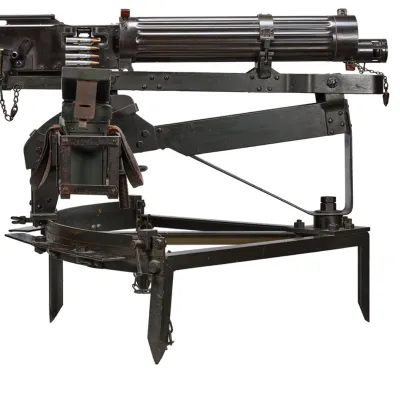
Vickers-Maxim Machine Gun, Mk. I
Development
The British Vickers gun was developed from the original automatic machine gun designed by Sir Hiram Stevens Maxim in 1884. Though an American by birth, Maxim came to Britain to build and sell his new gun. He was knighted for his services to the Empire in 1901.
Britain had been an early adopter of the Maxim gun, with the first examples entering service in 1887 on artillery-style wheeled carriages, though significant numbers did not arrive until the 1890s. These guns actually remained in service, alongside the Vickers, right through the First World War, as the War Office realised that Germany had taken a lead in machine gun production. Even captured German examples were converted to take British .303 ammunition.
The Maxim proved itself useful in colonial warfare against superior numbers of enemies not themselves equipped with firearms. It was estimated to have the firepower of up to 70 riflemen, and so early tactics focused upon devastating close-range defensive fire. In essence, the machine gun was treated as a form of automated infantry, exemplified by Maxim's original concept of a variable rate of fire; from 'Slow' (two rounds per minute) to 'Fast' (500 rounds per minute).
As long as machine guns were fired from static, defensive positions, or heavy, wheeled carriages, their weight was not crucial. However, whereas other countries retained close copies of the Maxim, the British War Office demanded an improved version. Sheffield-based company Vickers were asked to redesign the gun. By flipping the gun's mechanism upside down, they were able to make it both smaller and lighter. In doing so, in 1912, they produced the Vickers gun; perhaps the definitive Maxim type machine gun, and much simpler to produce and maintain than Germany's own Maxim, the MG08.
Use and effect
This lightened design, alongside the Lewis light machine gun, formed the basis of new, offensive tactics used to help break the stalemate later in the war. British machine guns were originally allocated at division level. It took two expert gunners, Majors Baker-Carr and Lindsay, to advocate for the formation of a dedicated elite unit.
The Machine Gun Corps was formed in 1915 and provided small teams who could operate and deploy these guns where they were needed most on the battlefield. The tactics developed by the new MGC allowed British forces to take the fight to the enemy, and are still used today. 'Traversing fire', in which the gun was fired and pivoted left-to-right, was a relatively rare, defensive tactic. Much more common were accurate long-range fire and 'indirect' fire where the gunner used scientific techniques and tools to fire at targets that they could not actually see. Thousands of bullets would create a 'beaten zone' that would destroy any enemy that entered it. Barrage fire allowed machine guns to directly support infantry as they advanced, and overhead fire meant that guns would actually fire over their own soldiers heads.
The Vickers, properly maintained and supplied with water in its cooling jacket, was very reliable. It was claimed that in Savoy Trench on the Somme in 1916, ten guns fired one million rounds in a twelve hour period. The Maxim and Vickers, however, were far more complicated than traditional infantry weapons. A soldier lacking the necessary specialist training could no more become a Vickers gunner than he could a fighter pilot. The role became a specialist one, involving ten weeks of intensive training at the Machine Gun Training Centre at Grantham.
The Vickers itself was not withdrawn from British service until 1968. By this time, it had been replaced in front-line service by the gas-operated, air-cooled Belgian-designed L7 General Purpose Machine Gun. This replaced water-cooling with a replaceable barrel system, and is still in service today.
the deadliest of all the deadly machines which are now destroying the populations of Europe.
Havelock Ellis, 'Impressions and Comments', 1921
Statistics
- Date entered service - 1912
- Action / Operating system - Recoil
- Barrel length - 72.3 cm (28.4 in)
- Overall length - 1.155 m (43.5 in)
- Weight - 40.1 kg (88.5 lb) (with water & mount)
- Effective range - 2286 m (2500 yd)
- Maximum range - 3658 m (4000 yd)
- Feed - Belt
- Capacity (rounds) - 250
- Calibre / Bore - 7.7x56mmR (.303 in)
- Muzzle velocity - 744 m/s (2440 fps)
- Rate of fire (rounds per minute) - 550
- Crew - 6
- Country of manufacture - Britain
- Manufacturer - Lithgow, Australia
- Manufacturer - Vickers Crayford
- Manufacturer - Vickers Erith
- Primary operator - Britain
- Other operators - Australia
- Other operators - Canada
- Other operators - Germany
- Other operators - New Zealand
- Other operators - USA
Mr B. McConnell, 1st Battalion, Royal Inniskilling Fusiliers
Mr McConnell took part in the Dardanelles Campaign and landed at Helles on 25 April 1915. He would be wounded and demobilised only a month later. In this interview, McConnell explains the roles of different men in a Vickers gun crew and describes a Turkish attack while his section was making tea.
I should say five or ten minutes afterwards I got wounded myself. The Vickers gun had been knocked off by a sniper the night before, so of course we couldn’t. There were no use in us looking through the sights so we had to look round the right of the gun to see where our bullets were striking, otherwise I think I would have had it through the head instead of through the arm.
Related Objects




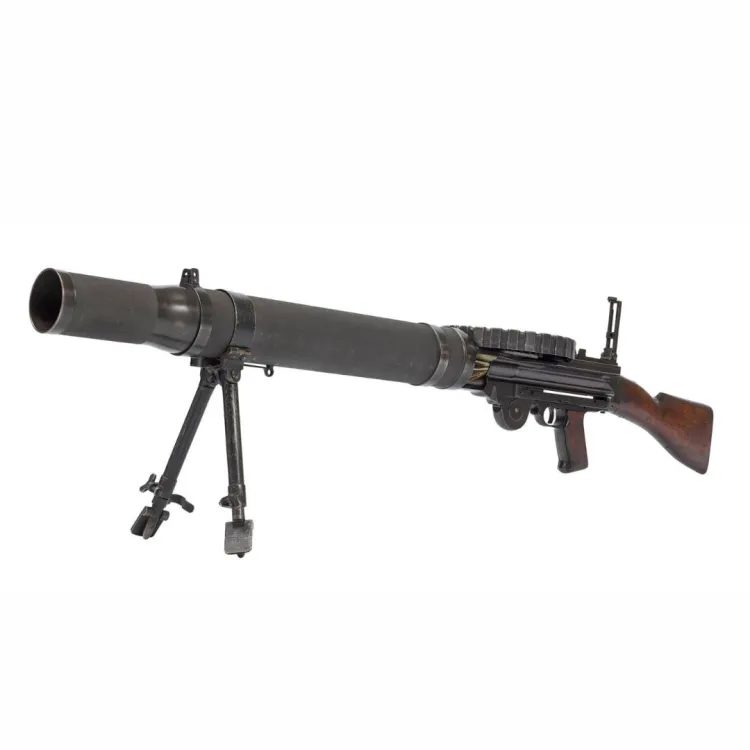
Lewis Light Machine Gun, Mk. I
Development
The 'Lewis gun' was a refinement by U.S. Army Colonel Isaac N. Lewis, of an existing design by another American, Samuel McClean. The resulting weapon went on to define the light machine gun as a class of firearm. Machine guns like the Maxim family could fire more continuously and with accuracy at long range, but were heavy and had to be served by a crew of men. A 'light' machine gun would allow soldiers to take the fight to the enemy.
The Lewis was designed with a rifle-style shoulder stock, pistol grip, and carrying sling. Instead of a water-filled barrel jacket, the Lewis was air-cooled using a finned radiator fitted beneath a steel shroud. When fired, this created a 'venturi' effect, sucking the hot air forwards and drawing colder air in behind it. The belt feed system of the Maxim was replaced by a rotating 'pan' magazine, limiting capacity but keeping the gun light and easy to handle. Importantly, a clamp-on bipod was also designed to allow a stable firing platform, replacing the fixed tripod mount of the heavy machine guns.
Though an American design, the United States Army was reluctant to adopt Colonel Lewis's gun. Instead he turned to Europe.
Use and effect
The British army was the first to adopt the Lewis gun, which became part of important reforms to the deployment of machine guns. The heavy Vickers and Maxim guns, and their gun crews, were taken from the infantry to form the new Machine Gun Corps. The MGC would treat the Vickers more like an artillery piece, delivering fire where it was needed to support the infantry.
Meanwhile, infantry regiments instead received the Lewis gun. Firing the same cartridge as the Vickers and with a similar rate of fire, it was far easier for soldiers to carry, get set up, and use in the attack. Along with the Vickers gun, it enabled the changes in tactics that led to later British and Allied success.
The Lewis also became the first ever aircraft machine gun, fitted in flexible mounts on two-seat spotter aircraft, but also mounted above the wing even on later fighters like the SE5a. The cooling radiator was often removed, as cold air rushing over the barrel made it unnecessary. A bigger, 97 round magazine was used to limit the need for frequent and fiddly magazine changes in moving aircraft at freezing altitudes.
Statistics
- Date entered service - 1913
- Action / Operating system - Gas
- Barrel length - 76.7 cm (30.2 in)
- Overall length - 1.283 m (50.5 in)
- Weight - 11.8 kg (26 lb)
- Effective range - 800 m (880 yd)
- Feed - Drum magazine
- Capacity (rounds) - 47 or 37
- Calibre / Bore - 7.62x63mm (.30-06) (USA)
- Calibre / Bore - 7.7x56mmR (.303 in) (British Empire)
- Muzzle velocity - 762 m/s (2500 fps)
- Rate of fire (rounds per minute) - 550
- Crew - 2
- Country of manufacture - Britain
- Manufacturer - Birmingham Small Arms Company
- Manufacturer - Savage Arms Company (USA)
- Primary operator - Britain
- Other operators - Australia
- Other operators - Canada
- Other operators - Germany (captured)
- Other operators - New Zealand
- Other operators - USA
Mr. A.E. Brown, Second Battalion, Lincolnshire Regiment
The Maxim gun had revolutionised warfare but still proved too slow and cumbersome for offensive operations. Lewis guns were lighter and proved more useful for this purpose. Mr. A.E. Brown was trained in the use of the Lewis gun and describes how the change in tactics was reflected in how his unit was armed.
When I first went out there was only two machine guns to a battalion and men; and a battalion and men was about twelve hundred men, back end of 1917 up to 1918, I think there would be about two Lewis guns or three Lewis guns to a company.
Related Objects


Blanch-Chevallier Grenade Launcher
Development
The proliferation of complex trench systems led to the widespread reintroduction of hand grenades like the British 'Mills bomb' from 1914. These provided a means of attacking an enemy otherwise protected by the cover of a trench, but had a very limited range of 30 m (33 yd) or so. This in turn led to the 'Hale' No.3 Mk.I rod-type rifle grenade of 1915, developed to convert infantry rifles into makeshift grenade launchers.
Grenades launched from a rifle could reach perhaps 140 m (153 yd), but still lacked an effective sighting system and had to be braced into the ground for firing. They could not be fired from the shoulder due to punishing recoil, which limited their usefulness in the attack. They also wore out the barrels and cracked the stocks of the rifles used.
One solution was to develop a dedicated grenade launcher weapon. Engineer Arnold Louis Chevallier immigrated to Britain prior to the War and came up with a wholly new design. He chose Herbert John Blanch of the London gunmaking firm J. Blanch & Son to build this, the only known prototype. The rear half of the launcher comprises a Martini tilting-block action previously used by the British army in the Martini-Henry and Martini-Enfield rifles.
In this case, a commercially produced .450 rifle made in the 1880s by the Braendlin Armoury Company was used. The rifle's barrel was replaced by a large barrel of 6.35 cm (2.5 inch) bore. This featured retaining clips at the muzzle and a sprung piston platform at the base. The grenade would have been launched by a .450 blank cartridge, with the large coil spring acting to dampen the resulting recoil along with a thick rubber butt-pad.
Use and effect
The Blanch-Chevallier was never issued. In fact, there is no evidence to suggest that it was even trialled by the British War Office. Instead, they persisted with improved rod grenades and repurposed a much older solution in the form of the grenade cup discharger, introduced in 1917 as an accessory for the SMLE rifle. It is not possible to evaluate the effectiveness of Chevallier's design, but two drawbacks are evident.
Firstly, to soak up the recoil of firing, it had to be extremely heavy, and a supply of grenades would have added to the weight. This would have made the carrying of a rifle impossible, though a revolver could have been supplied for close-range fighting and self defence. Secondly, the weapon as constructed could not load the standard No.5 hand grenade or the No.3 rifle grenade. It would have required either that Britain tool up for production of its proprietary grenade, or that the weapon be redesigned to accept an existing type. Due to a lack of safety features, it would also have to carried without a blank cartridge in the chamber.
Despite its failure to attract official attention, Chevallier's idea for a shoulder-fired grenade launcher was ahead of its time. Whereas rifle grenades had to be fired braced into the ground, the recoil reduction system and tall tangent backsight were intended to allow the weapon to be fired from the shoulder. This would allow arcing indirect fire like a rifle grenade, but also permit launching at a shallower angle to land grenades in specific parts of a trench system. It could even be used for direct fire against groups of the enemy or targets behind cover.
This flexibility prefigured the American M79 launcher of the 1960s, used to great effect in Vietnam. In this, the huge weight of the weapon and large dampening spring were replaced by a lightweight break-action launcher and a clever high-low pressure ammunition-based solution. This 40mm grenade is still in use today in under-barrel grenade launchers and grenade machine guns, the ultimate expression of the grenade projector concept.
Statistics
- Date entered service - Not issued
- Action / Operating system - Lever-operated tilting block
- Overall length - 80 cm (31.5 in)
- Weight - 7.1 kg (15 lb 10 oz)
- Effective range - Unknown
- Maximum range - Unknown
- Feed - muzzle-loaded
- Capacity (rounds) - 1
- Calibre / Bore - 6.35 cm (2.5 in)
- Muzzle velocity - Unknown
- Rate of fire (rounds per minute) - Unknown
- Crew - 1
- Country of manufacture - Britain
- Manufacturer - John Blanch
- Primary operator - Britain
Related Objects


Pattern 1894 Lance
Development
The lance was first adopted by the cavalry of the British Army in 1816, after its effect in the skilled hands of Napoleon's lancers had been seen on the field of Waterloo (1815). Four regiments of Light Dragoons were converted to Lancers in 1816 and more would follow. Initially armed with a lance of 4.87 m (16 ft), this was soon found to be impractical and a lance of 2.75 m (9 ft) was soon adopted and remained the standard length of British lance for the 100 years it remained as a service weapon of the cavalry. In 1820, a steel ball was added to the base of the point of the lance in order to prevent over-penetration down the shaft, making withdrawal easier. The British abandoned the ball in 1840, although a rondel type 'stop' continued in patterns for the Indian cavalry.
From 1836, shafts of bamboo were used exclusively until 1885, when problems of supply and quality saw ash, treated with linseed oil and tar, reintroduced alongside bamboo. All lances had a hide sling wrapped around the midpoint of the haft which was looped round the arm when in combat, providing a secure grip for the hand and preventing the lance from being lost. On ash staves a leather protector sleeve was added to the bottom half of the shaft. This both provided a grip and prevented chafing to the shaft from the carbine when slung. This also enabled a 'D' ring to be attached so that the lance could be kept in the correct position when being carried in the stirrup bucket, which was ordered on all service lances in 1896.
From 1868 until its final withdrawal from service in 1927, the lance head remained unchanged. The blade was of thick triangular form and hollow ground. The head lacked langets from 1868 and was shellaced onto the shaft despite claims from British cavalry officers that this left the head vulnerable to being cut off in combat. This was remedied in 1894 by doubling the length of the socket of the lance head.
Problems with supply, or perhaps the desire to produce a more robust weapon for shock use, saw the British Army design an experimental steel shafted lance in 1915. This retained the same 1868 head but was never introduced to service. It is remarkable that even after the experience of trench warfare had begun, improved lance designs for the cavalry were still being explored.
Use and effect
Which weapon, the lance or the sword, was best for cavalry was a question that divided military opinions in the 19th century. If a consensus can be said to have existed it was that the lance required a great deal of training to use effectively. It was also widely acknowledged that lancers should also carry swords, for use in the melee when a lances' length could be a disadvantage. Unlike the German cavalry, who had the lance as their main arme blanche, or the French, who equipped approximately half of their total cavalry regiments with this weapon, the British use of the lance was much more select.
Following the failure of shock cavalry in the South African War, the lance had been withdrawn from the British cavalry in 1903 and was not reinstated until six years later. In 1914, only the six designated Lancer regiments of the 26 regular cavalry regiments were issued with the lance, and none of the Yeomanry regiments carried it. However, the cavalry regiments of the British Indian Army did contain a much higher proportion of lancers, and were renowned for being particularly skilled with the weapon. At El Hinu, during the Affair of Abu Tellul (14 July 1918) the Poona Horse and Jodhpore and Mysore Lancers of the Imperial Service cavalry killed over 90 Ottoman soldiers with the lance. They captured 100 prisoners and four machine guns. This included a successful charge against an entrenched position.
The deadly effect the lance could have is described by Second-Lieutenant Leche of the 12th Lancers. When, in 1914, his Squadron was able to take by surprise a dismounted force of German cavalry in the flank and could "just take the Huns like pegs":
Our lances did great work, though they didn't go in as far as one would think - about a foot in most cases. Several men also used the butt with very good effect, and one man got his lance through up to the sling!... The doctor said the wounds were terrible. Anyhow they squealed enough when they got it.
Statistics
- Date entered service - 1894
- Overall length - 2.76 m (9 ft 0.5 in)
- Weight - 2.19 kg (4 lb 13 oz)
- Country of manufacture - Britain
- Manufacturer - Royal Small Arms Factory, Enfield
- Primary operator - Britain
Frank Seeley, Lincolnshire Yeomanry
By 1914, developments in weapons technology meant that cavalry was no longer the decisive battle winner of the past. While cavalry switched to support or mounted infantry roles on the Western Front, horses continued to play a key role on the open plains of the Middle East. Frank Seeley describes the Australian cavalry charge at Beersheba in Palestine.
...the Australians galloped through Beersheba, they were not armed with swords but that did not matter to them, they fixed bayonets and galloped through with fixed bayonets on the horses
Related Objects


Pattern 1897 Infantry Officer's Sword
Development
This sword marked a radical departure from its predecessors. Since 1822, British infantry officers had been armed with a combination cut and thrust sword with a half-basket hilt. Its slender, slightly curved, spear-pointed blade was pipe-backed: a feature that had become popular in officer's swords from about 1810 and was intended to add rigidity for thrusting. In 1845 this blade was replaced by a heavier, single fullered blade and the guard strengthened. The blade was now essentially an infantry version of the blade used for the contemporary 1821 patterns of Trooper's swords, but lighter and narrower as it did not have to withstand the shock of mounted use.
Although the general from of the 1822 and 1845 Infantry swords remained similar, the 1845 improvements made for a slightly sturdier, if heavier, fighting weapon. However as a cut and thrust weapon the 1845 sword was, by necessity, a compromise and by 1892 a new sword had been devised. Intended solely for thrusting, the blade was unlike anything that had gone before. The blade has no edge for the first half of its length, being identical front and back. These thick, rounded edges gave the blade great strength and rigidity, whilst a deep fuller along this portion of the blade meant the total weight was no more than its predecessor. The final half of the blade is flat and tapers into an acute spear-point.
From 1892-95, this new blade was mated to the 1845 half basket 'gothic' hilt. However, despite its strengthening, this guard left significant gaps through which the hand of the wielder could be attacked, and the brass could become bent with a strong blow. The result was the 1895 steel three-quarter basket hilt, with much reduced gaps and good overall hand protection. The backstrap of the new hilt was chequered along its length and was designed the thumb could sit on top, in a thrusting position. The final amendment to this sword came in 1897, when the inside of the guard was turned down, to sit comfortably against the side of the wearer.
Use and effect
Although designed as a fighting sword, the pistol had replaced the sword as the main weapon of the British infantry officer by the time Pattern 1897 entered service. Nevertheless, it was still carried in the field in the South African War and in 1899 a brown leather scabbard was introduced for active service. Reports from the latter part of the Mahdist War (1881-99) suggest that on the few occasions the patterns 1892-7 swords were used in anger it stood up well to the rigours of sword on sword combat.
Despite the obsolescence of the infantry sword when Britain declared war on August 6 1914, the order was still given throughout the army for officers to sharpen swords. This order was clearly followed as some Pattern 1897 swords show evidence of sharpening. The Pattern 1897 continues to be used today, albeit it in a purely ceremonial capacity, as part of the dress uniform of infantry officers of the British Army.
Statistics
- Date entered service - 1897
- Blade length - 81.5 cm ( 32 in)
- Overall length - 96.5 cm (40.4 in)
- Weight - 900 g (1lb 15.7 oz) (without scabbard)
- Country of manufacture - Britain
- Manufacturer - Wilkinson Sword, London
- Primary operator - Britain
Harry D'Arcy Jones, Worcestershire Yeomanry
Despite the manoeuvrability of cavalry, assaults on entrenched positioned with Maxim guns could still prove extremely dangerous. Harry D'Arcy Jones, who joined the Worcestershite Yeomanry before the outbreak of war, describes the results of a cavalry charge against an Ottoman position.
I remember when we reached the guns I saw our troop officer, coming into the right with his sword drawn, walking… Lost his horse you see
Related Objects


Pattern 1899 Cavalry Trooper's Sword
Development
This sword was the last attempt by the British Army to equip their cavalry with a combined cut and thrust sword. Since 1853 all cavalry, both Heavy and Light regiments, had been equipped with a universal cavalry sword of the same basic form. The blade was slightly curved with fuller running three-quarters of the length of each side. The final, unfullered, quarter of the blade was doubled edged and spear-pointed. This blade form remained unchanged, despite 50 years and six different patterns.
The first modification was to replace the three-bar hilt with a sheet steel bowl guard with a Maltese Cross pierced in it. In 1899 this too was changed to a larger plain bowl guard. From 1864 until 1890 a lighter, more manoeuvrable sword was sought, but when this proved deficiently weak, thicker, shorter blades with shallower fullers were reintroduced. However, these weighed more than the patterns that had been deemed too heavy some 25 years before. Not surprisingly therefore, the story of the Patterns 1853-1899 is largely one of complaint.
From the Crimean War to regimental testings to the Mahdist Wars, the overall reports on the performance of the British cavalry sword is one of dissatisfaction and failure. The Pattern 1899 was the heaviest of this family of swords and although its thick, short, blade meant it was unlikely to break in the rigours of mounted combat, it had its own share of faults. The desire to avoid a repeat of the press reported 'sword scandals' of the 1880's of trooper's weapons breaking in hand-to-hand combat meant though the Pattern 1899 was undoubtedly robust, it was clumsy and ill-balanced.
Use and effect
The Pattern 1899 was the standard service cavalry sword of the Second South African War. Although by this time the sword was more of an auxiliary weapon, with the rifle as the cavalry's main arm, it failed to be serviceable even in this marginalised role. On the few occasions that the British cavalry were able to close with the Boers, the Pattern 1899 sword proved defective. Colonel Robert Baden-Powell thought 'the present sword a perfectly useless weapon' and Major-General Sir John French, later commander of the British Expeditionary Force, remarked that the sword was 'the very worst that could be used by mounted troops.'
With an overly long, round grip and centre of balance far towards the point the sword required immense strength to use and was liable to turn in the hand, meaning the blade would not bite home. The Marquis of Tullibardine, commander of the Royal Horse Guards, thought this meant 'no one could possible use [the sword] without falling off if he really cut with it'. The Lieutenant-Colonel of the 18th Hussars described its failings at the Battle of Talana Hill:
A party of about 20 Boers were charged by half a squadron, 18th Hussars, the two parties met at full gallop and the Hussars did their best to cut down the enemy, till the latter threw their rifles away. The result was one man killed by a point and about eight wounded but none appeared to be much cut about and I believe more damage would have been done had the men be armed with heavy sticks.
By the time of the First World War the Pattern 1899 was no longer issued to the regular cavalry, although in the early months it was still in service with the Yeomanry, until sufficient numbers of the Pattern 1908 sword could be produced.
Despite its reputation as one of the worst cavalry swords ever in service with the British Army, there were some who were reluctant to see it replaced. At Cerisy, August 28 1914, Captain Bryant of the 12th Lancers, seven years after it had been withdrawn from service, was still 'using the old cutting sword' and claimed that 'well sharpened' he slew five of the enemy with it, his sword going 'in and out like a pat of butter.' Nevertheless, most cavalrymen were pleased to see the back of the Pattern 1899, and were only thankful to it in so far as its failing finally led to due care being spent on the design of its replacement.
Statistics
- Date entered service - 1899
- Blade length - 85 cm (33.5 in)
- Overall length - 1.02 m (40 in)
- Weight - 1.24 kg (2 lb 12 oz) (without scabbard)
- Country of manufacture - Britain
- Manufacturer - Royal Small Arms Factory, Enfield
- Primary operator - Britain
Related Objects


Pattern 1908 Mark I* Cavalry Trooper's Sword
Development
The failure of the Pattern 1899 sword in the Second South African War provoked the establishment of committees and trials to arrive at an improved sword for the cavalry. Whereas previously, swords had been designed by cutlers, and submitted to the military for regimental trails, the design of the Pattern 1908 would take an altogether more scientific approach.
In 1903, a special committee was formed, including such distinguished cavalry officers as General Sir John French and Major General Douglas Haig, which dismissed the Pattern 1899 sword and, in a break from a tradition of over 50 years, determined that the new sword should have a straight and narrow, t-sectioned blade for thrusting. 200 experimental swords of this type were made and issued to cavalry regiments for testing in 1904.
Although largely well received, there were still those of influence (notably Colonel Napier, the Inspector of Gymnasia and Captain Hutton, the sword and fencing expert) that objected to a pure thrusting sword. This saw further experimenting along cut and thrust swords of the old style which, not surprisingly, were found unsatisfactory.
In order to move forward, a new committee was established under Major-General Scobell in 1906 which consisted of a range of regimental officers who had a wealth of experience in mounted swordsmanship. Their remit was to decide upon a sword for the cavalry that was primarily for thrusting, and to devise accompanying sword exercises.
The committee examined 16 patterns of sword, including experimental types and cavalry swords in foreign service. After much deliberation the committee decreed that the sword should be as the 1904 experimental sword, straight and narrow, but with a chisel edge so it could be used, on occasion for cutting.
The sword makers Wilkinson and Mole produced a total of four experimental swords and, following some modifications, one of Moles was taken on for further trials. 500 swords were ordered from both Mole and Wilkinson, and sent for trails to regiments in Britain and India.
The changes between this experimental 1906 sword and the final recommendation of 1908 were only minor, and finally the British cavalry had a sword that was perfectly suited for shock action. The Pattern 1908's ergonomically sculpted grip, weighted pommel and thick, stiff, spear-pointed blade made it the perfect sword for delivering a thrust when mounted.
Despite the scientific nature of the sword's development, it still needed formal approval from Edward VII to enter service. The King thought it was a 'hideous' weapon and it took Generals French and Haig to convince him to do so. Even then, the King insisted that the new sword only be carried on active service, with previous types retained for ceremonial use. The great design success of the Pattern 1908 inspired George S Patton's design of the U.S. Model of 1913 Cavalry Sword.
Use and effect
The opening weeks of the war saw cavalry at the forefront and ample opportunity for the Pattern 1908 sword, and its officer variant the Pattern 1912, to be tested in combat. It was with a sword of this type that the first British kill of the War was made, by Captain Hornby, 4th Dragoon Guards, in a skirmish with the German 4th Cuirassiers. Hornby had followed the new drills where it was stated:
In the charge against both Infantry and Cavalry, each man should ride at his opponent at full speed with the fixed determination of running him through and killing him - hand and arm simply directing the point - the impetus being sufficient to drive the point home
In the Eastern theatres of Syria and Palestine there was much more occasion for mounted shock action throughout the whole War. Against a moving target, however, executing the new drills could be difficult in practice, despite high levels of training. At the highly successful charge at El Mughar, 13 November 1917, Captain Bulteel of the Royal Buckinghamshire Yeomanry stated:
Blown and galloping horses are not exactly "handy", so it was nearly impossible to get at a dodging Turk. One missed and missed again until the odd one wasn't quick enough'. However, when contact was made it seems the new sword and drill performed admirably: 'In just such a case the hours of arms drill paid off for instinctively one leant forward and remained so, to offset the jerk as the sword comes out - in fact, precisely as one had been warned.
The success of cavalry in Syria and Palestine even led to the Pattern 1908 being issued more widely to mounted rifle brigades. It was reasoned, especially after the heroics of 4th Australian Light Horse at Beersheba who used the bayonet in lieu of swords, that the issue of swords would enable mounted units to act with greater determination and speed in the attack, as opposed to dismounting and fighting with the rifle alone. In the closing stages of the War in the East, this decision was proved right numerous times.
One such occasion was at Jenin, 20 September 1918, where Australian Light Horse, newly equipped with the Pattern 1908, captured a large Turkish force at sword point. Although the development of the tank saw cavalry eventually disappear, this was not a quick transition. The last time British sword armed cavalry were deployed on active service was in the Second World War, against the Vichy French in Syria in 1941. Today the Pattern 1908 is no longer issued as a combat weapon, but is still carried ceremonially by cavalry regiments of the British Army.
Statistics
- Date entered service - 1912
- Blade length - 89 cm (35 in)
- Overall length - 1.08 m (42.5 in)
- Weight - 1.347 kg (2 lb 15.5 oz) (without scabbard)
- Country of manufacture - Britain
- Manufacturer - Royal Small Arms Factory, Enfield
- Primary operator - Britain
Related Objects


Pritchard-Greener Bayonet
Development
The designer of this bayonet was Captain Arthur Pritchard, who enlisted into the Royal Berkshire regiment in early 1915 at the age of 17. He returned to Britain in 1916 and approached Wilkinson Sword with the idea for a bayonet for the Webley Mark VI service revolver. His idea was to create a small bayonet made from the tip of the 1897 Infantry Officer's sword. The problem Wilkinson Sword had at that time was that it was already producing the 1907 bayonet for the SMLE rifle as well as the 1908 Cavalry Trooper's sword and it was seen as quite impractical for them to cut down existing swords not to mention the cost of labour involved in assembling these bayonets. Pritchard's idea was too difficult for them to achieve at this time.
Pritchard's bayonet instead was produced at Greener's, a rival of Wilkinson Sword. Much of their business was reconditioning obsolete weapons. The company had a surplus amount of Model 1874 Gras bayonets, which were used in place of the 1897 sword tip. Although the manufacture of the bayonet was labour intensive the cost was cut by recycling the Gras bayonets. Two patterns of this bayonet were produced, the common gunmetal hilted version and the rarer steel hilted version. Both of the same form, it is likely that change to gunmetal might have been for economic reasons rather than practical reasons.
Use and effect
The Pritchard-Greener bayonet was never a standard issue of the British Army. It could be purchased privately by officers and would probably have been a useful addition to trench raiders to use in close-quarter combat but few were made and no evidence exists to prove they were used in the trenches. However, one can imagine the psychological boost it would have provided to men leaping into enemy trenches from No-Man's Land. It would also have served as a potentially useful backup weapon, if the revolver misfired or ran out of ammunition.
Statistics
- Date entered service - about 1916
- Blade length - 26.6 cm (10.5 in)
- Overall length - 32 cm (12.6 in)
- Weight - 460 g (1 lb)
- Country of manufacture - Britain
- Manufacturer - W.W. Greener
- Primary operator - Britain
Related Objects


Push Dagger
Development
The lack of a British issue trench weapon saw commercial opportunities for civilian manufactures. One of the most prolific was Robbins of Dudley, who had been manufacturing basic blacksmith ironwork since 1876. With the onset of trench warfare, they turned their attention to designing and producing a variety of unique weapons for private sale to troops heading off on active service.
These included unusual miniature curved sabre types with stirrup-hilted guards, double-edged short swords and even rare variants with South-East Asian kris style blades. The most popular types were push daggers and Robbins devised at least four variants on this theme, with this type being the most common.
Use and effect
Designed to be used in a punching motion, some versions had a pommel spike to enable a downward strike. Many were originally blackened to be inconspicuous at night. Despite the short tang making the blade liable to break, this remained one of the most popular private purchase daggers amongst British troops.
Statistics
- Date entered service - 1914
- Blade length - 12.4 cm (4.8 in)
- Overall length - 15.5 cm (6.1 in)
- Weight - 190 g (6.8 oz) (without sheath)
- Country of manufacture - Britain
- Manufacturer - Robbins of Dudley
- Primary operator - Britain
Related Objects
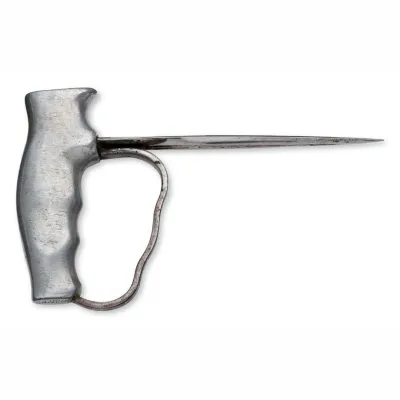

Knuckleduster Knife
Development
The British Empire did not issue a purpose-made trench dagger, so cutlery companies offered a wide range for private purchase. As such, the British were amongst the most enthusiastic producers of knuckleduster knives, and designs exist from before the War. It seems that this type of weapon, with its emphasis on the knuckleduster element rather than the knife blade, appealed to British sensibilities.
Colonel the Rt. Hon. Sir John Macdonald wrote a series of articles during the War imploring the issue of a trench dagger to British troops in an attempt to overcome the pervasive feeling that the use of the knife or dagger in warfare was somehow unsoldierly and un-British. His pleas went unanswered, but the popularity of this compact design seems to suggest the British serviceman's aversion to pure daggers was at least partially true.
Use and effect
British weapons of this type were trialled by the American Expeditionary Force in 1918, resulting in their heavy, brass knuckleduster knife Model of 1918 Mark I Trench Knife. This British knuckleduster knife also inspired the BC 41 Commando knuckleduster knife of the Second World War.
This weapon was almost identical to its predecessor, save for having pointed, rather than rounded metal 'knuckles. It was issued as a fighting knife of the British army until superseded by the Fairbairn-Sykes fighting knife. Knuckleduster knives later fell out of favour in military circles as more sophisticated dagger-style fighting techniques were developed.
Statistics
- Date entered service - 1915
- Blade length - 12.2 cm (4.8 in) - broken
- Overall length - 29.2 cm (8.5 in)
- Weight - 178 g (6.3 oz) (without sheath)
- Country of manufacture - Britain
- Manufacturer - Sutherland & Rhoden
- Primary operator - Britain
Related Objects


Trench Pike
Development
The war in the trenches saw the reintroduction of many weapons long thought obsolete. Staff weapons had not been a serious battlefield arm of the infantry since the development of the bayonet in the 17th century. The nature of warfare on the Western Front, however, saw all types of ancient weapons revived.
The pike had survived in naval warfare however and new British patterns of boarding pikes were being created as late as 1894. Much like repelling hostile boarders of an enemy ship, trench pikes fulfilled a similar function. Of a handy length, they could have been used for defending trenches from enemy raids or assaults, perhaps left at strategic points so they could be quickly grabbed by defenders. The broad disc-like shoe on the bottom would have prevented the weapon from sinking into the mud of a trench and its blade covering would have protected it from the elements. A simple pike would be much better suited, and less dangerous, to being left exposed and readily to hand like this than a rifle. Lighter and more manoeuvrable in the cramped conditions of a trench than a rifle fitted with bayonet, its simplicity and total lack of working parts meant it could function in all conditions.
Use and effect
The pike has a thick, flattened diamond-sectioned blade that is well suited for thrusting. On some versions the blade is detachable; thus the quillons serve as both a hand guard when used as a dagger, or as a stop to prevent over-penetration when used as a spear. It is possible this kind of pike was an issue version of weapons that had been at first improvised in the trenches. Frank Richards of the Royal Welch Fusiliers commented on seeing two soldiers preparing for a raid by 'fixing knives on to a couple of broomsticks with some sticking plaster'.
The infamous wire cutting or 'death companies' of the Italian Army sometimes made rudimentary pikes of their long hafted wire cutters, by affixing bayonets onto the ends of the device. Heavily armoured to protect themselves in their dangerous task, such armoured pikemen were a sight that had not been seen in war for three hundred years.
Yet this was not to be the last time pikes were issued by the British military. In the Second World War, the threat of invasion in 1942 saw the pike once again reinstated as a temporary weapon of war for the Home Guard. Many of these were produced by welding the large stores of, the now obsolete, Pattern 1907 bayonets onto metal pipes.
Statistics
- Date entered service - 1914
- Blade length - 20.9 cm (8.2 in.)
- Overall length - 1.58 m (62.1 in.)
- Weight - 1.21 kg (2 lb. 10.6 oz) (without sheath)
- Country of manufacture - Britain
- Manufacturer - Unknown
- Primary operator - Britain
Related Objects


Welsh Knife
Development
This unique form of 'new or improved trench knife' was patented by Felix Joubert. Joubert was a renowned armour restorer who had worked at Windsor Castle and the Wallace Collection, and also a sometime faker of antique arms and armour who sold to unsuspecting collectors.
The 'Welsh knife' was purchased by Thomas Evelyn Scott-Ellis, eighth Baron Howard de Walden, for equipping the battalion he was second in command of with a weapon for trench fighting, between 1916 and 1917. De Walden was a military man who had served with the 10th Hussars in the Second South African War and on his return to Britain joined the 2nd County of London Yeomanry. An accomplished fencer who was a member the British 1908 Olympic squad, this passion led to his interest in arms and armour, especially that of the medieval period and of his native Wales.
As a result of this hobby, he commissioned Joubert to construct him a bespoke reproduction 14th century harness so he could better understand how armour worked. When the War began, De Walden made repeated requests to find a more active posting, and was subsequently sent to Gallipoli. On his return to England in a staff role, Lord Howard used his family connections to gain transfer to the front. Soon he was appointed second-in-command of the 9th Battalion, Royal Welch Fusiliers; a post in which he remained until he was recalled to the War Office in December 1917.
From 1915, there had been open debate in the press and military journals about the lack of a standard issue trench knife for British servicemen. It seems that De Walden was moved by such debates and decided to address the matter for his own battalion by privately commissioning Joubert to design a suitable weapon. Joubert claimed in his patent application that the knife was based on 'the well known and historic Welsh cledd'.
However, no form of such knife is known to exist and it seems likely this was a connection Joubert made to appeal to the nationality of De Walden and his regiment. Instead Joubert's design appears to be based upon the leaf-shaped swords of the late Bronze Age found throughout Europe. His weapon is a much broader, more robust version than the sword types it is based upon and was well suited to the rigours of life in the trenches.
The addition of a 'skull-cracker' pointed pommel is so that even the base of the 'Welsh knife' can be used offensively, if there is no room to employ the weapon blade first. A wrist loop through the hilt to prevent the weapon being dropped in combat was added along with a folding guard protected the hand, and also enabled the weapon to be worn flush to the body when sheathed. Some blades were engraved 'DROS URDDAS CYMRU', which translates as 'For the honour of Wales.'
Use and effect
The weapon was carried by the battalion's Lewis gunners at the Battle of Messines, June 1917, as they are recorded as having advanced 'carrying the strange knives furnished by Lord Howard de Walden'. Lieutenant-Colonel Lloyd-Williams, who later in the War was second in command of the battalion, stated that 'all machine gunners and bombers were always equipped', with this knife and 'every member of a raiding party was so armed'. Certainly surviving numbers would corroborate this claim as although rare, surviving numbers suggest there were more produced than would have been needed for the battalion's 17 Lewis gunners.
The effectiveness of the 'Welsh knife' as a weapon is more in doubt. Lloyd-Williams claims it was used with 'conspicuous success' at Messines Ridge but his claim that it was 'more for bayoneting than cutting' seems not to suit the weapon's design. Its broad blade is certainly intended as a cutting weapon; as such a large point would have made effective thrusting difficult. However the rigidity of the blade would have lacked the flexibility for a good cutting stroke and the thick blade edge would have been difficult to sharpen well. The great weight of the 'Welsh knife' would have made it a fearsome weapon, as being of all metal construction it is much heavier than most contemporary trench clubs, but the stiff, thick blade would have been more likely to cause blunt force trauma than cut or puncture efficiently.
Nevertheless, although this weapon was probably designed with more style than substance in mind, in order to appeal to the tastes of its purchaser, the 'Welsh knife' did look forward as well back in terms of the development of arms and armour. The 'Welsh knife' inspired the design of the Smatchet fighting knife of The Second World War by the renowned hand-to-hand combat expert and innovator, Lieutenant-Colonel William E. Fairbairn.
Statistics
- Date entered service - 1916
- Blade length - 44.8 cm (17.6 in)
- Overall length - 60 cm (23.6 in)
- Weight - 1.03 kg (2 lb 4 oz) (without scabbard)
- Country of manufacture - Britain
- Manufacturer - Felix Joubert, Chelsea
- Primary operator - Britain
Related Objects

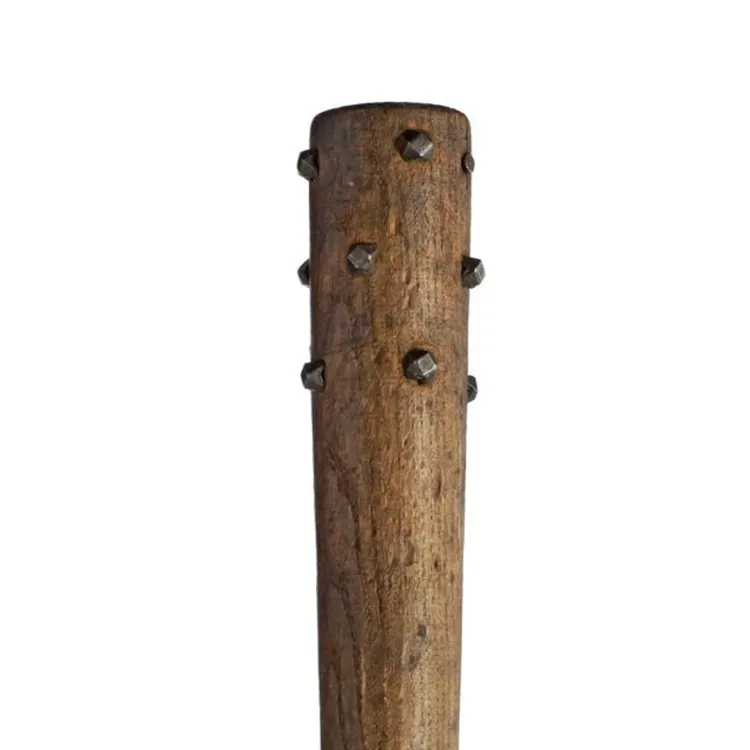
Lead-Cored Studded Trench Club
Development
Clubs and maces reappeared in the early months of 1915 as a stalemate set in and trench raiding for prisoners, intelligence gathering, and simply to dominate 'no man's land' was attempted by both sides. Although clubs were used by all the warring nations, they were particularly popular with British troops. This was due in part to no standard trench dagger being issued to them and perhaps also, at least initially, because British troops looked on daggers unfavourably as an assassin's weapon rather than a soldier's.
The majority of trench clubs were not improvised by the soldiers that would use them but purposefully manufactured by supporting arms. The Royal Engineers cast flanged mace heads in their thousands which were then fitted to the standard British entrenching tool handle. These were produced from 1915-18 and in one week alone, the Hazerbrouck Workshops had over three thousands of these weapons in store, ready to be issued.
Another common British version is this lead-filled truncheon type club, with hobnails hammered into the head. Again, this type would have needed to be purposely manufactured, rather than improvised in the field.
Use and effect
A suitably weighted club could be fiercely effective, even against helmeted opponents. Private Stephen Graham of the Scots Guards describes a six man raiding party, all being armed with clubs coming across the enemy:
(they) flew at them and pounded their heads with clubs and down went one Fritz in a heap. One was killed, the other bruised and overwhelmed.
It seems 'one sharp blow on the head from one of these' was usually enough to kill or disable an enemy for capture.
Statistics
- Date entered service - 1915
- Overall length - 45.7 cm (18 in)
- Weight - 450 g (1 lb)
- Country of manufacture - Probably Britain
- Manufacturer - Unknown
- Primary operator - Britain
Related Objects


No.5 Mk.I Mills Bomb
Development
The War Department believed that the Belgian designed self-igniting hand grenade would be a valuable asset for British soldiers in the trenches. Patented in 1912 by Captain Leon Roland of the Belgian Army, the Compagnie Belge de Munitions (CBdM) was established in order to market the grenade to a British manufacturer. The task was given to William Mills of Mills Co. An experienced engineer, he was given the task of redesigning the grenade, making it safer and more efficient than its Belgian counterpart.
After a few false starts, in 1915 Mills sent prototypes to the troops in France of his cast iron bodied, egg shaped grenade. Eventually this prototype became the No.5 Mark 1 and was the first British hand grenade ever to be issued on such a large scale. Resembling a small 'pineapple' due to its segmented outer form, these segments were originally designed to fragment. Due to the nature of explosives, however, they failed to do so, but instead provided a firm grip in the wet conditions of the trenches.
Use and effect
To detonate the grenade the safety pin had to be removed. Once the pin was pulled out, by use of the attached ring, the user would hold the lever down and prepare to throw. When thrown, the lever would release. As the lever released, the striker would drop onto a percussion cap, the blast from which lit the fuse. This burned for five seconds before it reached the detonator. A good bomber would have to be able to throw a bomb to a distance of around 30.5 m (100 feet), protecting themselves from the blast. It was deemed that cricketers, especially those with a good bowling arm, made the most effective bombers.
The No.5 grenades were supplied to the infantry in wooden chests, each containing 12 grenades, with a tin of igniter sets. These complete detonator units each comprised the detonating charge, a 5-second fuze, and a cap chamber housing the initiating percussion cap, along with a base plug key. Arming a Mills bomb was straightforward, requiring only that the base plug be unscrewed, the detonator assembly inserted and the plug screwed back down. This was always done ahead of time and whilst in cover, but remained an inherently risky task. Private Clarrie Jarman, a scout bomber of the 7th Queen's Regiment recalled:
There was a bang and screams and the stretcher bearers went at the double to some poor devils who had let their concentration wander.
These grenades were an essential part of trench warfare, in particular during raids. Interestingly, notes from a bombing course that took place at the School of Arms in Hythe in January 1920, still taught the tactics of bombing a trench. It has to be concluded that the lessons learned from the War impacted on the future of bombing and what tactics to use to gain optimum effect.
Consisting of eight men and one N.C.O. in order to storm a trench you would need to be in the following formation:
- Man No. 1) A rifleman, equipped with three bombs for emergency. His primary task was to 'precede the party down the trench and by means of his bayonet repel enemy onslaught.'
- Man No. 2) A bayonet man, who passed back messages from the rifleman to the thrower.
- Man No. 3) The first thrower, carrying up to 12 bombs. 'His duty is to bomb the main trench as far forward as possible.' Man
- No. 4) Acts as carrier to the thrower. Assists with throwing where possible, his primary duty is to bomb communication trenches.
- Man No. 5) The N.C.O., who is also equipped with a few bombs.
- Man No. 6) The second thrower, whose task is to also bomb communication trenches. He stops and bombs the communication trench until another section from the rear takes over. He also replaces the third man if he becomes a casualty.
- Man No. 7) Assists the sixth man as a carrier and auxiliary bomber.
- Men No. 8 and 9) Rifle bombers. They carry 12 bombs and an ample supply of rods (which are inserted into the grenade at one end and into the barrel of the rifle at the other) so if necessary they can use the throwers bombs and vice versa.
The third and fourth men should be together if possible, as well as the eighth man with the ninth, but bunching the section together is to be avoided as the whole party may suffer from one bomb.
Statistics
- Date entered service - 1915
- Overall length - 10 cm (3.9 in)
- Weight - 760 g (1 lb 10 oz)
- Effective range - 18 m (20 yd) (kill zone)
- Country of manufacture - Britain
- Manufacturer - Mills Munition Factory
- Primary operator - Britain
Thomas Nash, Private, Manchester Regiment
Different types of grenade were developed throughout the First World War. This included 'Jam-Tin' grenades, where old food containers were filled with explosives and bits of old metal, such as cut up bits of barbed wire, and thrown at the enemy. By 1915, the No. 5 Mills bomb was being issued to British and Commonwealth soldiers on the Western Front and Thomas Nash describes in detail the terrible impact it could have on a person.
At the end of those ten minutes we got orders to over the top and the best of luck, so up a small ladder we went out of the trenches into no-man’s land, with our bayonets fixed all ready... to meet Germans face to face. That was a terrible hour of death, to see men blown up in the air, blown to atoms with explosives, machine gun bullets killing, just lay there on the floor passing by.
Related Objects


British 18-inch Howitzer Cannon Mk.I
The First World War was expected to be mobile, fast moving and over quickly. Notoriously, the Western Front instead became a gigantic siege. To break this stalemate, heavier artillery was constantly demanded. This railway howitzer is the only survivor of the British Army's biggest guns.
Artillery was the most destructive weapon of the First World War and caused the most casualties. Heavier and heavier guns were required to support the infantry trying to achieve the elusive breakthrough against an enemy dug in ever more stubbornly on the Western Front. The heaviest artillery could only be deployed by rail.
Just four 18-inch railway howitzers were built. They were not brought into action before the Armistice in 1918 but one was stationed at Dover during the Second World War. The original 18-inch railway mounting was much longer than this Victorian proof sleigh, which was used for range trials until 1959.
I remember there was an elderly couple standing by their cottage near where we were shooting and every time we fired their roof lost a few more tiles... A lump of (German) shrapnel went through the ammo wagon...we picked up some pieces and worked out that they were 15" shells.
David Collyer on 'Boche Buster' in about 1941, from "Somewhere in England..." in Bygone Kent, 1982
Development
The idea of bringing artillery and rolling stock together seems to have initially been undertaken during the American Civil War (1861-1865) when a 13-inch Mortar was mounted on a flatcar. During the Anglo-Egyptian War (1882), Admiral Sir Percy Scott placed naval landing guns on railway wagons to help protect troop trains and 4.7-inch guns similarly mounted were used during the Boer War in 1900. During the First World War, railway artillery seemed to be the answer to the glutinous mud that affected the Western Front and all the belligerents deployed some form of it.
The British were able to draw on reserve naval and coast defence guns with the 9.2-inch being the first in 1915: others included the 12-inch Howitzer and the 14-inch. Indeed a 14-inch Mark III gun mounted on the carriage 'Boche-Buster', firing in the presence of King George V in 1918, scored a direct hit on a German troop carrying train at Douai Railway junction at his suggestion and became known as the King's Shot.
As the German subterranean defences of the Hindenburg Line became deeper and more robust, General Headquarters in France in 1917 requested a heavier more penetrative projectile which meant larger, weightier artillery. The Elswick Ordnance Company of Newcastle started work on an 18-inch Howitzer barrel in 1918 but of the five earmarked (L1-L5), none were completed before the end of the war and did not enter British service until 1920.
Use and Effect
In the inter-war period, one of the barrels was selected for periodic ballistics trials and found either at Shoeburyness, Salisbury Plain, or at the Royal Arsenal, Woolwich. Later, in 1940, during the early part of the Second World War, the threat of a German invasion focussed Winston Churchill's attention an apparent weakness in the coast defences of the south-east.
He hit upon the brilliant idea of contacting the surviving King's Shot detachment commander, Major Monty Cleeve, to scour the country for any surviving heavy artillery that might be used to make good any deficiencies, especially around Dover in Kent. This proved very successful, with an 18-inch Howitzer barrel being mounted on one of the converted 14-inch carriages and railed to Kent.
Another surviving 18-inch barrel (L1), placed upon a Victorian converted Railway Proof Carriage, was retained at Shoeburyness for trials into the penetration of concrete which commenced in 1943. This was of particular interest to the Royal Air Force and quite probably Barnes Wallis of 'Bouncing-Bomb' fame, who was keen to develop an air-dropped super-bomb of 10 tons capable of destroying viaducts or penetrating 20-feet of reinforced concrete - soon to become known as 'Grand Slam'.
It was, of course, far simpler to undertake a test of this kind using artillery rather than having to modify a Lancaster and take a crew from front-line duty. L1 and its Victorian mounting were eventually purchased by the Royal Artillery Historical Trust in 1991 and displayed at the Rotunda, Woolwich and the Royal Artillery Barracks, Larkhill before coming to Fort Nelson on loan in 2013.
Statistics
- Date entered service - 1920
- Action / Operating system - Cordite propellant
- Barrel length - 16.47 m (648.4 in)
- Length of Sleigh - 7 m
- Weight - 87,075 kg
- Range - 20.92 km (13 miles)
- Calibre - 347 mm (18 in)
- Projectile weight - 1135 kg
- Rate of fire (rounds per hour) - 2
- Muzzle velocity - 570 m/s (1880 fps)
- Crew - 24
- Country of manufacture - Britain
- Manufacturer - Elswick Ordnance Co. Newcastle
- Primary operator - Britain
Mr. C. Reynolds, Private, King's Own Yorkshire Light Infantry / Machine Gun Corps
60% of battlefield deaths in the First World War were caused by artillery. Advances in size and firepower made howitzers and mortars dangerous over distances far greater than any rifle bullet. Machine gunners, such as Mr. Reynolds, found themselves particular targets of bombardment, who explains the situation.
It started in the night. Ooooh shelling like the devil, you could feel the feel the thud of the soil you know, and then it all went quiet and we looked up and they all got out the from the guns and had to run, to the right, back where the headquarters was.
Related Objects

Canada
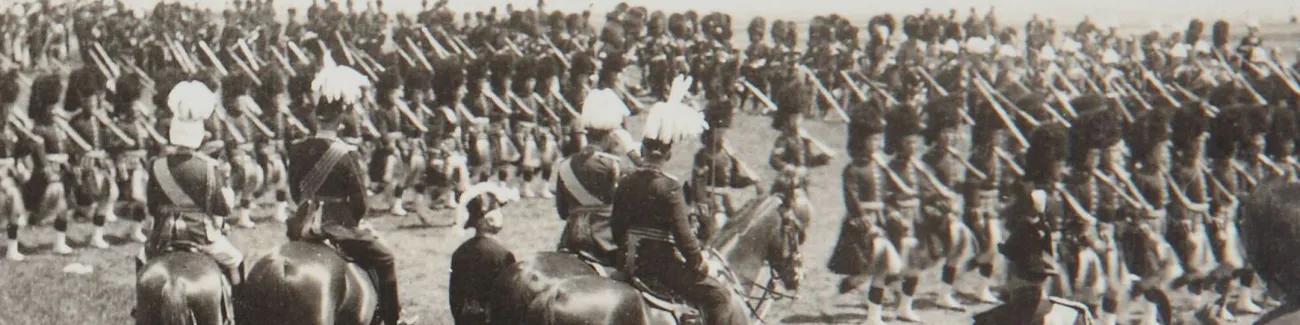

Ross Sniper Rifle Mk.III with Warner and Swasey Scope 1911
Development
The Ross rifle was designed by Charles Ross (1872-1942) in 1896 and manufactured at his factory in Quebec. A very fast but overly complex straight pull bolt action rifle, it was redesigned a number of times. The first incarnation of the Ross rifle Mark I (1902), chambered the standard British .303 in cartridge. From 1907, Ross redesigned his rifle several times, most notably increasing the length of the barrel, altering safety features and changing the cartridge to the more powerful .280 in Ross cartridge. This resulted in various different starred patterns of the Mark II version.
By 1911 the Ross rifle Mark III (sometimes referred to as the Model 1910, the year of its design) was complete and became the official rifle of the Canadian Army. Reverting back to .303 in calibre, it was taken to the trenches of the First World War, and turned out to be a complete failure as an infantry rifle. The weapon was too sensitive for life in the mud and dirt of the trenches, resulting in fouling of the barrel. When it came to stripping the Ross to clean, it was found that the bolt could be assembled in the wrong order. This could result in the rifle being fired with the bolt not locked into the receiver. One soldier was killed in this way before a modification was made.
Use and effect
The Ross rifle did have one redeeming feature; its incredible accuracy, especially when paired with a telescopic sight. By 1916, the Ross was replaced by the Short Magazine Lee-Enfield rifle, however it was kept in service for use by Canadian snipers. Snipers were trained to stalk the enemy, conceal themselves accordingly, and possess the ability to kill with one shot. In order to help achieve this, two scopes were used by the Canadians; the American designed Winchester A5 and the more widely available Warner and Swasey scope.
With its 5x magnification, the Warner and Swasey scope provided its user with a clear, bright and large size picture. It had the added bonus of being fitted with elevation and windage drums. These drums could suffer from loss of zero if handled roughly, resulting in an inaccurate shot revealing the snipers position. As a solution, snipers would hold down the sight in its true position with rubber bands. The sight was also flawed in that it had an 'eye relief' of just one inch (2.5 cm), despite having a large rubber eye cup. This often meant snipers were inclined to flinch whilst they were taking shots, again affecting their accuracy.
The final cause for concern was the mounting of the scope. It could often loosen causing the sight to become unsecure. Herbert McBride, author of A Rifleman Went to War, had a solution to this problem: 'By using a wedge- made of a piece of safety razor blade-and salt water, I got her on so tight that I came near to being court-martialled when I finally turned it in as the armourer could not get it off.' Despite the flaws connected to the Ross rifle and its accompanying Warner Swasey scope, the Canadian snipers excelled at their art. Corporal Francis Pegahmagabow (1891-1952), was the most effective sniper of the War capturing 300 prisoners and achieving 378 kills with his Ross rifle.
Statistics
- Date entered service - 1911
- Action / Operating system - Straight-pull bolt
- Barrel length - 89 cm (35 in)
- Overall length - 1.280 m (50.5 in)
- Weight - 5.6 kg (12 lb 5.5 oz)
- Effective range - 600 m (656 yd) with scope
- Feed - Internal magazine
- Capacity (rounds) - 5
- Calibre / Bore - 7.7x56mmR (.303 in)
- Muzzle velocity - 794 m/s (2604 fps)
- Country of manufacture - Canada
- Manufacturer - Ross Rifle Co
- Manufacturer - Warner and Swasey
- Primary operator - Canada
Related Objects


Bowie Trench Knife, converted from a Ross Bayonet
Development
The first trench weapons were those manufactured by the troops themselves, by modifying existing equipment to be fit for purpose. Bayonets were the edged weapon that infantrymen of every nation had ready access to and so were a common subject of conversion. Some, like the French Lebel bayonet were overly long and prone to breaking, and hence had their blades shortened into stiletto style daggers.
Unlike most nations' bayonets, the Ross bayonet was not particular long, but its thick, flat blade and spatulate tip made it an inefficient, if robust weapon. To improve upon this, some troops ground down the tip to a clipped point, making a much lighter and better thrusting weapon. Some also removed the bayonet features of muzzle ring and press stud, to further lighten the weapon.
Use and effect
Soldiers of the Canadian Expeditionary Force were the acknowledged masters of trench raiding. Major Hesketh-Pritchard, the founder of the first British Army sniper school, said that Canadian patrols were known as Silent Death as:
...armed with trench daggers its members killed as silently as possible. This soon made the Germans very shy of taking their evening crawl.
The unofficial conversion of the blade of the Ross bayonet was in turn adopted by the Canadian military and from 1916 the bayonet's 'final version' was issued with a clipped point. However, some show personal modification beyond this, resulting in the classic Bowie-type fighting knife profile.
After the war, a large number of Ross bayonets were sold to the William Margolin Company of Montreal, who modified them for sale into commercial hunting knives. The Ross bayonet however was reissued in the Second World War, again as a converted fighting knife, to Canadian Commandos.
Statistics
- Date entered service - 1916
- Blade length - 25.8 cm (10.2 in)
- Overall length - 37.3 cm (14.7 in)
- Weight - 500 g (1 lbs 1.6 oz) (without sheath)
- Country of manufacture - Canada
- Manufacturer - Ross Rifle Company, Quebec City
- Primary operator - Canada
Related Object

New Zealand and Australia
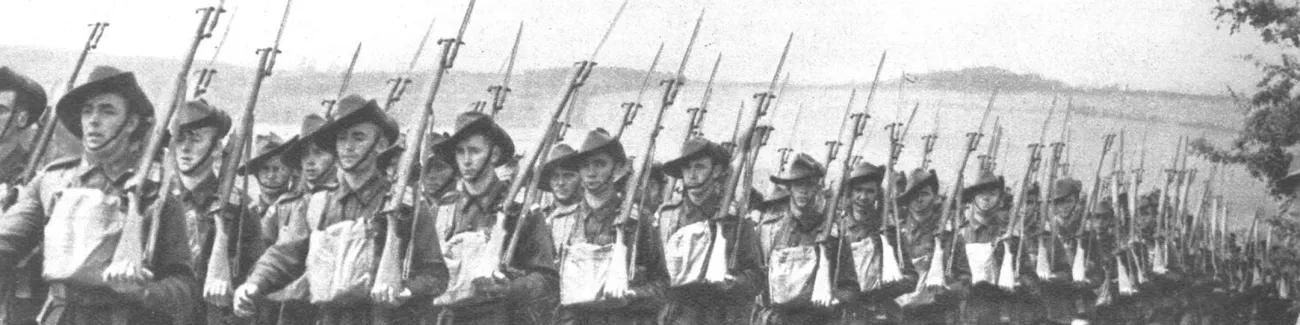
Magazine Lee-Enfield Rifle, Mk.I and Pattern 1888 Bayonet
Development
Britain was the only nation to adopt the bolt-action mechanism developed by Scots-Canadian James Paris Lee, when it replaced the lever-operated Martini-Henry with the Lee-Metford rifle in 1888. 'Metford' referred to British engineer William Ellis Metford, who designed the original pattern of rifling for the weapon, which was fitted with an eight-round magazine. Like all British infantry arms before it, the Metford was designed to fire black powder, in this case inside the new .303 cartridge.
However, by 1895 it had been discovered that the fast-burning smokeless propellants coming in to use would rapidly wear out Metford's shallow, rounded grooves. This polygonal rifling system was actually ahead of its time, and thanks to advances in metallurgy is back in use today, for example in the Glock pistol adopted by the Austrian and British armies. Nonetheless, at the time a replacement type of rifling was needed.
The pattern devised at the Royal Firearms Factory at Enfield reverted to conventional square grooves, and gave the weapon the Lee-Enfield name. Magazine capacity was also increased by widening the magazine to accommodate two columns of cartridges, and, later, a metal bridge over the action to allow five rounds at a time to be stripped from chargers (clips) carried in pouches on the soldier's web equipment.
Use and effect
Velocity was key to the power and accuracy of infantry rifles. Improvements to the Lee-Metford pushed muzzle velocity from 622 metres per second (2040 feet per second) up to 751 m/s (2460 fps). Nonetheless, this was still lower than the 878 m/s (2,881 fps) of the Mauser 98.
The Metford's original black powder cartridge was loaded with a round-nosed bullet that did not 'tumble' (yaw) in human tissue. This resulted in less severe wounds than those caused by previous weapons. This was soon replaced by more lethal designs including the infamous 'Dum-Dum' and ultimately, the modern pointed bullet.
The Lee action was also not as strong nor as accurate as the Mauser, and whilst almost legendary today, was not well thought of by many officers and men when it was introduced. However, it did have the advantage of twice the magazine capacity of most of its rivals. It was also easier to use in combat.
In the Mauser, the operator must overcome the pressure of the firing pin spring, as well as any resistance from the fired cartridge case, as the bolt handle is pulled upwards. In the Lee, the firing pin is cocked as the bolt is pushed forwards, allowing the user to apply more muscles to the task, and speeding up reloading.
The Lee-Enfield appears to be about the worst rifle in the hands of the troops of the great powers.
Major William Anstruther-Thompson, Royal Horse Guards, 1900
Statistics
- Date entered service - 1895
- Action / Operating system - Bolt-action
- Barrel length - 76.7 cm (30.2 in)
- Overall length - 1.257 m (49.5 in)
- Weight - 4.3 kg (9 lb 8 oz)
- Effective range - 550 m (600 yd)
- Maximum range - 3200 m (3500 yd)
- Feed - Box magazine
- Capacity (rounds) - 8
- Calibre / Bore - 7.7x56mmR (.303 in)
- Muzzle velocity - 625 m/s (2050 fps)
- Country of manufacture - Britain
- Manufacturer - Birmingham Small Arms Company
- Manufacturer - Royal Small Arms Enfield
- Manufacturer - Royal Small Arms Factory Sparkbrook
- Primary operator - Britain
- Other operators - Australia
- Other operators - Canada
- Other operators - New Zealand
- Other operators - Portugal
J. Curdie, Private, 6th Battalion, Highland Light Infantry
By late 1915, it was clear to Allied command that the Gallipoli campaign was a failure. Attention now turned to evacuating thousands of men without the Ottomans launching a counterattack. The Drip Rifle was a mechanism attached to a SMLE which allowed the rifle to fire periodically, deceiving the enemy into thinking the opposite trenches were occupied. Mr. J. Curdie explains their set-up and other tricks of the trenches.
...we had braziers which were hooded and in which had clips of ammunition suspended above them and candles which when they burn through threads, let the braziers drop in and they created a bit of a din in the brazier.
Related Objects

Short Magazine Lee-Enfield (SMLE) Rifle and Pattern 1907 Bayonet
Development
The key word in the SMLE's designation is 'Short', which refers to the length of the rifle relative to the old 'Long' Magazine Lee-Metford and Lee-Enfield rifles that it replaced. It was discovered at the end of the 19th century that more powerful smokeless propellant would allow long, cumbersome infantry rifles to be reduced in length without any loss in capability. This would make the weapon lighter and easier to manipulate, and also simplify production and logistics.
At the same time, the British Army was facing skilled Boer marksmen in the South African War (1899-1902), with their accurate, long-ranged Mauser rifles. This led to complaints against both British standards of marksmanship training and the Lee rifle. Some advocated that long range accuracy was the key, but the Indian Army, also experiencing real combat in the North West Frontier region (now Afghanistan), showed that an overhaul of traditional tactics was needed. Soldiers standing shoulder-to-shoulder in the open, and firing simultaneously on direct orders from their officers, were an easy target for any enemy that chose not to fight in this way.
Officers with the Indian Army were instrumental in changes to doctrine and training that would allow soldiers to fire independently and as rapidly as necessary, as targets became available. These changes are reflected in the Mark III* version of the SMLE, which did away with antiquated 'dial' sights for massed rifle fire at extreme range, and a cut-off plate, intended to keep the magazine in reserve, which reflected strict fire orders already out of use by 1914.
Use and effect
One standard short rifle for all troops meant that the traditional short carbines used by the cavalry and artillery could be abandoned. Further reflecting changes in fighting style, sighting arrangements were also changed on the SMLE. Front and rear sights were closer together, allowing the shooter to quickly align them for a 'snap' shot.
This new rifle and these new tactics, both geared toward the reality of close to medium-range combat, were vital in helping to halt the German advance in 1914. The shorter, handier rifle with its distinctive stubby appearance also went on to provide an edge in trench warfare, the extent of which its designers could not have predicted.
The high rates of fire achieved in training also resulted in claims that the British 'Tommy' was able to deliver a greater volume of fire than his enemies or allies.
Our men have come to believe that every one of you carries a portable Maxim with him.
A German officer's comments on the high rate of British rifle fire at the Battle of Mons.
Statistics
- Date entered service - 1903
- Action / Operating system - Bolt-action
- Barrel length - 64 cm (25.2 in)
- Overall length - 1.118 m (44 in)
- Weight - 3.96 kg (8 lb 11 oz)
- Effective range - 503 m (550 yd)
- Maximum range - 2743 m (3000 yd)
- Feed - Box magazine
- Capacity (rounds) - 10
- Calibre / Bore - 7.7x56mmR (.303 in)
- Muzzle velocity - 744 m/s (2441 fps)
- Rate of fire (rounds per minute) - 25
- Country of manufacture - Britain
- Manufacturer - Birmingham Small Arms Company
- Manufacturer - London Small Arms Company
- Manufacturer - National Rifle Factory
- Manufacturer - Royal Small Arms Factory Enfield
- Manufacturer - Royal Small Arms Factory Sparkbrook
- Manufacturer - Standard Small Arms
- Primary operator - Britain
- Other operators - Australia
- Other operators - Canada
- Other operators - India
- Other operators - New Zealand
- Other operators - Portugal
Related Objects

British Sectioned SMLE Mk.III Rifle, about 1908
Short, Magazine Lee-Enfield (SMLE) Trench Adapted Rifle
Development
The SMLE rifle had been well suited to war in the trenches. In 1916, it was further refined as the Mark III* by eliminating redundant features, by which time fabric action covers and metal muzzle covers had been issued to limit ingress of mud and water. Work began too on dedicated sniper variants. A number of other adaptations were made specifically for trench warfare in the form of attachments or accessories. These could, in theory, be fitted to any service rifle.
'Overhead fire' devices were developed to permit a soldier to not only see above ground level by means of a periscope attachment, but also to continue firing from safety. The metal frame was collapsible and contained an auxiliary trigger linked to the rifle's trigger. Additional attachments were also developed.
In 1915, it was realised that while thrown hand grenades were limited in range by the strength of the soldier's arm, the power of a rifle could be used to project 'bombs' to greater ranges, and potentially also improve accuracy. A blank cartridge was loaded and a rod, slightly smaller than the bore of the SMLE rifle, was slid into the barrel. Firing would propel this new 'rod grenade' out of the barrel. At first, a series of dedicated designs were produced that could only be fired from a rifle.
Later, the standard No.5 Mills 'bomb' was converted by means of a different screw-on baseplate to attach a copper rod, changing its designation to 'No.23' and permitting either hand throwing or rifle discharge. Under this system, a sheet metal bracket had to be fitted, held in place by a standard bayonet (the pictured example has the blade cut back for instructional use).
All of these rod systems tended to wear the SMLE's rifling, and so the 'cup' system was introduced in 1917. This used a detachable metal cup, a concept used with muzzleloading arms in the 18th and early 19th centuries. Again, a blank cartridge was inserted into the chamber prior to firing, and the new No.36 hand grenade prepared for rifle discharge by screwing a circular plate onto its base.
Use and effect
The overhead fire device successfully allowed soldiers to use several feet of earth as cover against enemy fire. However, not enough were available to give any great volume of fire, relegating the device to short range sniping at enemy soldiers who strayed into 'no man's land' or raised their heads above the parapet of their own trench.
The British version was not as fully developed as the German equivalent, and lacked an auxiliary bolt handle. As such, it had to be brought down from the parapet for reloading. It also took time to fit and detach these devices, which meant that a spare rifle would typically be found for use with the frame. It became, in effect, a specialist trench weapon in its own right.
The same applied to grenade launching devices. Whilst capable of projecting a grenade many times further than the human hand, launching such heavy projectiles generated immense recoil. Both rod and cup type systems had to be fired with the butt jammed into the ground. With practice, rough aim could be established simply by leaning the rifle at the correct angle, though support frames with clamps were also created. This harsh recoil tended to crack the wooden stock of the rifle.
Despite this, rifle grenades were too useful to be abandoned, and development of a satisfactory standalone launcher would take too long (though it was attempted with the little-known Blanch-Chevallier launcher). Instead, rifles deemed to be in too poor a state for general issue were wrapped with reinforcing copper wire and designated as full-time grenade launchers. These rifles were already marked 'EY' for 'Emergency use only'.
Detachable wirecutters were more successful as truly interchangeable accessories, and were often fitted prior to an attack. If time was short to remove them prior to actual combat, they could be left on the rifle and would not greatly interfere with its operation at trench fighting ranges. They would throw off a shooter's aim at ranges beyond 100 m (109 yd) however, as they added weight to the muzzle, changing the balance of the rifle.
Statistics
- Date entered service - 1916
- Action / Operating system - Bolt-action
- Barrel length - 64 cm (25.2 in)
- Overall length - 1.118 m (44 in)
- Weight - 3.96 kg (8 lb 11 oz)
- Effective range - 503 m (550 yd)
- Feed - Box magazine
- Capacity (rounds) - 10
- Calibre / Bore - 7.7x56mmR (.303 in)
- Muzzle velocity - 744 m/s (2441 fps)
- Rate of fire (rounds per minute) - 25
- Country of manufacture - Britain
- Manufacturer - Birmingham Small Arms Company
- Manufacturer - London Small Arms Company
- Manufacturer - National Rifle Factory
- Manufacturer - Royal Small Arms Factory Enfield
- Manufacturer - Royal Small Arms Factory Sparkbrook
- Manufacturer - Standard Small Arms
- Primary operator - Britain
- Other operators - Australia
- Other operators - Canada
- Other operators - India
- Other operators - New Zealand
Related Objects
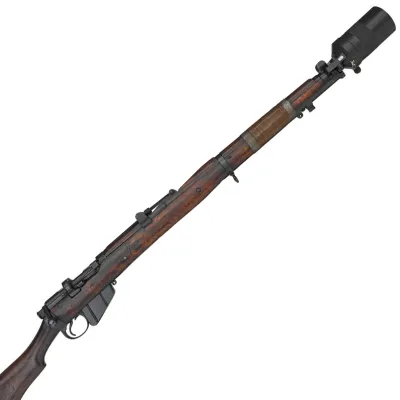
Vickers-Maxim Machine Gun Mk.I
Development
The British Vickers gun was developed from the original automatic machine gun designed by Sir Hiram Stevens Maxim in 1884. Though an American by birth, Maxim came to Britain to build and sell his new gun. He was knighted for his services to the Empire in 1901.
Britain had been an early adopter of the Maxim gun, with the first examples entering service in 1887 on artillery-style wheeled carriages, though significant numbers did not arrive until the 1890s. These guns actually remained in service, alongside the Vickers, right through the First World War, as the War Office realised that Germany had taken a lead in machine gun production. Even captured German examples were converted to take British .303 ammunition.
The Maxim proved itself useful in colonial warfare against superior numbers of enemies not themselves equipped with firearms. It was estimated to have the firepower of up to 70 riflemen, and so early tactics focused upon devastating close-range defensive fire. In essence, the machine gun was treated as a form of automated infantry, exemplified by Maxim's original concept of a variable rate of fire; from 'Slow' (two rounds per minute) to 'Fast' (500 rounds per minute). As long as machine guns were fired from static, defensive positions, or heavy, wheeled carriages, their weight was not crucial.
Whereas other countries retained close copies of the Maxim, however, the British War Office demanded an improved version. Sheffield-based company Vickers were asked to redesign the gun. By flipping the gun's mechanism upside down, they were able to make it both smaller and lighter. In doing so, in 1912 they produced the Vickers gun, perhaps the definitive Maxim type machine gun, and much simpler to produce and maintain than Germany's own Maxim, the MG08.
Use and effect
This lightened design, alongside the Lewis light machine gun, formed the basis of new, offensive tactics used to help break the stalemate later in the war. British machine guns were originally allocated at division level. It took two expert gunners, Majors Baker-Carr and Lindsay, to advocate for the formation of a dedicated elite unit.
The Machine Gun Corps was formed in 1915 and provided small teams who could operate and deploy these guns where they were needed most on the battlefield. The tactics developed by the new MGC allowed British forces to take the fight to the enemy, and are still used today. 'Traversing fire', in which the gun was fired and pivoted left-to-right, was a relatively rare, defensive tactic.
Much more common were accurate long-range fire and 'indirect' fire, where the gunner used scientific techniques and tools to fire at targets that they could not actually see. Thousands of bullets would create a 'beaten zone' that would destroy any enemy that entered it. Barrage fire allowed machine guns to directly support infantry as they advanced, and overhead fire meant that guns would actually fire over their own soldiers heads.
The Vickers, properly maintained and supplied with water in its cooling jacket, was very reliable. It was claimed that in Savoy Trench on the Somme in 1916, ten guns fired one million rounds in a twelve hour period. However, the Maxim and Vickers were far more complicated than traditional infantry weapons. A soldier lacking the necessary specialist training could no more become a Vickers gunner than he could a fighter pilot. The role became a specialist one, involving ten weeks of intensive training at the Machine Gun Training Centre at Grantham.
The Vickers itself was not withdrawn from British service until 1968. By this time it had been replaced in front-line service by the gas-operated, air-cooled Belgian-designed L7 General Purpose Machine Gun. This replaced water-cooling with a replaceable barrel system, and is still in service today.
The deadliest of all the deadly machines which are now destroying the populations of Europe.
Havelock Ellis, 'Impressions and Comments', 1921
Statistics
- Date entered service - 1912
- Action / Operating system - Recoil
- Overall length - 1.155 m (43.5 in)
- Barrel length - 72.3 cm (28.4 in)
- Weight - 40.1 kg (88.5 lb) (with water & mount)
- Effective range - 2286 m (2500 yd)
- Maximum range - 3658 m (4000 yd)
- Feed - Belt
- Capacity (rounds) - 250
- Calibre / Bore - 7.7x56mmR (.303 in)
- Muzzle velocity - 744 m/s (2440 fps)
- Rate of fire (rounds per minute) - 550
- Crew - 6
- Country of manufacture - Britain
- Manufacturer - Lithgow Australia
- Manufacturer - Vickers Crayford
- Manufacturer - Vickers Erith
- Primary operator - Britain
- Other operators - Australia
- Other operators - Canada
- Other operators - Germany
- Other operators - New Zealand
- Other operators - USA
Related Objects

Lewis Light Machine Gun, Mk.I
Development
The 'Lewis gun' was a refinement by U.S. Army Colonel Isaac N. Lewis of an existing design by another American, Samuel McClean. The resulting weapon went on to define the light machine gun as a class of firearm. Machine guns like the Maxim family could fire more continuously and with accuracy at long range, but were heavy and had to be served by a crew of men. A 'light' machine gun would allow soldiers to take the fight to the enemy.
The Lewis was designed with a rifle-style shoulder stock, pistol grip, and carrying sling. Instead of a water-filled barrel jacket, the Lewis was air-cooled using a finned radiator fitted beneath a steel shroud. When fired, this created a 'venturi' effect, sucking the hot air forwards and drawing colder air in behind it. The belt feed system of the Maxim was replaced by a rotating 'pan' magazine, limiting capacity but keeping the gun light and easy to handle. Importantly, a clamp-on bipod was also designed to allow a stable firing platform, replacing the fixed tripod mount of the heavy machine guns.
Though an American design, the United States Army was reluctant to adopt Colonel Lewis's gun. Instead, he turned to Europe.
Use and effect
The British army was the first to adopt the Lewis gun, which became part of important reforms to the deployment of machine guns. The heavy Vickers and Maxim guns, and their gun crews, were taken from the infantry to form the new Machine Gun Corps. The MGC would treat the Vickers more like an artillery piece, delivering fire where it was needed to support the infantry. Meanwhile, infantry regiments instead received the Lewis gun.
Firing the same cartridge as the Vickers and with a similar rate of fire, it was far easier for soldiers to carry, get set up, and use in the attack. Along with the Vickers gun, it enabled the changes in tactics that led to later British and Allied success.
The Lewis also became the first ever aircraft machine gun, fitted in flexible mounts on two-seat spotter aircraft, but also mounted above the wing even on later fighters like the SE5a. The cooling radiator was often removed, as cold air rushing over the barrel made it unnecessary. A bigger, 97 round magazine was used to limit the need for frequent and fiddly magazine changes in moving aircraft at freezing altitudes.
Statistics
- Date entered service - 1913
- Action / Operating system - Gas
- Barrel length - 76.7 cm (30.2 in)
- Overall length - 1.283 m (50.5 in)
- Weight - 11.8 kg (26 lb)
- Effective range - 800 m (880 yd)
- Feed - Drum magazine
- Capacity (rounds) - 47 or 37
- Calibre / Bore - 7.62x63mm (.30-06) (USA)
- Calibre / Bore - 7.7x56mmR (.303 in) (British Empire)
- Muzzle velocity - 762 m/s (2500 fps)
- Rate of fire (rounds per minute) - 550
- Crew - 2
- Country of manufacture - Britain
- Manufacturer - Birmingham Small Arms Company
- Manufacturer - Savage Arms Company (USA)
- Primary operator - Britain
- Other operators - Australia
- Other operators - Canada
- Other operators - Germany (captured)
- Other operators - New Zealand
- Other operators - USA
Related Objects

United States
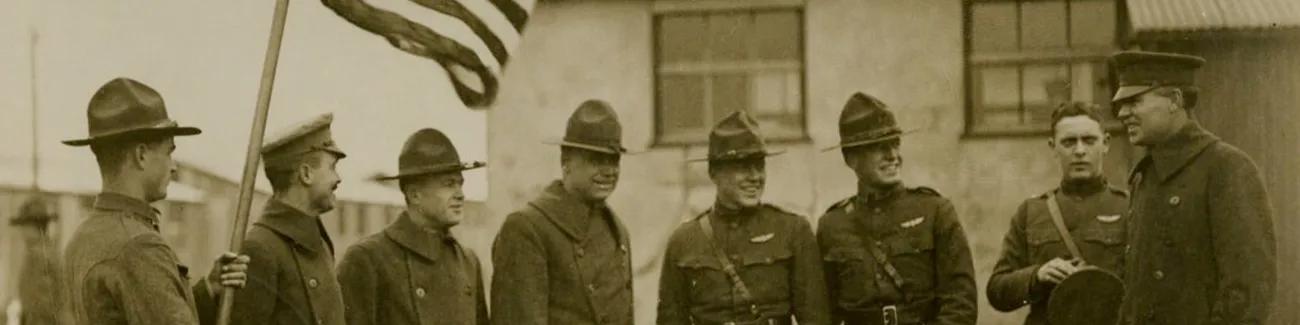

Model 1903 Mk.I Springfield Rifle with Pedersen Device and M1905 Bayonet
Development
There were two standard issue American rifles during the First World War; the M1903 Springfield and the more common British-designed M1917. The two rifles were similar in most respects and both owed much to the German Mauser. The M1903, however, was a closer derivative, being officially licenced by Mauser to the U.S. Government and built by Springfield Armory and Rock Island Armory.
Like the British, the Americans had come up against the Mauser in combat, in their case during the Spanish-American War of 1898. In one incident, 750 Spanish soldiers with Mausers were able to hold off 6600 Americans with outdated rifles. The main departure from the Mauser rifle was in the adoption of one short rifle in place of separate long rifles and short carbines, as per the British SMLE.
Initially, an unusual rod bayonet was devised to be carried on the rifle like a cleaning rod. This was found to be easily broken, and was replaced by a typical knife bayonet with scabbard. As America joined the First World War and experienced close-quarter trench fighting, a need for a more rapid fire weapon became apparent. Germany solved this by inventing a new class of weapon in the submachine gun, and specialised assault units to carry it.
The alternative US concept involved a conversion kit for the infantry rifle, named for inventor John D Pedersen. The soldier would load and fire his Springfield or Enfield as normal until closing with the enemy, at which point he would remove the manual bolt and install the Pedersen device. The device was classified secret until such time as enough could be produced to have a surprise effect as part of major offensive in 1919. The war ended before this could happen.
Use and effect
Early production Springfields suffered from poor heat treatment, making their receivers weak. Once solved, the rifle was very robust and offered an excellent balance of weight, size, power, and accuracy. After demobilisation, M1917 Enfields became surplus and the 1903 resumed status as the standard issue US rifle. It remained in use until the end of the Second World War alongside the M1 Garand.
The Remington-manufactured Pedersen device was not a success story. It saw no use during the War, and post-war trials to determine its utility did not impress, partly because authorities did not anticipate another static, trench-based war in the future. Instead, the need was identified for a full-power, full-time semi-automatic rifle. Even by First World War standards, the concept was flawed. Installing the device took precious time, and although high in capacity, magazines were difficult to change by modern standards.
Unlike the German MP 18,1 submachine gun, it did not permit automatic fire and fired an even less potent cartridge. It also required a modification to the receiver of the Springfield rifle, resulting in the 'Mark 1' rifle. Although preferable to the burden of carrying a rifle and a pistol-calibre carbine or submachine gun, the device and accessories nonetheless added weight. Each soldier would have to carry enough cartridges of different types for both rifle and device. A better solution was simply to issue a mixture of close and longer range weapons, or to seek a single, compromise design.
The Pedersen therefore represents a dead-end en-route to universal adoption of semi-automatic rifles, submachine guns and later, assault rifles. Today, the device is extremely rare due to a destruction order by the U.S. government. It is a technically interesting reaction to the difficulties encountered by the world's militaries in the trenches of the First World War.
Statistics
- Date entered service - 1903
- Action / Operating system - Bolt / Blowback
- Barrel length - 61 cm (24 in)
- Overall length - 1.97 m (43 in)
- Weight - 3.94 kg (8.7 lb)
- Effective range - 800 m (874 yd)
- Feed - Internal magazine (rifle) box magazine (device)
- Capacity (rounds) - 5 (rifle) 40 (device)
- Calibre / Bore - 7.62x63mm (.30-06 Springfield / .308 in)
- Muzzle velocity - 2700 fps (823 m/s)
- Rate of fire (rounds per minute) - about 15 (rifle) or 200 (device)
- Country of manufacture - USA
- Manufacturer - Eddystone
- Manufacturer - Remington
- Manufacturer - Springfield Armory
- Manufacturer - Winchester
- Primary operator - USA
Related Objects
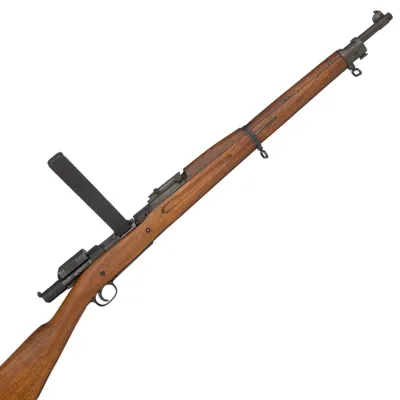

Model 1917 'Enfield' Rifle and Bayonet
Development
The entry of the United States into the war was one of the major contributions to Allied victory. Surprisingly however, more U.S. soldiers in the First World War carried British Enfield rifles than their own M1903 Springfield design. The latter, based on the German Mauser, was powerful, accurate, and robust, but the need to equip up to four million soldiers could not be met from existing stocks. It was for this reason that America turned to a British design; not the Lee-Enfield, but a new design originating from the same factory.
Like the M1903, it too borrowed from the Mauser, and indeed early prototypes were converted M1903s. The final design, adopted as the Pattern 1913, had the best features of both, with the exception of a backwards step to a five round magazine instead of the ten of the SMLE. The outbreak of war in 1914 stopped Britain's efforts to introduce this new .276 calibre high-velocity rifle. The design survived in the form of the Pattern 1914 rifle, in the standard British .303 calibre, manufacture of which was contracted to three American firms; Winchester, Remington, and Eddystone. It was for these reasons of convenience that the U.S. ordered large quantities of the M1917, an American-built, British-designed weapon from those same companies.
Production rates needed for industrial-scale warfare outstripped factory capacity, however, and necessitated that civilian factories build military weapons. Many rifles were built at a train factory, the Baldwin Locomotive Works at Eddystone, Pennsylvania. The British Pattern 1913 bayonet was also copied for use with the U.S. version, differing only in its markings, which included the flaming bomb of the U.S Ordnance Department.
Use and effect
The M1917 fired the same powerful .30-06 cartridge as the M1903 Springfield. Due to the smaller diameter of the .30-06 cartridge, it is actually possible to load the rifle's magazine with an extra round, giving it a slight edge over the Mauser's five, though far short of the Enfield's ten.
With a shared Mauser heritage, this 'U.S. Enfield' compared favourably with the M1903 Springfield. In the words of a U.S. firearms expert of the day, Major General Julian Hatcher;
The rifle that was being produced for the British was of a highly advanced design, making it the best military rifle used during World War I. Though it was basically a typical Mauser, it was improved in several respects, and had a bolt and receiver of high grade nickel steel that gave it a superbly strong action. The well protected peep sight, mounted on the receiver, close to the shooter's eye, with a front sight likewise protected by strong steel ears, gave a sighting combination that was far superior to that on the Springfield, and by a considerable margin the best and most practical of any seen in that war.
Surplus M1917 rifles, along with their .303 Pattern 1914 counterparts, were both in service with the British Home Guard in the Second World War. The American rifles were painted with a red band to prevent the wrong ammunition being chambered (though contrary to myth, it was not possible to blow either rifle up in this way).
Statistics
- Date entered service - 1917
- Action / Operating system - Bolt
- Barrel length - 61 cm (24 in)
- Overall length - 1.176 m (46.3 in)
- Weight - 4.17 kg (9 lb 3 oz)
- Effective range - 800 m (874 yd)
- Feed - Internal magazine
- Capacity (rounds) - 6
- Calibre / Bore - 7.62x63mm (.30-06 Springfield / .308 in)
- Muzzle velocity - 823 m/s (2700 fps)
- Rate of fire (rounds per minute) - about 15
- Country of manufacture - USA
- Manufacturer - Remington, Eddystone
- Manufacturer - Winchester
- Primary operator - USA
Related Objects


Colt Model 1911 Pistol
Development
The story of the Colt Model 1911 (or 'Government Model') must begin with its inventor John Moses Browning (1855-1926). Born in Utah, Browning designed a number of guns for Winchester, however disagreements with the company led Browning to move to Belgium, finding success designing for Fabrique Nationale (FN).
Prior to his departure for Europe, Colt purchased a number of his designs for self-loading pistols in 1896. These early patents were designed for use with a .38 ACP round, the first high velocity, small calibre used by the US army. By 1906, the US military concluded that they required more stopping power from their sidearm. Over the next five years, experiments with human cadavers, live animals, and a military contract version of the Colt Model 1905 (M1905), led to the military adoption of the M1911 in .45 ACP.
The M1911 was essentially an upgraded model of the M1905. Retaining its short recoil operation, modifications included a grip safety device, a feature not typically used in Browning's pistol designs. The design also featured a strengthened magazine to accommodate the increased bullet weight of the round from 200-230 grains. The pistol itself was also strengthened to account for this, most notably by improving the slide stops.
Over 1,000,000 M1911 were manufactured prior to the War. Manufacturers of the pistol included Colt, Savage, Remington and the Springfield Armory. Manufacturing rights were also sold internationally, allowing countries such as Norway and Argentina to produce this pistol.
Use and effect
Officially the sidearm of the US military, British and Canadian officers also made use of the M1911 through private purchase. It proved a popular choice amongst soldiers in the harsh conditions of the trenches, as it rarely misfired. Compared to the precision engineering of the German Luger, the M1911 was more robust and adapted well to the dirt and mud of the Western Front.
The pistol was championed for its 'stopping power' due to the substantial size and weight of the .45 ACP round. This was an advantage in close quarter combat. Over greater distances however, the low velocity of the .45 ACP round resulted in reduced penetrative power compared to the 9mm Parabellum of the Luger.
Redesigned in 1921, the final incarnation of the M1911 was the M1911A1. Changes included an arched grip shape, altered trigger guard, and an easier to use safety guard. In 1985, the M1911A1 was finally replaced by the US armed forces with the Italian Beretta M9 in 9x19mm Parabellum.
Different versions of the M1911 are still used today in different military and law enforcement agencies worldwide. It is also still a popular civilian choice due to a greater perceived stopping power.
Statistics
- Date entered service - 1911
- Action / Operating system - Recoil
- Barrel length - 12.8 cm (5 in)
- Overall length - 21.6 cm (8.5 in)
- Weight - 1.08 kg (2 lb 6 oz)
- Effective range - 40 m (44 yd)
- Feed - Box magazine
- Capacity (rounds) - 7
- Calibre / Bore - 11.43 mm (.45 ACP)
- Muzzle velocity - 251 m/s (825 fps)
- Country of manufacture - USA
- Manufacturer - Colt
- Manufacturer - Remington
- Manufacturer - Savage
- Manufacturer - Springfield Armory
- Primary operator - USA
- Other operators - Argentina
- Other operators - Norway
Related Objects


Winchester Model 97 'Trench Gun' with Model 1917 Bayonet
Development
The Winchester 1897 Model was a redevelopment of John Moses Browning's (1855-1926), 1893 design. Browning, a genius in the development of firearms, made his first gun at the age of 14. After his father's death he inherited the family business and turned it into a gun-making workshop, named Browning Arms Company.
In 1883, the Winchester Repeating Arms Factory became interested in Browning's designs and acquired the rights to Browning's rifle designs. It was the start of a long relationship with Winchester, which was not always smooth. Besides Winchester, Browning also designed arms for Colt, Fabrique Nationale and Remington.
In 1897, Browning designed one of the most famous rifles of the American West for Winchester, the Winchester Model 1897 lever-action repeating rifle. Alongside his rifle designs, Browning also produced a design for a shotgun. Browning then followed these innovations with a pump-action mechanism for his shotguns, the basic model for all shotguns designed during that period. The Winchester 1897 design varies slightly to Browning's 1893 design in that the receiver is stronger, allowing the shotgun cartridge to expel out of the side of the breech.
The 1897 Model was available with different barrel lengths, different calibres of 12 and 16 gauge and as a solid or take-down frame. The more common frame was the take-down versions. The latter more common and allowing the barrel and slide assembly to be removed from the frame, making them easier to pack into a short case. The 16-gauge guns had a standard barrel length of 71 cm (28 in), while 12-gauge guns were furnished with 76 cm (30 in) length barrels. Barrels as long as 91 cm (36 in) could be ordered.
Use and effect
The entry of the U.S.A into the War in 1917 saw many Winchester 1897 'Trench Guns' being issued for service. The 'Trench Gun' differed from the standard shotgun as it had a 51 cm (20 in) barrel and bayonet lug in order for the Model 1917 bayonet to be attached. It also sported a steel hand guard, which wrapped around the barrel to prevent soldiers burning their hands on the hot barrel whilst firing.
When America entered the War, there was a need for more service weapons to be issued to the troops as the brutality of trench warfare and close-quarter combat became clear. In short, the Allies required close-range firepower that came with devastating effects on the human body.
The 'Trench Gun' is the most famous variant of the Winchester Model 97. It is capable of 'slam-firing', a technique where the trigger is held as the gun is pumped, resulting in a devastating rapid spray of 12 gauge buckshot. With its bayonet attachment, a new type of close-quarter combat had hit the trenches. It is said that the German army actually appealed to The Hague to have this weapon outlawed.
As well as close-quarter fighting, it is said that the 'Trench Gun' was also used to deflect enemy grenades. By shooting at them in a clay pigeon style fashion, troops managed to prevent them exploding into their own or Allied trenches. Winchester continued to sell this gun until 1945.
Statistics
- Date entered service - 1917
- Action / Operating system - Pump-action
- Barrel length - 50.8 cm (20 in)
- Overall length - 14.4 cm (5.7 in)
- Weight - 4.25 kg (9lb 6 oz)
- Effective range - 50 m (55 yd)
- Feed - Tube magazine
- Capacity (rounds) - 5
- Calibre / Bore - 12 bore (9 x .32 in balls)
- Muzzle velocity - 366 m/s (1200 fps)
- Country of manufacture - USA
- Manufacturer - Winchester Repeating Arms Company
- Primary operator - USA
Related Objects

Browning Automatic Rifle
Development
The 'BAR' (pronounced Bee-eh-ahr) was conceived as an automatic rifle rather than the light machine gun it later became. It would be used to attack the enemy directly rather than simply support the advance of infantry armed with conventional bolt-action rifles. The intent was to arm lines of soldiers who would advance on the enemy giving 'marching fire'. This is shown by the stout leather belt originally designed for BAR gunners. This had ammunition pouches and a special metal butt-cup at the hip to help support the weight of the gun on its sling.
Inventor John M. Browning 'sold' the weapon to the U.S. military by means of a massed firepower demonstration in front of generals and politicians in Washington, D.C. in February 1917. Though originally ordered in July 1917 from manufacturer Colt, with further contracts awarded to Winchester and Marlin-Rockwell, the weapon was not produced in sufficient numbers for use until late in 1918. Browning arranged for his son Val, a 2nd Lieutenant in the U.S. Army, to receive some of the first batch of guns. Val Browning used the weapon in combat, and became one of the first instructors on the type.
Use and effect
The American .30-06 cartridge used in the BAR was extremely powerful, more so than the NATO 7.62x51 mm cartridge that replaced it. Delivered on full-automatic, the physical and psychological effects were devastating, as both the criminals and law enforcement of post-war America would later discover.
The weapon itself was extremely robust, being made from high-quality machined steel. In actual combat, the marching fire tactic originally envisaged proved to be a failure. Instead, the gun was used as a force multiplier, supporting infantry attacks and maximising firepower in the defence. This was closer to the British use of the Lewis gun as a light machine gun, though the BAR was limited by its low-capacity magazine. Later changes to the weapon moved it closer to this LMG role.
Like other advanced designs, the BAR arrived too late for widespread use and made little direct impact on tactics. BARs were used extensively by the American forces during the Allied Meuse-Argonne offensive that brought the war to an end from September to November 1918. The type became a mainstay during the Second World War, and the A2 form was fitted with a bipod and carrying handle. Some variants incorporated a quick-change barrel, completing the development of the BAR into a true light machine gun. The tilting bolt mechanism and gas operation of the BAR survive to this day in the FN MAG, NATO's main general purpose machine gun.
[The BARs] were highly praised by our officers and men who had to use them. Although these guns received hard usage, being on the front for days at a time in the rain and when the gunners had little opportunity to clean them, they invariably functioned well.
U.S. Assistant Secretary of War, 1919
Statistics
- Date entered service - 1918
- Action / Operating system - Gas
- Barrel length - 610 cm (24 in)
- Overall length - 1.194 m (47 in)
- Weight - 7.25 kg (16 lb)
- Effective range - 550 m (600 yd)
- Feed - Box magazine
- Capacity (rounds) - 20
- Calibre / Bore - 7.62x63mm (.30-06 Springfield)
- Muzzle velocity - 860 m/s (2822 fps)
- Rate of fire (rounds per minute) - 550
- Crew - 2
- Country of manufacture - USA
- Manufacturer - Colt
- Manufacturer - Marlin-Rockwell Corporation
- Manufacturer - Winchester
- Primary operator - USA
Related Objects

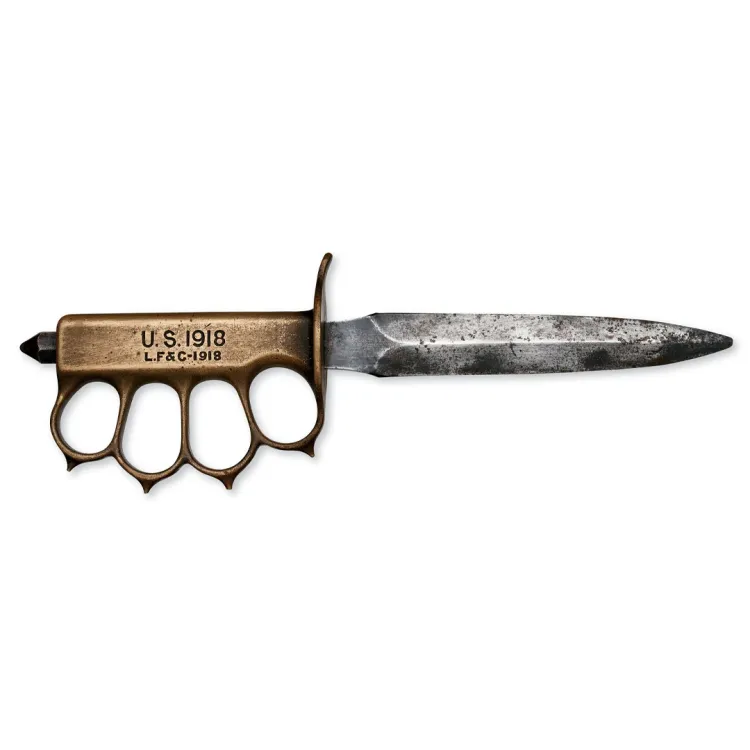
Model of 1917 Trench Knife
Development
As a latecomer to the War, America was able to develop and issue weapons knowing full well the type of conflict its troops would be fighting. As such, they were able to draw upon the experiences of their allies and also take note of the commercially available trench weapons of Britain and France. The result was the Model of 1917 Trench Knife, which was the first knuckleduster knife issued to any army.
Like most of the British knuckleduster knives, the M1917 was also designed by a civilian company, Henry Disston & Sons of Philadelphia. Also like the British Robbins of Dudley, Disston & Sons was not a traditional knife maker, but with the War they turned their attention to military knives. Whereas British troops had to rely on privately purchasing or manufacturing their own trench daggers, however, the M1917 was on general issue to the soldiers of the American Expeditionary Force.
The weapon's long, triangular blade has no edge to speak of and can only be used to thrust with. Unlike most knuckleduster knives, it is intended to be used with the blade uppermost, with the thumb on top and secure against the downturned quillon. In 1918, the knobbed knuckleduster guard was replaced with a double row of teeth, which was more robust as a defence and would cause more damage when punched with. Identical in every other respect to its predecessor, this was designated the Model of 1918.
Use and effect
The long varnished grip of the M1917 and M1918 could be prone to slipping in the hand and the blade was rather brittle, sometimes snapping in use. Its triangular form also meant it could not be used at all for a cutting stroke. These deficiencies led to further trails by the AEF, including experimenting with French and British daggers. The result was the Model of 1918 Mark I Trench Knife.
This weapon, with its more fully formed knuckleduster, borrowed elements from British knuckleduster knives and copied exactly the blade design of the French Modèle 1916 dagger. The result was a blade that could cut and thrust, a guard that could be punched with, was hard to knock out of the hand and could be easily held in the whilst crawling. The addition of a sharp 'skull-cracker' pommel added a forth method of attacking with the new weapon.
Although developed during the War, the Mark I Trench Knife was not ready for production until December 1918. Nevertheless, it had a long service history, only finally being declared obsolete in January 1945. Whilst military knuckleduster knives have largely fallen out of fashion, Argentinian Paratrooper are still issued with a fighting knife of this type - the Yarará Paracaidista.
Statistics
- Date entered service - 1917
- Blade length - 23.5 cm (9.25 in)
- Overall length - 36 cm (14.25 in)
- Weight - 325 g (11.5 oz) (without sheath)
- Country of manufacture - USA
- Manufacturer - Henry Disston & Sons of Philadelphia
- Primary operator - USA
Related Objects

France
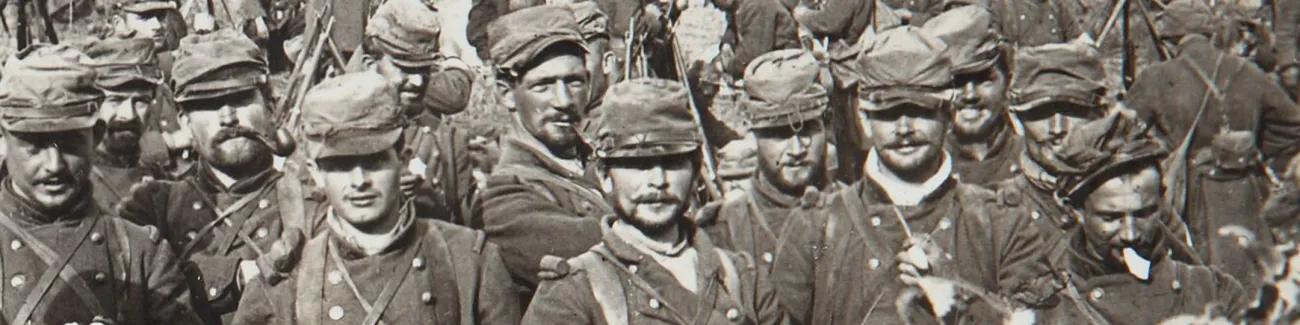

Modèle 1886/93 'Lebel' Rifle and Bayonet
Development
Though relatively low-powered by later standards, the Lebel had been revolutionary in 1886. It used smokeless powder formulated by chemist Paul Vieille which burned hotter, faster and cleaner than 'black' powder. This enabled more powerful, accurate rifles that did not jam from fouling or give away the shooter's position with a cloud of smoke. This French 'Poudre B' was therefore ground-breaking.
The rifle itself is named, or more correctly nicknamed, after the designer of the bullet it originally fired. French Lieutenant Colonel Nicolas Lebel designed one of the first full metal jacket bullets for the new rifle. It had a flat nose to solve the problem of the bullet igniting the primer of the round in front of it. This was an inherent problem with tube magazines, in which cartridges sit end-to-end.
The problem came when the old round-nosed bullet design was being replaced by more aerodynamically efficient pointed bullets, known as 'Spitzer' from the German for 'spire'. This acute point could ignite the primer of the round in front and cause an explosion. Lebel took the compromise approach of squaring off the front of the bullet. Later, a groove was cut around the head of the cartridge case that would safely keep the point of the bullet in place, away from the primer. The 'M93' modification included a change to the bolt head that prevented hot gases from burning the firer's face if a cartridge case were to rupture.
Use and effect
Despite continuing developments in French infantry rifles, the Lebel remained the primary weapon of the Poilu throughout the First World War. The more advanced 'en bloc' clip-fed Berthier series of rifles was restricted to colonial troops until after the War. Even faster than the charger clip system used with the Enfield or Mauser rifles, en bloc clips are held within the weapon until empty, then ejected.
The older Lebel had the theoretical advantage over the Berthier in having a magazine nearly three times the size; the largest of any standard infantry rifle magazine issued at the time. The long tube magazine also kept the rifle slim. However, loading it was time-consuming and required fine motor skills that tired, stressed soldiers in the trenches might lack. It would have been necessary sometimes to resort to loading a single round into the breech, one at a time.
With the Berthier's clip, multiple rounds could be inserted into the magazine in one motion, and in the same amount of time. The Berthier was held back only by the three round capacity of the Modèle 1907. Once an updated version with a five round magazine was introduced in 1918, the Lebel became truly obsolete, but this was too late for the war effort.
Soldiers affectionately renamed the rifle 'La Belle' (the beautiful), and its bayonet 'Rosalie', after a gruesome soldier's song by Théodore Botrel, the 'Bard of the Armies'. The latter, with its length and small cross-section, was a highly effective thrusting weapon, if more prone to breakage than a knife or sword design.
Statistics
- Date entered service - 1886
- Action / Operating system - Bolt
- Barrel length - 80 cm (31.5 in)
- Overall length - 1.3 m (51.2 in)
- Weight - 4.18 kg (9.2 lb)
- Effective range - 550 m (600 yd)
- Feed - Tube magazine
- Capacity (rounds) - 8
- Calibre / Bore - 8x50mmR Lebel (.33 in)
- Muzzle velocity - 2400 m/s (730 fps)
- Rate of fire (rounds per minute) - about 12
- Country of manufacture - France
- Manufacturer - Chatellerault arsenal
- Manufacturer - Saint-Etienne arsenal
- Manufacturer - Tulle arsenal
- Primary operator - France
- Other operators - Belgium
Related Objects

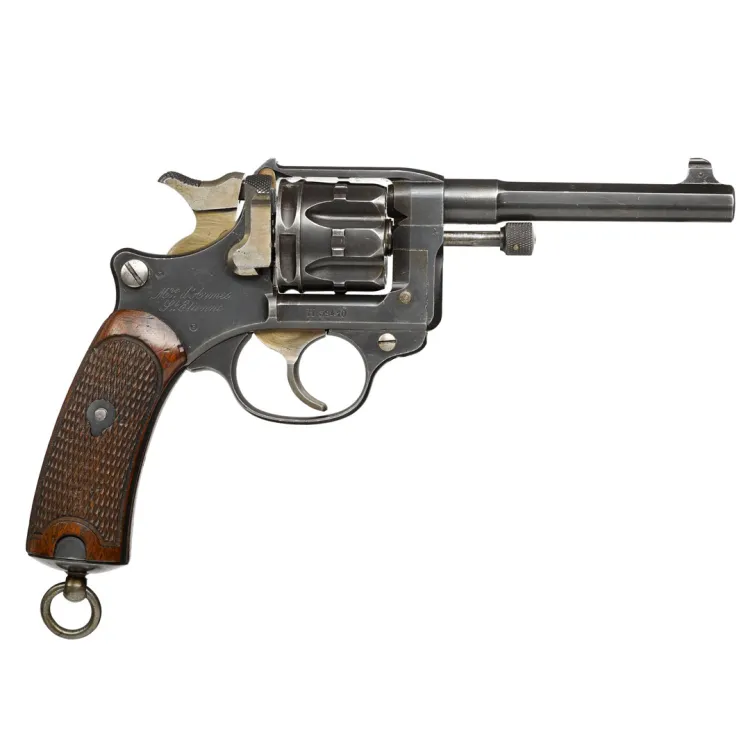
Modèle 1892 Revolver
Development
After undergoing minor refinements from its commercial design, the Modèle 1892 was adopted as Modèle d'Ordonnance 1892 army revolver, replacing the Modèle 1873 Chamelot-Delvigne revolver.
Designed and manufactured from 1892-1927 by Manufacture d'armes de Saint-Étienne, this double-action revolver had a swing out cylinder with a spring operated casing extractor. Fitted with the Abadie system, a lever on the right hand side of the frame released the cylinder for loading. This feature also locked the hammer in place when loading, preventing an accidental discharge.
Chambering the relatively weak 8mm Lebel revolver cartridge, this was one of the first revolvers to have cartridges with jacketed bullets. The low muzzle velocity generated by this weapon meant that in the trenches it had unimpressive man stopping capabilities when compared to the British Webley. In terms of terminal ballistics, it just barely reached the level of the .32 ACP.
Use and effect
Originally designed to serve as a French Army officer's personal sidearm, it was also issued to officers in the Navy and Gendarmerie. Non-commissioned officers continued to carry the older Modèle 1873 service revolver, but some were issued .32 ACP automatic pistols (the 'Spanish' Ruby pistol) during the War.
Its trigger pull when fired in double-action mode was stiff, affecting the accuracy of the shot. On the other hand, as it was made up of only four components, it was ideal for field stripping, even without tools. The Modèle 1892 was later officially replaced by semi-automatic pistols in 1935, but many saw service during the Second World War and were brought to the United States as souvenirs.
Statistics
- Date entered service - 1892
- Action / Operating system - Double action
- Barrel length - 11.7 cm (4.6 in)
- Overall length - 83 cm (33.5 in)
- Weight - 850 g (1 lb 14 oz)
- Effective range - 30 m (34 yd)
- Feed - Cylinder
- Capacity (rounds) - 6
- Calibre / Bore - 8 mm (.315 in)
- Muzzle velocity - 220 m/s (720 fps)
- Country of manufacture - France
- Manufacturer - Manufacture d'Armes de Saint-Etienne (MAS)
- Primary operator - France
Related Objects


Saint Étienne Modèle 1907 Machine Gun
Development
Like the Austrian Schwarzlose machine gun, the designers of the French M1907 took a risk by opting for a unique mechanical design. Whilst the former was simplified however, the M1907 was, if anything, overcomplicated. It employed a gas piston similar to that patented by Hiram Maxim in the 1880s, used on the commercially developed French Hotchkiss designs from 1893, and commonly found on military firearms today. In these, propellant gas is tapped from the barrel and pushes directly back onto a piston mounted alongside the barrel.
This design worked the opposite way around, and so needed an extra mechanism to get the bolt travelling in the right direction. A rack and pinion mechanism, like that used to steer a car, was installed. The reason for this backwards design was simple; just as Hotchkiss had worked around existing patents, the French government did not wish to pay the Hotchkiss company to use their mechanism.
The first attempt at this 'blow forward' gas-operated gun was produced by the state arsenal of Puteaux, and refined by engineers at their counterpart in St. Etienne. The resulting St. Etienne M1907 machine gun was further modified in 1916 to accommodate an adjustable gas regulator to help the gun keep functioning under heavy use, and a belt feed system like that of the Maxim guns. The tripod issued with the gun was designed to be lowered allow firing from the prone position.
Use and effect
The St. Etienne soon gained a reputation for unreliability. Without the water cooling of the Maxim or the massive brass radiator of the Hotchkiss, it overheated. Despite this lack of a water jacket, the gun still weighed considerably more than the British Vickers. The overly complicated piston with rack and pinion design comprised many parts and had to be kept very clean to avoid stoppages.
Parts would have to be replaced in the field as they failed. The design permitted mud and water to access these vulnerable components, in particular the large spring that effectively powered the gun. This was mounted underneath the barrel, near to the ground, and uncovered to help prevent the heat of firing from affecting the tension of the spring or causing it to fracture. Instead, both heat and weather conditions negatively affected the operation of the gun. Managing these issues was difficult at the best of times, but very taxing in the conditions encountered by French soldiers in the trenches of the First World War.
The gun did have reduced recoil due to the opposite action of its mechanism, but recoil was not generally a concern for machine guns mounted on tripods or other static mounts. It also sported a variable rate of fire, from eight to 600 rounds per minute. This was considered a useful feature in colonial warfare where both guns and ammunition was in short supply and ambient heat was high. In the trenches it added needless complication.
Like the Hotchkiss that replaced it, the St. Etienne was fed from a short metal strip rather than a long belt. This was intended to prevent the inevitable overheating that resulted from reliance upon air for cooling the barrel. This did help with the issue of heat, but seriously reduced the effective rate of fire possible. A belt feed and 300 round belt were made available in 1916, but only for defensive roles. This at a time when the increasingly strategic use of machine guns cried out for the sustained fire possible with belt-fed, water cooled guns.
The sights were also upgraded in 1916. Prior to this, the build-up of heat would change the point of impact of the bullet, also a serious flaw in a machine gun. Perhaps unsurprisingly, as sufficient quantities of the M1914 Hotchkiss gun were produced, this much more robust design began to replace the St. Etienne.
Statistics
- Date entered service - 1907
- Action / Operating system - Gas
- Barrel length - 71 cm (28 in)
- Overall length - 118.1 cm (46.5 in)
- Weight - 50 kg (111 lb) (with mount)
- Effective range - 1500 m (1640 yd)
- Maximum range - 2400 m (2625 yd)
- Feed - Strip
- Capacity (rounds) - 25
- Calibre / Bore - 8x50mmR Lebel (.33 in)
- Muzzle velocity - 724 m/s (2376 fps)
- Rate of fire (rounds per minute) - 450
- Crew - 5
- Country of manufacture - France
- Manufacturer - Manufacture d'Armes de Saint-Etienne (MAS)
- Primary operator - France
- Other operators - Greece
- Other operators - Italy
Related Objects


Hotchkiss Modèle 1914 Machine Gun
Development
Most nations participating in the First World War adopted a version of the superb Maxim gun of the 1880s. Some purchased direct from Vickers, Sons & Maxim in Britain. Others, like Germany and Russia, licenced the design and produced their own variant. France did not, instead choosing to avoid Maxim's patents entirely and develop an indigenous design.
Laurence Benét and Henri Mercié of the commercially successful Hotchkiss company produced a series of guns based on patents from Captain Baron Adolph von Odkolek of the Austrian Army. This series, which began with the Modèle 1897, became almost the opposite of the Maxim; gas rather than recoil operated, air rather than water-cooled, and strip-fed rather than belt-fed.
Whilst all of these things made the Maxim the success that it was, Hotchkiss were somewhat successful at using these differences to best advantage. Being gas operated and equipped with an adjustable gas regulator, the gun could be kept working as it became dirty simply by opening up the regulator to allow more propellant gas to drive the gun. Lack of a water jacket meant no water, condenser tube or can to deal with, and eased issues in the French African colonies with water supply. The Modèle 1914 instead featured a distinctive large brass radiator around the breech end of the barrel to create enough surface area to effectively cool the gun.
Finally, rather than Maxim's cloth belt of ammunition, the Hotchkiss used stamped metal strips fed left to right through the gun and replaced when empty.
Use and effect
The simplified M1914 Hotchkiss was reliable and tough, although this toughness made for an excessively heavy gun by comparison with others of its class. It served throughout the First World War, becoming instrumental in holding back the overwhelming German assault upon Verdun in 1916. One infantry section near Hill 304 was able to hold its position for ten days using only two of these guns by employing teams of soldiers and officers to hand-load feed strips from loose cartridges for the Lebel and Berthier infantry rifles. More than 150,000 rounds were fired; 75,000 rounds per gun.
The Belgian army also used the gun, rechambered for their own service calibre. Lacking a heavy machine gun of their own during the War, the American Expeditionary Force also made it their primary machine gun. Some examples were still in use with the French army at the outbreak of the Second World War in 1939.
The weak points of the design, in terms of effective modern use of machine guns, were the strip ammunition feed and air-cooled barrel, both of which limited the gun's usefulness in sustained fire; the ability to put large quantities of bullets where they were needed, for as long as they were needed. Unlike true magazine feed systems like that of the Lewis gun, strip-feeding could not make the gun more portable due to the inherent weight of the basic design. Whereas their British counterparts had to blister their hands by loading almost every Vickers gun belt by hand, French gunners received Hotchkiss strips pre-loaded. From 1915, belt-fed modifications were also made available.
Statistics
- Date entered service - 1914
- Action / Operating system - Gas
- Barrel length - 78.5 cm (31 in)
- Overall length - 1.4 m (55 in)
- Weight - 47.5 kg (105 lb) (with mount)
- Effective range - 1600 m (1750 yd)
- Maximum range - 3800 m (4150 yd)
- Feed - Strip
- Capacity (rounds) - 30
- Calibre / Bore - 8x50mmR (.315 in) or 6.5x55mm (.26 in)
- Muzzle velocity - 724 m/s (2375 fps)
- Rate of fire (rounds per minute) - 550
- Crew - 3
- Country of manufacture - France
- Manufacturer - Hotchkiss
- Primary operator - France
- Other operators - Belgium
- Other operators - USA
Related Objects


Modèle 1833 Naval Boarding Knife
Development
At the outbreak of war, the French military, like most European armies, did not consider the dagger a weapon of war. Colonial troops, notably the Senegalese Tirailleur's, carried their traditional coupe-coupe machete but this, despite subsequent German propaganda, was more intended as a tool than weapon. The close-up nature of trench warfare however, where chance night-time encounters with the enemy could occur, meant silent, easy to use weapons were soon needed that could be used independently of the rifle.
The first type of knife issued to French troops was the traditional Spanish lock-knife, the navajas, and over 150,000 were ordered by the military. Unfortunately, supply could not keep up with demand and the French military even resorted to issuing butcher's knives to troops. Such was the need for trench weapons that the French military reissued arms long thought redundant.
The Modèle 1833 Naval Boarding Knife was itself already a conversion of old technology. Made of ground down, obsolete socket bayonet blades, these were once again given new life in October 1915 when 10,500 Modèle 1833 knives were brought out of storage and issued to units on active service.
Use and effect
Unlike the navajas knife, which with its locking blade could be classed as a utility rather than pure fighting knife, there was no doubt as to the purpose of the Modèle 1833. With its fixed, hollow-ground triangular sectioned blade, it could not hold an edge and was useless as a tool, but the thick, strong blade made an excellent stabbing weapon.
According to Alexandre Renaud in his account of the war, 'Cannon Fodder', carrying trench daggers was not popular with French troops:
These knives were to be entrusted to the four most resolute men in each squad for cleaning up enemy trenches. But nobody volunteered, and it was necessary to issue them compulsorily. Favereau, one of those designated to clean up trenches, gave vent to his rage: "You won't do it, and I won't have this knife for long. I'm not a murderer [if you get taken prisoner] you'll get yourself skewered by the Boches with this tool!"
Statistics
- Date entered service - 1833
- Blade length - 17 cm (6.7 in)
- Overall length - 30.4 cm (11.9 in)
- Weight - 155 g (5.5 oz) (without sheath)
- Country of manufacture - France
- Manufacturer - Manufacture d'armes de Châtellerault
- Primary operator - France
Related Objects


Modèle 1913 Lance
Development
The French army had fielded lancers since 1809, and Napoleon expanded this section of his cavalry before the invasion of Russia with the conversion of four regiments of dragoons to lancers. By 1914, all 26 regiments of French Dragoons carried the lance, along with six of the 14 regiments of hussars and five of the 21 Chasseurs à Cheval regiments.
Since the mid-19th century, the preferred material for lance hafts had been male bamboo, as it combined strength with flexibility. Due to difficulties in acquiring it in sufficient numbers, however, France chose to manufacture lances entirely of burnished steel as the Germans did. By 1914 this new lance was issued to all but six Dragoon regiments, who retained their Modèle 1890 bamboo hafted lances.
Use and effect
The M1913 retained the M1890 blade type. Both had a hollow-ground triangular blade with rondel stop below it to prevent over penetration of the target. This stop also provided an attachment point for a pennant. A metal ring was added to enabled a leather sling to be attached so the weapon couldn't be accidentally dropped, which in earlier models was wrapped around the bamboo, serving as a grip. The grip on the M1913 was instead provided by a leather sleeve that fitted over the central section.
Shorter and more manoeuvrable than the German lance, the M1913 with its acutely pointed blade was better suited to thrusting with, although it lacked the blade strength for the couched use of the Stahlrohrlanze. Von Poseck records the majority of German casualties suffered in cavalry to cavalry combat with the French being caused by lance thrusts. Among them was Prince Henry of Bavaria, who was wounded by the lance of a French Dragoon at Gondrexon on 13 August 1914.
Statistics
- Date entered service - 1913
- Blade length - 12.4 cm (4.8 in)
- Overall length - 2.98 m (9 ft 9.25 in)
- Weight - 2.17 kg (4 lb 12.5 oz)
- Country of manufacture - France
- Manufacturer - Manufacture d'armes de Châtellerault
- Primary operator - France
Related Objects


Modèle 1916 Trench Dagger
Development
From 1915, the French begun to develop trench weapons at the Châtellerault arms factory, with Lieutenant-Colonel Coutrot experimenting by converting existing military swords and bayonets into combat daggers. Several designs were decided upon and then sent to be manufactured by private firms.
Despite such variety of knives being issued to French troops during the War, there was only one, the Modèle 1916, that received an official military designation. Given this fact, it is strange that the dagger was in fact devised by the cutlery manufacturer Astier-Prodon of Thiers, rather than Châtellerault. It was subsequently produced by a number of other civilian manufacturers to keep up with demand.
Early models lack the metal reinforcing ferrule, to strengthen the connection of blade to hilt. All versions have a strong, doubled-edged blade of diamond-shaped cross-section. Some of the Modèle 1916 daggers are marked 'Le Vengeur de 1870' on the blade, referencing the fall of Paris and French defeat in the Franco-Prussian war.
Use and effect
In addition to being issued to infantry, the Modèle 1916 proved popular with members of the 'Special Artillery', the first tank crews of the French military. After testing a series of allied trench weapons, the American's settled on copying the Modèle 1916's blade for their new trench dagger.
The Model of 1918 Mark I Trench Knife was produced too late for use in the War, however it was in service with the US military from December 1918 until 1945.
Statistics
- Date entered service - 1916
- Blade length - 16.9 cm (6.65 in)
- Overall length - 28.2 cm (11.1 in)
- Weight - 200 g (7.05 oz) (without sheath)
- Country of manufacture - France
- Manufacturer - Astier-Prodon of Thiers
- Primary operator - France
Related Objects


Trench Club with Cast Iron Head
Development
Clubs are amongst the earliest weapons used by man, but trench warfare saw the return of these most basic types of weapons, long thought obsolete. This type, the Trench Mace, bears a striking resemblance to the 'goedendag' club, Flemish for 'good day', used by the victorious Flemish at the Battle of Courtrai in 1302.
The 14th century goedendag was a two-handed weapon which was used to fearsome effect by the Flemish militias against the invading French and their armoured knights. Other trench clubs, mainly German and Austrian, seem to be modelled on other know medieval types, notable the spiked 'morgenstern' (morning star).
Use and effect
Over 600 years later, a smaller version of the 'goedendag' was again being used on the battlefields of Flanders in actions of medieval ferocity. The author Robert Graves, when a Captain of the Royal Welsh Fusiliers, noted before a raid that:
...some of the officers were going to carry clubs with spikes on, which were very handy weapons at close quarters in a trench.
Statistics
- Date entered service - 1914
- Overall length - 47.6 cm (18.74 in)
- Weight - 635 g (1 lb 6.4 oz)
- Country of manufacture - Probably France
- Manufacturer - Unknown
- Primary operator - France
- Other operators - Britain
Related Objects

Belgium
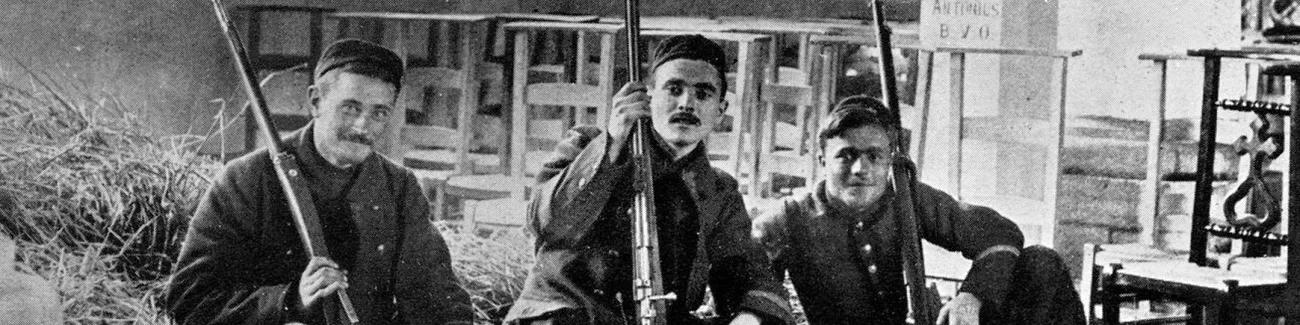

Mauser Model 1889 Rifle
Development
German brothers Wilhelm and Peter Paul Mauser produced their first bolt-action rifle in 1871, and were restless in their efforts to improve upon it. Even when their own government failed to recognise the potential of their labours, other nations paid close attention.
The Model 1889 was produced after Wilhelm's death, in response to a requirement by the Belgian government for a modern infantry rifle. Like Britain, Belgium had adopted a lever-actuated single-shot rifle just before the bolt-action came into its own. The same year Belgium adopted its M1870 'Comblain' rifle, it found itself with ringside seats to the clash between neighbours Prussia and France.
Both sides were equipped with bolt-action rifles. These early weapons lacked a magazine and were actually slower to operate than lever-actuated equivalents. With the introduction of bolt-action magazine rifles like the French Lebel in 1886, single-shot designs like the Comblain were rendered obsolete overnight. Trials were held in 1888 to determine a replacement, and with specified modifications, the Mauser offering was adopted the following year.
The rifle was built by the Belgian state arsenal (Manufacture D'Armes de L'Etat), but to increase the rate of production, a private company was formed specifically to manufacture the new rifle. This was Fabrique Nationale Armes de Guerre, who built their new factory in Herstal near Liège. German company Loewe & Co. had a 50% stake in this new company.
Use and effect
The Belgian Mauser was a truly modern design in 1889, though it did include a thin metal reinforcing shroud around the barrel that proved to be unnecessary and invited corrosion from trapped moisture. Otherwise, the Belgian Mauser, with its one-piece bolt design, became the first of a series of designs that made the Mauser a world standard rifle, adopted by over 20 nations.
In July 1914 Belgium was invaded by Germany, the country that had supplied its service rifle. The Germans carried the Mauser 1898, itself an improvement upon the Belgian 1889 version. Belgium had not made the changeover to the higher velocity pointed bullet, and its rifle was therefore less powerful and less accurate. If their rifles gave them a slight edge, Germany's army was much better equipped in terms of machine guns and other weapons, and far larger in size.
Though Belgian troops significantly delayed the German advance and were able to hold part of the Western Front until the end of the war, most of the country would remain under German occupation until 1918. Though the Belgian Mauser continued to be produced outside the country by the W.W. Greener company in Britain and by Hopkins & Allen in the United States.
Perhaps the most important legacy of the rifle is as the first product to be manufactured by Fabrique Nationale d'Herstal or FN Herstal, who today are Europe's largest exporters of firearms. The M1889 rifle itself continued to be built until 1925, and was finally upgraded to accept modern ammunition in 1936. The old rifles served until replaced from 1949 onwards by another FN rifle, the self-loading FN-49.
Statistics
- Date entered service - 1889
- Action / Operating system - Bolt
- Barrel length - 78 cm (30.7 in)
- Overall length - 1.27 m (50 in)
- Weight - 3.68 kg (8.1 lb)
- Effective range - 500 m (547 yd)
- Feed - Internal magazine
- Capacity (rounds) - 5
- Calibre / Bore - 7.65x53mm (.30 in)
- Muzzle velocity - 640 m/s (2100 fps)
- Rate of fire (rounds per minute) - about 15
- Country of manufacture - Belgium
- Manufacturer - Fabrique Nationale (FN)
- Manufacturer - Mauser
- Primary operator - Belgium
- Other operators - Germany (captured)
- Other operators - Ottoman Empire
Related Objects


Browning Modèle 1900 Pistol
Development
Although less well known than other iconic self-loading pistols such as the Colt 1911 and Browning Hi-Power, the Modèle 1900 was an important milestone in firearms history. Designed by one of the most prolific and influential firearms designer in history, John Moses Browning (1855-1926), the first prototype of this model was produced in 1896, three years after the ground-breaking German Borchardt pistol. In that same year Hart O. Berg, the manager of the Belgian firearms manufacturer Fabrique Nationale (FN) saw both the potential and genius of Browning's design. Berg invested in some of Browning's patents, and persuaded him to join his company.
Browning lived through a period of great innovation in firearms technology. Born at a time when modern self-contained ammunition did not exist, he witnessed many of his designs being used during the First World War.
Production began in 1899 as the Modèle 1899. By 1900, the pistol was modified slightly, reducing the barrel length from 122 mm (4.8 in) to 102 mm (4 in). It was then adopted as the Modèle 1900. Unlike Browning's more iconic designs in .45 ACP and 9 mm, the Modèle 1900 chambers the relatively weak .32 ACP (7.65x17 mm Browning SR) cartridge, allowing it to employ the mechanically simple and reliable blowback mechanism. FN eventually produced over 700,000 for sale to civilian, military, and police customers.
Use and effect
The pistol was adopted as a standard service pistol by the Belgian military at a time when low-powered revolvers were the norm. Many countries did not adopt this pistol due to the size and weakness of its cartridge. Combat experience around this time and during the First World War showed that a more powerful cartridge was needed to reliably penetrate heavy clothing and reach vital organs.
Browning continued to refine his pistol designs, developing the Modèle 1903 in 9x20mmSR Browning Long, and the .380 ACP version of the Modèle 1910. This led to development of Browning's classic design, the Colt Government Model or Model of 1911. Eugen Schauman used the Modèle 1900 in 1904 to assassinate Nikolai Ivanovich Bobrikov, the Russian Governor-General of Finland.
Statistics
- Date entered service - 1900
- Action / Operating system - Recoil
- Barrel length - 10.2 cm (4.01 in)
- Overall length - 17.2 cm (6.8 in)
- Weight - 625 g ( 1 lb 4 oz)
- Effective range - 20 m (21 yd)
- Feed - Box magazine
- Capacity (rounds) - 7
- Calibre / Bore - 7.62x17mmSR (.32 ACP)
- Muzzle velocity - 282 m/s (925 ft/s)
- Country of manufacture - Belgium
- Manufacturer - Fabrique Nationale (FN)
- Primary operator - Belgium
Related Objects

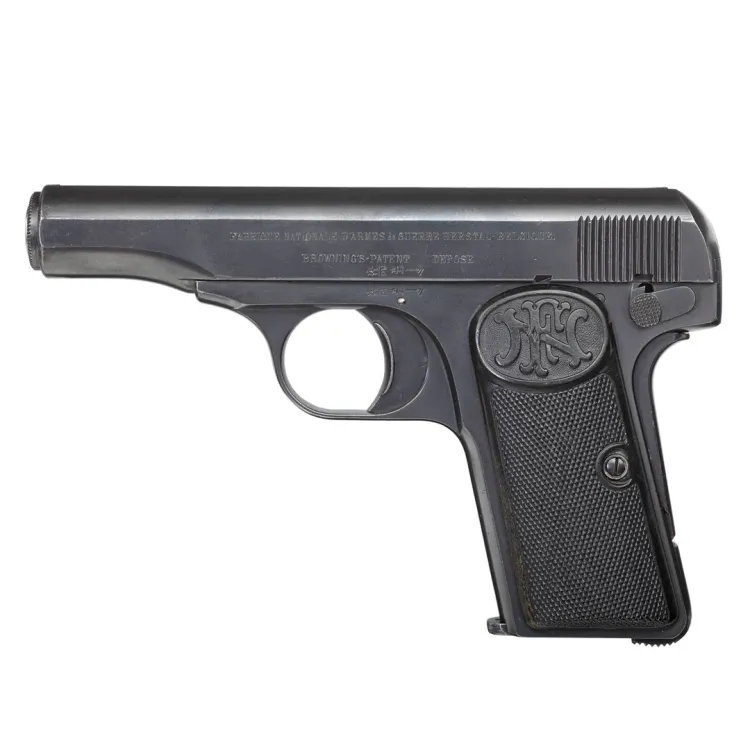
Browning Modèle 1910 Pistol
Development
Developed by John Moses Browning (1855-1926), the Modèle 1910 was manufactured by Fabrique Nationale (FN). Whilst Browning's military arms were produced by the Colt Arms Company, Hartford, U.S.A, his pistols and sporting guns were produced by FN.
There were two versions of the Modèle 1910; one developed for the .32 ACP (7.65x17 mm) cartridge, and one type for the slightly larger .380 ACP (9x17 mm Browning Short) cartridge. The .32 ACP type held seven rounds and the .380 ACP six rounds. A few models were designed with interchangeable barrels to accommodate both calibres. This pistol employs the simple blowback mechanism, a popular feature of Browning's early self-loading pistols. Weapons which use this system require cartridges with low velocities and pressures.
Unlike its predecessors the Modèle 1900, Modèle 1903, and most other pistol designs of the time, its recoil spring is coiled around the barrel. This configuration is found on later pistol designs, such as the Walther PPK. This pistol featured three safety mechanisms. The first was a magazine safety that prevented firing when the magazine was removed. Secondly, a grip safety was fitted allowing the weapon to discharge only when grasped by the hand. Finally, a frame mounted safety catch was incorporated.
Use and effect
The pistol was never issued as a standard service weapon, but did see use in the Belgian military through private purchase. In 1922, Browning modified the pistol for the Yugoslavian military. The barrel was lengthened and the grip enlarged, increasing magazine capacity by two rounds. This became known as the Modèle 1922 (or Modèle 1910/22). Both models were manufactured until the early 1980s being replaced by FN model 140DA/Browning BDA380 pistols.
The Modèle 1910 will forever be associated with the outbreak of the First World War. On 28 June 1914, Gavrilo Princip, a member of the Serbian nationalist group 'The Black Hand', used his Modèle 1910 in .380 ACP to assassinate Archduke Franz Ferdinand and his wife Sophie Duchess of Hohenberg. A failed assassination attempt by the group that same morning had injured one of the Archduke's aides. Later that day, as the Archduke's motorcade was en-route to the hospital, a one off chance presented itself to Princip.
Taking advantage of the royal couple's wrong turn down a side street, Princip pulled out the easily concealed Modèle 1910, and shot the couple from a distance of about two metres. The first shot hit the Archduke in the neck, severing his internal jugular vein, mortally wounding him. The Duchess received a fatal wound to the abdomen from a bullet that penetrated the side of the vehicle. Ironically, a pistol that was not as powerful and accurate as some of its foreign equivalents helped to unleash a new type of warfare.
Statistics
- Date entered service - 1912
- Action / Operating system - Recoil
- Barrel length - 9 cm (3.5 in)
- Overall length - 15.2 cm (6 in)
- Weight - 590 g (1 lb 5 oz)
- Effective range - 25 m (27 yd)
- Feed - Box magazine
- Capacity (rounds) - 6
- Calibre / Bore - 9.65 mm (.380 ACP)
- Muzzle velocity - 300 m/s (1000 fps)
- Country of manufacture - Belgium
- Manufacturer - Fabrique Nationale (FN)
- Primary operator - Belgium
Related Objects


CSRG Modèle 1915 'Chauchat' Machine Rifle
Development
Dubbed a machine rifle, but in practical use one of the earliest light machine guns, the Chauchat was the only machine gun ever to use the 'long recoil' system of operation. Unlike the short recoil of more successful designs like the Maxim gun, this requires that the barrel recoils the full length of the cartridge. This makes for a very long and heavy weapon with some severe recoil. Without a tripod mount, the firer acts as part of the recoil system; if he moves too much, the mechanism will not function properly, and the gun stops.
The Chauchat was pioneering in terms of industrial design. Unlike its contemporaries in blued machined steel and walnut, the Chauchat was made from stamped steel and lathe-turned parts. Like the later British Sten submachine gun, the idea was to allow large quantities of guns to be made quickly and cheaply in factories not set up for traditional firearms manufacture. Around 250,000 were made thanks to this approach.
However, the compromises made in the design process resulted in some issues that limited the effectiveness of the weapon in the field.
Use and effect
The 'Chauchat' has a reputation as the worst machine gun ever fielded, one not entirely deserved. Manageable problems with reliability were compounded by conversion for US service to .30-06 calibre as the Model of 1918 machine rifle. The weapon was also prone to jamming due to the expansion of parts as they heated up, and would not fire until sufficiently cooled. It does have the distinction of being the first light machine gun to feature a magazine feed, useful given the more dynamic nature of that role. However, the original curved magazine was dangerously open to the elements for trench use.
The Chauchat also had a very low rate of fire, less than half that of the definitive LMG of the era, the Lewis gun. Coupled with low capacity, this seriously limited its effectiveness as a machine gun, as it could not sustain a suitable effective rate of fire. This would in theory at least make it controllable for the shooter, were it not for the brutal recoil and unreliability caused by its mechanism. This necessitated a special firing technique not only to keep the gun working reliably, but to prevent bruising. Finally, the gun's short barrel compromised the effective range of the already lower-velocity Lebel cartridge.
Though an essential stop-gap weapon for the Allies, it is perhaps noteworthy that nothing of the Chauchat design carried over into later weapon designs, save for the more successful inter-war Belgian derivative, the M1915/27.
Statistics
- Date entered service - 1915
- Action / Operating system - Long recoil
- Barrel length - 45 cm (17.7 in)
- Overall length - 1.17 m (46 in)
- Weight - 9.5 kg (21 lb)
- Effective range - 366 m (400 yd)
- Feed - Box magazine
- Capacity (rounds) - 20
- Calibre / Bore - 7.65x54mm (Belgian)
- Calibre / Bore - 8x50mmR (.30-06) (USA)
- Muzzle velocity - 700 m/s (2300 fps)
- Rate of fire (rounds per minute) - 240
- Crew - 2
- Country of manufacture - France
- Manufacturer - Gladiator Sidarme
- Primary operator - Belgium
- Other operators - France
- Other operators - USA
Related Objects

Russia
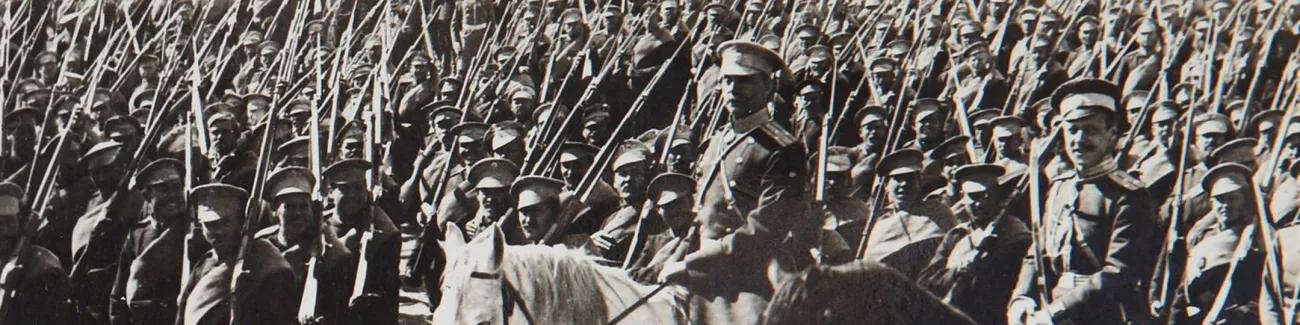

Moisin Model 1891 Rifle and Bayonet
Development
Often known as the 'Mosin-Nagant', this rifle was actually known in Russia as 'Vintovka Mosina' (Mosin Rifle), or 'Trechlineynaja vintovka' (three-line rifle) after its .30 calibre bore. The involvement of Belgian firearms designer Leon Nagant is unclear, but the bulk of the final design is credited to Captain Sergei Ivanovich Mosin. Typically for nineteenth century rifles, different versions were produced for infantry, mounted infantry, and the Russian Cossack cavalry.
Like the French, Russia chose to remain with a socket bayonet with a long spike blade. At that time, most nations had moved toward sword and knife bayonets. Other bayonets were designed to double as tools, but the sole intended function of the socket bayonet is to kill the enemy. This reflects the continued faith placed in the bayonet by Russian, French, and other commanders.
The rifle was produced at the Russian arsenals of Tula and Izhesvk where firearms manufacture continues to this day. Mosin took into account the lack of industrial development in Russian at the time, and came up with a rifle that would be easy and cheap to produce. This was a definite advantage in producing the millions of rifles needed for Russia's war with Japan in 1902, which along with Britain's war in South Africa provided a glimpse of what modern industrial war might be like. When global war broke out in 1914 however, there were still insufficient rifles to equip the enlarged Russian army and contracts were let to American companies to build more.
Developmental changes to Mosin's design were minimal. An upper handguard was added in 1894 to protect the shooter's support hand from a hot barrel, and the original round-nosed bullet was replaced by higher velocity pointed bullets from 1908. More changes occurred after the First World War but these too were minor.
Use and effect
The Mosin was less accurate and certainly less user-friendly than other infantry rifles of the First World War period. Like the French Lebel, the straight and stiff bolt of the Mosin was difficult to manipulate, as was the safety catch. Despite these drawbacks, the rifle was still very powerful and extremely reliable. Higher quality rifles specially selected for accuracy served Russian snipers well into the Second World War and beyond. Over fifty million Mosins are still in existence, and have been encountered recently in the hands of the Taliban. The cartridge designed for the rifle in 1891 is still in use worldwide in SVD rifles and PKM machine guns.
The Mosin is known for its service on the Eastern Front of the First World War. The rifle pictured here was captured during the little-known 'North Russia Intervention' of 1918. Beginning in the final months of the First World War, this was an Anglo-American led attempt to remove the Bolshevik ('Red') Russian government installed following Lenin's 1917 revolution. Weapons, ammunition, supplies, and thousands of troops were provided but the failure of America and Britain to support the 'White' Russians led directly to the rise of communism, Stalin, and ultimately to the Cold War.
Both 'White' and 'Red' Russian troops were armed with the Mosin, many of which had been produced in the United States for Russia by the Remington and Westinghouse companies. The American portion of the allied contingent in North Russia also carried these weapons, drawn from the remainder of the now-cancelled Russian contract. An unusual move, this was intended to ease supply problems by making use of local ammunition supplies.
This rifle was captured from the 'Red' Russians holding the fortified island of Mudjug in Archangelsk. The allied attack on Mudjug was perhaps the first combined arms amphibious assault in history, and shows the extent to which military tactics had changed during the First World War.
Statistics
- Date entered service - 1891
- Action / Operating system - Bolt
- Barrel length - 80 cm (3.5 in)
- Overall length - 1.306 m (51.4 in)
- Weight - 4.22 kg (9 lb 5 oz)
- Effective range - 500 m (550 yd)
- Feed - Internal magazine
- Capacity (rounds) - 5
- Calibre / Bore - 7.62x54mmR (.30 in)
- Muzzle velocity - 865 m/s (2838 fps)
- Rate of fire (rounds per minute) - about 15
- Country of manufacture - Russia
- Manufacturer - Chatellerault arsenal (France)
- Manufacturer - Izhevsk arsenal
- Manufacturer - New England Westinghouse (USA)
- Manufacturer - Remington (USA)
- Manufacturer - Sestroryetsk arsenal
- Manufacturer - Tula arsenal
- Primary operator - Russia
- Other operators - Austria-Hungary
- Other operators - USA
Related Objects


Nagant Model 1895 Revolver
Development
This solid frame seven shot revolver was designed by Léon (1833-1900) and Émile (1830-1902) Nagant, of the firearms company Fabrique d'Armes Émile et Léon Nagant. Having developed revolvers for the Belgian military since the 1870s, the two were experienced in the field of firearms design. From 1892-95 Léon patented the first gas-sealed revolver, the only one of its type to triumph on the commercial market.
The first 20,000 Nagant Model 1895 revolvers were manufactured in Liège, however having worked with the Russians on the Mosin Nagant Model 1891, the two brothers had a close connection with the Russian military, which undoubtedly led to the official adoption of this revolver as its sidearm. Mass manufacture of the revolver began at the Tula Arms Factory around 1898, and was available in both single and double action versions.
Nagant's unusual design meant that when cocked, the cylinder moved towards the barrel, creating a gas seal. Due to the designs requirements, this revolver chambered an unusual, long-cased round with a tapered mouth fully enclosing the bullet, known as the 7.62x38mm Nagant. As this movement occurs, the round partially relocates itself into the back of the revolver barrel, enhancing the gas seal system. Theoretically this process increases the accuracy and velocity of the bullet by maximising the gas pressures from inside the cylinder, which are traditionally lost when a standard revolver is fired.
Use and effect
This revolver saw use in Sweden, Poland, Greece, and possibly Romania, however details of its issue are lacking. Its main user was Russia, particularly throughout the First World War. The single action version was issued to enlisted men, allowing them a more accurate shot but a lower rate of fire as the hammer would have to be cocked for every shot. The double-action version (which was noted to be heavy) was reserved and only issued to officers, providing a more rapid rate of fire if desired.
The seven rounds were loaded into this revolver individually and were extracted by use of an ejector rod, which passed through the axis of the cylinder. This limited the rate of fire of the revolver. The subject of the Nagant's ability to increase accuracy and velocity is a debate that continues. There is no doubt that the gas seal does what it is intended to do, however the amount of extra energy created is not considered considerable enough to justify the mechanical complication involved in creating this weapon. The gas seal system on the Nagant means that it is one of the few revolvers to which a suppressor can be fitted. The absence of the gap between cylinder and barrel results in the loud report, which is usually heard from a revolver, going unnoticed, and the sound usually heard from the muzzle is silenced by the suppressor.
These were used by Russian reconnaissance and scout troops during the Second World War. Although declared obsolete in 1930, manufacture carried on throughout the Second World War to around 1950. The total number produced is said to be around 2,000,000. Remarkably, they are still in use today being carried by armed guards. The high-risk 'game' of Russian Roulette was invented by officers during the Russian Revolution. It was played using the Nagant revolver.
Statistics
- Date entered service - 1895
- Action / Operating system - Double-action
- Barrel length - 11.4 cm (4.3 in)
- Overall length - 23 cm (9.1 in)
- Weight - 750 g (1 lb 10 oz)
- Effective range - 35 m (34 yd)
- Feed - Cylinder
- Capacity (rounds) - 7
- Calibre / Bore - 7.62x38mmR (.30 in)
- Muzzle velocity - 327 m/s (1070 fps)
- Country of manufacture - Belgium
- Manufacturer - Tula Arsenal
- Primary operator - Russia
- Other operators - Belgium
- Other operators - Poland
- Other operators - Sweden
- Other operators - possibly Greece
- Other operators - possibly Romania
Related Objects


Maxim Pulemyot Maxima 1910 Machine Gun
Development
The 1904-5 Russo-Japanese War came as a wakeup call for many in Europe in terms of the realities of modern warfare and the potential of the machine gun. Russia was pleased with the performance of its commercially purchased British and German Maxim machine guns, and so commissioned the state arsenal at Tula to produce the PM 1905.
A copy of Maxim's 1887-vintage World Standard gun with its blued steel receiver and brass water jacket, it was mounted on either a wheeled artillery-style carriage or a static tripod. This was followed in 1910 by the definitive Russian Maxim, the PM 1910.
Painted in green, it was little changed, with one major distinguishing feature; a unique wheeled sledge mount invented by army Colonel A. A. Sokolov. This included a large armoured shield that slotted over the gun's jacketed barrel and protected the gunner from incoming small arms fire and artillery fragmentation. It had a view-port to allow use of the front sight. Hiram Maxim's original designs had provided for similar armour plates to be fitted, but only Russia adopted one of this size. Armour for guns was useful in the defence of fixed positions. However, as machine guns saw greater offensive use, gunners found themselves magnets for enemy fire that might come in from above. As the big shield was another 11 kg to carry, and might actually make them more visible to the enemy, gunners often removed it.
Second World War Soviet examples were fitted with a snow cap on the water jacket, an idea borrowed from their Finnish enemy that allowed the use of snow and ice in environments where liquid water was scarce. Water jackets were also reduced in weight by corrugation, as per the early British Vickers gun.
Use and effect
Like all Maxim guns, the PM 1910 was a success. The powerful 7.62x54mmR round lent itself especially well to use in weapons that had to fire at long ranges and maintain lethality. In a gun that operated on the recoil of the cartridge, it was a case of the more, the better. The rimmed design of the cartridge also functioned well in Maxim type guns. The Maxim lock and belt feed design involved pulling rounds backwards out of the belt prior to pushing them forwards again into the chamber, so a pronounced rim, usually a cause of jams in automatic weapons, was a useful feature.
The gun's wheeled mount, whilst heavy, was much more mobile than the tripod or four-legged sledge of its rivals. Given solid enough ground, one man could move the gun into a new position by grabbing the rear trail and pulling the gun along like a trolley. The PM 1910, complete with armour shield and sledge mount, has even appeared in the 2014 unrest in eastern Ukraine in the hands of pro-Russian separatists and, more recently, in the 2022 invasion of Ukraine. Though it is unknown whether these examples have actually seen use, they were superficially complete and in good condition, and ammunition is readily available in the region as it is shared with the more modern PKM machine gun and SVD sniper rifle.
Statistics
- Date entered service - 1910
- Action / Operating system - Recoil
- Barrel length - 72 cm (28.3 in)
- Overall length - 1.07 m (42.1 in)
- Weight - 67.5 kg (149 lb) (with mount, shield, and water)
- Effective range - 1500 m (1640 yd)
- Maximum range - 3500 m (3828 yd)
- Feed - Belt
- Capacity (rounds) - 250
- Calibre / Bore - 7.62x54mmR (.312 in)
- Muzzle velocity - 869 m/s (2850 fps)
- Rate of fire (rounds per minute) - 600
- Crew - 3
- Country of manufacture - Russia
- Manufacturer - Izhevsk
- Manufacturer - Tula
- Primary operator - Russia
- Other operators - Austria-Hungary
Related Objects


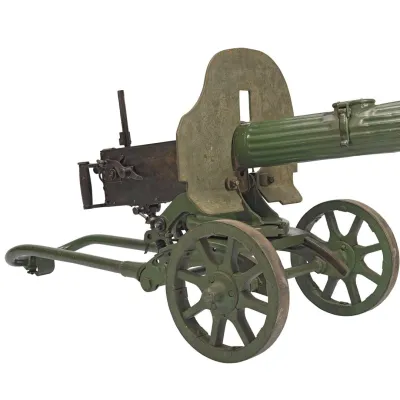

Fedorov Avtomat Rifle Model 1916
Development
The concept behind this revolutionary weapon would become known as the 'assault rifle', and defined the modern infantry rifle. Captain Vladimir Fedorov of the Russian army was among the first to recognise that most infantry combat takes place at less than 300 metres. There was therefore no need for most soldiers to be able to hit targets at 1000 metres, particularly with machine guns coming to the fore.
A less powerful cartridge would also be lighter and smaller, allowing more rounds to be carried, and would have lower recoil. The result would be lighter, more compact, automatic infantry weapons. Pistol cartridges, as used in submachine guns like the German MP 18,1 were too weak for use beyond 100m. Federov therefore designed a new 'intermediate' power cartridge with these properties in mind. The new round contained a lighter, slower bullet than the then-standard 7.62x54mmR Russian cartridge (still in widespread use today).
By the time the rifle was in production however, the First World War had broken out and Russian authorities opted instead for 6.5mm Arisaka, a full-power cartridge already available in quantity from Russia's then ally, Britain, who had supplemented their rifle stocks with 150,000 Japanese Arisaka rifles after the outbreak of war in 1914.
Use and effect
Like most advanced designs around the time of the First World War, the Fedorov saw little use, despite field trials and an order being placed for 25,000 rifles in 1916. Not enough rifles could be manufactured. Some Fedorov rifles were later taken out of storage to aid in the defence against the German invasion on the border with Finland in 1941.
The change to 6.5 mm Arisaka also compromised Fedorov's original vision. Despite this, the Fedorov was still less than half the weight of the Lewis gun or Browning BAR. It and its designer also directly inspired Mikhail Kalashnikov's famous AK-47, the definitive assault rifle, and changed the meaning of the Russian term 'avtomat'. Mikhail Kalashnikov read Fedorov's treatise on automatic weapons in 1942 whilst recuperating from war wounds and before borrowing elements from more modern designs like the German Sturmgewehr. Today, every military force in the world uses assault rifles.
Statistics
- Date entered service - 1916
- Action / Operating system - Recoil
- Barrel length - 52 cm (20 in)
- Overall length - 1.045 m (41 in)
- Weight - 4.4 kg (9.7 lb)
- Effective range - 300 m (328 yd)
- Feed - Box magazine
- Capacity (rounds) - 25
- Calibre / Bore - 6.5mm Federov
- Calibre / Bore - 6.5x50mm SR Arisaka (.26 in)
- Muzzle velocity - 654 m/s (2145 fps)
- Rate of fire (rounds per minute) - 600
- Country of manufacture - Russia
- Manufacturer - Kovrov Arms Factory
- Primary operator - Russia
Related Objects


1881 Pattern Dragoon Shashka Sword
Development
By 1881 there was a total of six sword patterns worn by the various regiments of Russian cavalry and a total of 13 different types across the whole military. At a time when the use of swords as a primary combat weapon was in sharp decline, such variety was unnecessary. As such, a commission under General Gorlov was set up to come up with a standard sword pattern that could be used by the whole cavalry.
The result was that the hilt of the Pattern 1841 Dragoon Shashka and the Caucasian type blade. This was a thick, single edged, spear pointed blade with one broad fuller. The 1881 Cossack version retained their distinctive Caucasian type hilt, although from 1909 Cossacks were allowed to forgo altogether regulation swords and 'to serve carrying the weapons which have been handed down to them by their fathers and forefathers, provided such weapons are in a serviceable condition.'
The Dragoon, Cossack and Officers Pattern of shashka formed the combat 'system of 1881', which was worn hanging from a narrow belt over the right shoulder, whereas most cavalry swords of the period were attached to the saddle. The sword was worn with the edge facing backward, in the Caucasian style. The Dragoon scabbard also contained a fitting to hold a bayonet.
In addition to the Pattern 1881 Shaska, from 1913 until the 1930s all the front ranks of Russian cavalry units carried the Pattern 1910 lance. This was a crudely made weapon of all steel construction with a short, hollow-ground, cruciform point.
Use and effect
Because of their small horses, the Russian cavalry were generally unsuited to shock action with the sword or lance. As such, they tended to operate more as mounted infantry, with bayonets fixed to their scabbard for dismounted action. However, there were exceptions and the Russians were involved in the only full scale cavalry battle of the War, and the last of history, at Jaroslavice, on 21 August 1914. The Austro-Hungarian 4th Cavalry Division was pitched against the Russian 10th Cavalry Division in an indecisive clash, as part of a failed reconnaissance in force by the Austrians.
Statistics
- Date entered service - 1881
- Blade length - 86 cm (33.8 in)
- Overall length - .01 m (39.7 in)
- Weight - 924 g (2 lb 0.6 oz)
- Country of manufacture - Russia
- Manufacturer - Unknown Russian state arsenal
- Primary operator - Russia
Related Objects


Italy
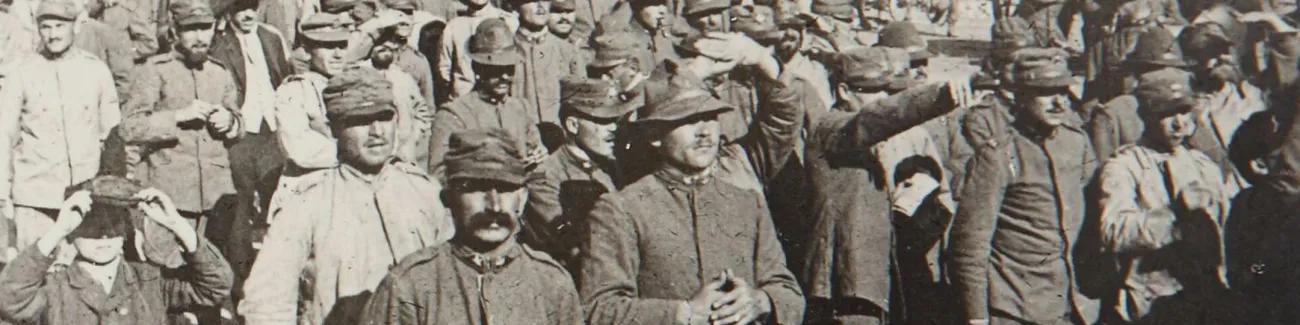

Carcano Modello 1891 Rifle
Development
Contrary to popular belief, Ferdinand Ritter von Mannlicher, the designer of the Austro-Hungarian infantry rifle, had no part in the development of the Carcano. This rifle was developed by the team at the Torino Arms Factory, Italy, led by Lieutenant Colonel Salvatore Carcano under government commission led by Colonel G. Paraviccini. Indeed it is also referred to as the Paraviccini-Carcano.
The rifle uses a modified Mannlicher type magazine with en-bloc clip. The similarities between the Carcano and the Mannlicher end there. The Mannlicher design meant that through opening the base of the magazine, the empty clip could be ejected. Like the later Mannlicher rifles, the empty clip could also be ejected through the open receiver, when the bolt was open by pressing the clip catch inside the trigger guard. The clip differs also from the original Mannlicher design, whereby it has no dedicated bottom or top, and can be loaded either side down. This bolt action rifle when used with the correct ammunition it was very accurate, due to its gain-twist rifling.
At the breech of the rifle the rate of twist began at 1:19.25 inches, meaning the round would turn once every 19.25 inches. By the time the round reaches the muzzle end the rate of twist increases to 1:8.25 inches, resulting in a more accurate shot than its contemporaries.
Manufacturing this rifling was extremely costly and eventually was abandoned in the 1930s. The Carcano chambered a 6.5x52mm Modello 1895 round. It used a round nosed metal jacketed bullet. It was noted, however, that inconsistencies in the powder types meant a varied result in bullet velocity.
Use and effect
Used by the Italian Army during the War, the Carcano Modello 1891 had two carbine versions. The Moschetto da Cavalleria Modello 1891, was issued to the cavalry. This had a folding integral bayonet and a shorter 450 mm (17.7 inches) barrel. Also the Moschetto per Truppe Speciali Modello 1891, which was issued to special troops. This included machine gun, mortar and motorcycle crews. This also had the shorter barrel but a standard bayonet fixing. Both models with the considerably shorter barrels did not benefit from the gain-twist system.
Special attachments available for the Carcano included a wire-cutting guide, which could be attached to the muzzle and bayonet via a clip. This acted as a guide for cutting a strand of wire by firing a round. Also a clip-on foresight was available to help men 'aim off' when shooting at aircraft. Although the Carcano had no sniper variant, due to its accuracy it was used successfully in that role. Often telescopic sights would be fitted to the rifle. The successor of the Modello 1891, the Carcano Modello 1938, continued to be used throughout the Second World War until it was replaced by the American M1 Garrand.
Many now obsolete Carcanos were sold off to the U.S.A as military surplus. Most notoriously, the Carcano Modello 1938 was used with 4x magnification telescopic sights in 1963 by Lee Harvey Oswald, to assassinate President J.F. Kennedy.
Statistics
- Date entered service - 1891
- Action / Operating system - Bolt-action
- Barrel length - 78 cm (29.1 in)
- Overall length - 1.3 m (51 in)
- Weight - 3.8 kg (8 lb 6 oz)
- Effective range - 600 m (656 yd)
- Feed - En-bloc clip
- Capacity (rounds) - 6
- Calibre / Bore - 6.5x52mm Carcano
- Muzzle velocity - 755 m/s (2477 fps)
- Country of manufacture - Italy
- Manufacturer - Reale Fabbrica d' Armi di Torino
- Primary operator - Italy
Related Objects


Glisenti Modello 1910 Pistol
Development
This short recoil operated pistol was patented in 1906-07 by Italian Army officer Abiel Bethel Revelli di Beaumont (1864-1930). Originally an artillery officer, Revelli became a very accomplished designer. Having developed the Revelli-Terni rifle in 1909, he later invented the more famously known Fiat-Revelli Modello 1914, machine gun and the Fiat Modello 1915 (Villar Perosa) sub-machine gun. The Modello 1910 was patented by Revelli for the company Societa Siderugica Glisenti, who acquired the machinery to begin production from the United Kingdom. Glisenti sold the manufacturing rights to Metallurgica Brescia gia Tempini. Around 100,000 Modello 1910s were produced between 1910 and 1915.
The Savoy crest sits prominently on the black chequered grips. King Vittorio Emanuele III, ruled the Kingdom of Italy at the time of the War and was a Savoy-Carignano, a branch of the House of Savoy. The 1906 patent of this pistol originally intend it for use with a 7.65mm Glisenti cartridge. Not powerful enough for military use, the cartridge was up graded to the 9mm Glisenti, which was specially developed for this pistol. Based on the German 9x19mm Parabellum, it was significantly less powerful. This cartridge was also used in other Italian firearms at the time such as the Villar Perosa and the Beretta Model 1915 pistol.
Use and effect
The pistol was adopted by the Italian army, and used from 1910 until the 1920s. It replaced the six shot Bodeo Model 1889 revolver, which was never declared obsolete and saw use throughout both world wars. The Modello 1910 had a number of flaws, which ultimately effected its time in service. Amongst them the Bakelite grips were very weak and often cracked, resulting in them being replaced with wooden ones.
The power of the pistol could not rival that of other short recoil pistols. Due to the design of the firing system, it could not withstand cartridges as strong as the 9x19mm Parabellum, hence the decision to adopt the 9mm Glisenti. This weaker cartridge produced a lower muzzle velocity, in turn affecting the penetrative power of the pistol.
In 1912, an attempt was made to improve the pistol. A simplified model was issued, called the 'Brixia'. It had a strengthened frame, had its safety grips removed and weighed 150 g (5 oz) more. The cartridge, however, remained the same. The Brixia was still not enough of an improvement for the Italian army and so it was instead to be sold on the civilian market, however the outbreak of the War lead to this venture being cancelled.
The Modello 1910 began to be phased out by the Spanish produced Ruby pistol and the Beretta Modello 1915. The Modello 1910 was declared obsolete in 1934, however it saw limited service in the Second World War, despite being superseded by the Beretta.
Statistics
- Date entered service - 1910
- Action / Operating system - Blowback
- Barrel length - 10 cm (3.94 in)
- Overall length - 20.7 cm (8.15 in)
- Weight - 820 g ( 1 lb 13 oz)
- Effective range - 21 m (23 yd)
- Feed - Box magazine
- Capacity (rounds) - 7
- Calibre / Bore - 9 mm Glisenti (.35 in)
- Muzzle velocity - 305 m/s (1000 ft/s)
- Country of manufacture - Italy
- Manufacturer - Metallurgica Brescia gia Tempini
- Primary operator - Italy
Related Objects


Villar Perosa Modello 1915 Light Machine Gun
Development
Technically the first submachine gun to see military service, the Villar Perosa was designed by Italian Army officer Abiel Bethel Revelli di Beaumont (1864-1930). This talented designer also developed the Revelli-Terni rifle in 1909, the Glisenti Modello 1906 and 1910 self-loading pistols, and later he invented the more famously known Fiat-Revelli Modello 1914 machine gun.
Submachine guns are often referred to as 'machine pistols' due to the pistol ammunition they chamber, however they could never render the machine gun obsolete. Pistol cartridges greatly limited their effective range and 'stopping power'. Though each round would be approximately half the weight of a rifle cartridge, more than twice the rounds would be needed to even begin to match the firepower of a rifle-calibre machine gun. For close-quarter combat however, the submachine gun allows a high volume of fire in a portable package. The concept was ideal for trench combat and, in theory, was also suitable for the mountain warfare for which the Villar Perosa was intended.
The story of the Villar Perosa is a curious one. This delayed blowback weapon built by Officine Villar Perosa (OVP) was originally designed to be mounted on aircraft, but improvements in aircraft durability made it obsolete. It chambered the 9mm Glisenti, which was specially developed for the Modello 1910 pistol. Based on the German 9x19mm Parabellum, it was significantly less powerful, producing a lower muzzle velocity, which in turn affected the penetrative power of the round. In essence, this weapon was simply a pair of submachine guns mounted side-by-side and fitted with a spade grip firing unit. This reflects its intended role in Italian service as a form of short range light machine gun rather than a true submachine gun like the German MP 18,1.
Available for use with the gun was a shield, upon which the gun could be mounted. Even bicycle mounts were available, for transport in the mountains.
Use and effect
The Villar Perosa was used, as intended, by the Italian army. After experiencing trouble with their heavy machine guns in the mountains, the Italians in 1916 began to equip their infantry with the Villar Perosa. Compared to the Revelli machine gun, it was light and portable; ideal for mountain war on the Italian front. The disadvantages to the Villar Perosa are evident from its appearance. It has no practical grip or stock, limiting its use as a true submachine gun. This was overcome by attaching a harness to it, and eventually tactics were developed to use it in 'marching fire'.
Proof that this was not entirely effective comes from the fact that most Villar Perosas were supposedly broken down and their components used to build the OVP Modello 1918 submachine guns. Essentially, one half of a Villar Perosa was fitted with a wooded stock and fore-end and a conventional rifle-style trigger mechanism.
The advantage of the Villar Perosa as originally deployed was its extremely high rate of fire. An English language manual for the weapon boasts:
'Fifty shots in one second, or at the rate of 3,000 per minute. The action is instantaneous and does not require any time to speed up - the entire fifty shots are discharged in one second.'
This potential rate of fire would have played an important role upon the Italian front. Unfortunately, a magazine feed system limited the effective rate of fire to something closer to 200 rounds per minute.
Nonetheless, whilst suffering defeat at the battle of Caporetto in 1917, the use of this weapon against the 'Hutier tactics' of the Central Powers gave Italian forces a small advantage. It was eventually the use of poison gas by the Germans which led to the collapse of the Italian Second Army.
Statistics
- Date entered service - 1915
- Action / Operating system - Delayed blowback
- Barrel length - 43.5 cm (17 in)
- Overall length - 63.5 cm (25 in)
- Weight - 22.4 kg (49 lb 6 oz)
- Effective range - 300 m (328 yd)
- Feed - Box magazine
- Capacity (rounds) - 50 (2x25)
- Calibre / Bore - 11.6 mm (.455 in) (British Trials)
- Calibre / Bore - 9 mm Glisenti (.35 in)
- Muzzle velocity - 320 m/s (1,050 fps)
- Rate of fire (rounds per minute) - 1200-1500
- Country of manufacture - Italy
- Manufacturer - Officine Villar Perosa (OVP)
- Primary operator - Italy
Related Objects

Central Powers
Germany
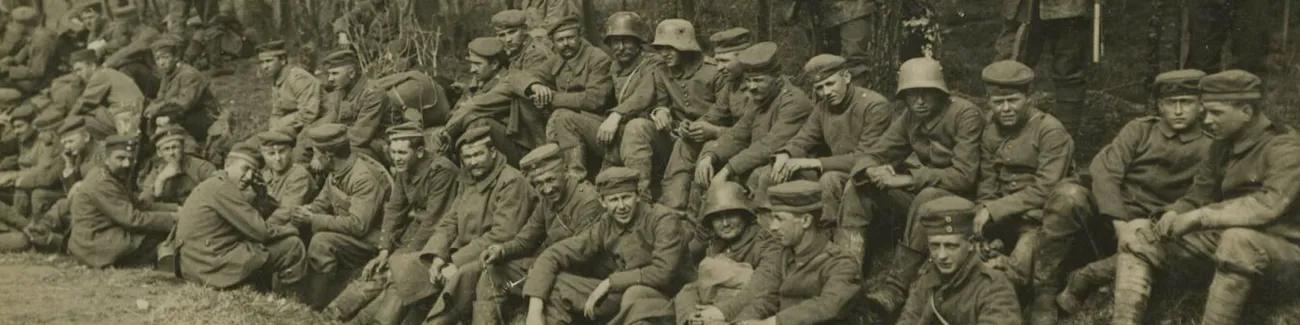

Mauser Gewehr 98 Rifle
Development
The German tradition of bolt-action rifles was second only to that of the French. Prussia and France had clashed in 1870, and the cultural memory of that war was strong throughout the First World War. German fears of civilian insurgency was the cause of much brutality in Belgium and France, and France for her part sought revenge for her defeat. This bitter rivalry was reflected in a small arms race between the two nations.
The Prussian army adopted the original single-shot bolt-action Mauser immediately after the Franco-Prussian War, and this was developed by the Mauser brothers, Peter Paul and Wilhelm, into what became a world standard rifle, rather like the Kalashnikov today. The ultimate variant was the Gewehr 98; the culmination of a series of commercially successful rifles that began with the Model 93 sold to Spain in 1893. The rifle's ammunition was designed for the Gewehr 88, an otherwise unsuccessful German military rifle not part of the Mauser family.
Germany was the first to introduce the pointed 'spitzer' (spire-shaped) or 'S' bullet. Unlike the flat-based British .303, this was a truly modern design with an aerodynamically shaped 'boat' tail. The 7.92mm round was also powerful enough to project the special armour-piercing 'K' bullet through the side of the early British tanks.
A range of bayonets were issued for the G98, the most common being the S84/98 with 25.3 cm (10") blade. Yet the most famous today is the 'saw-back' variant of the S98/05 sword bayonet. This was demonised in British propaganda as the 'butcher blade', implied to have been designed to cause needlessly horrific wounds. In fact, bayonet blades with serrated backs had been commonly used for more than a century by both Britain and Germany. They were actually intended for issue to pioneer and engineer troops who might have a need to cut wood.
Use and effect
The robust, reliable, powerful and accurate Mauser had excelled against the British in the hands of Boer guerrillas, but did not provide an edge in 1914. Though very large and well-equipped, the German army lacked experience of modern warfare. The much smaller British Expeditionary Force had recent combat experience in South Africa and the North West Frontier (present-day Afghanistan).
As a result, whilst it forced the BEF into fighting retreat, it suffered disproportionately heavy casualties against the less accurate Lee-Enfield rifle in these early battles. Any advantage in terms of rifle technology, therefore, was with the ten-round magazine capacity and rapid action of the SMLE.
As for the 'butcher blade', in practice this would not have caused any more severe a wound than the smooth S98/05. Both were broad cutting blades that created correspondingly wide wound channels. This assumes that the blade would reliably penetrate the layers of cloth and leather that an enemy soldier would be wearing, as a great deal more force would be required to push the blade home than a spike blade like that of the French Lebel.
Statistics
- Date entered service - 1898
- Action / Operating system - Bolt
- Barrel length - 74 cm (29.1 in)
- Overall length - 1.25 m (49.2 in)
- Weight - 4.09 kg (9 lb)
- Effective range - 550 m (600 yd)
- Feed - Internal magazine
- Capacity (rounds) - 5
- Calibre / Bore - 7.92x57mm (.31 in)
- Muzzle velocity - 878 m/s (2881 fps)
- Rate of fire (rounds per minute) - about 15
- Country of manufacture - Germany
- Manufacturer - Amberg arsenal
- Manufacturer - Danzig arsenal
- Manufacturer - Deutsche Waffen und Munitionsfabriken
- Manufacturer - Erfurt arsenal
- Manufacturer - Haenel Sauer & Sohn
- Manufacturer - Leipzig arsenal
- Manufacturer - Mauser
- Manufacturer - Simson
- Manufacturer - Spandau arsenal
- Manufacturer - V. Chr. Schilling Co.
- Manufacturer - Waffenwerke Oberspree
- Primary operator - Germany
- Other operators - Ottoman Empire
Related Objects


Mauser C96 Pistol
Development
The Mauser Modell 96 or 'Mauser C96' as it is also known, was patented in 1895, and was one of the earliest self-loading pistols to enter military service. Much of the design had been done by the Feederle brothers who worked for Mauser, however it was Peter Paul Mauser (1838-1914) who patented and produced it at his arms factory at Oberndorf.
Mauser began his career as a gunsmith in the Royal Württem Arms Factory. With the help of his brother Wilhelm, Mauser designed the Model 1871 breech-loading rifle which, after improvements, was accepted into German military service as the Modell 1871. The German military initially passed on the C96, however the weapon found great success on the civilian market, mostly with hunters due to its ability to transform into a type of carbine. This was achieved by adding the iconic walnut stock to the rear of the grip. This stock is multi-purpose as it also acts as the carrying device for the weapon. A carbine version of the C96 with a 240 mm (9.4 in) barrel was also developed.
The calibre of the early C96 pistols was predominantly 7.63x25mm. The Feederle brothers adapted and used the Borchardt cartridge in their design for this pistol. The 7.63x25mm Mauser cartridge used the same design and dimensions as the Borchardt C93, however it was loaded with a stronger powder charge and a slightly heavier bullet.
Variations of this weapon were produced with different magazine capacities. All variants loaded via the breech with aid of a stripper clip, and a six shot, a ten shot, and a 20 shot magazine were all produced in 7.63mm. A ten shot magazine for the 6 mm version was also developed. Shortly before the outbreak of the First World War, Mauser began to produce C96 pistols in 9mm Parabellum for export. These were widely available on the Chinese market.
Use and effect
Although the C96 was widely available on the commercial market, by 1908 around 70,000 had been produced. Most notably, the Italian Navy had ordered around 6,000 pistols for naval use and the Sultan of Constantinople's body guards were equipped with this pistol. Its first true taste of military action was during the second South African War, where it was very popular amongst British officers.
Due to a lack of Luger pistols during the First World War, the C96 in 9mm was adopted by the German army in 1917. These pistols were clearly marked with an engraved '9', usually in red paint on the grip, to avoid confusion with the 7.63mm calibre. With its stripper clip loading system, the C96 was not as quick to load as many other self-loading pistols of the trenches such as the Colt Model 1911 or the Luger.
It was also a bulky pistol. The range, however, which could be achieved with a stocked C96 was considerable compared to any other pistol of this conflict. It continued to be developed during the 1920s; most famously the 'Bolo' version of the pistol had a shorter barrel and was exported to Russia. It also continued to feature in warfare throughout the Second World War.
Affectionately referred to as 'Broomhandle' due to the grip, the strange form of the C96 made it the perfect candidate for Hollywood. Featured in the original Star Wars trilogy, a C96 modified with external props was used by Han Solo and, on occasion, by Luke Skywalker. The DL-44 blaster pistol has become almost iconic as the original C96.
Statistics
- Date entered service - 1896
- Action / Operating system - Recoil
- Barrel length - 14 cm (5.5 in)
- Overall length - 31 cm (12.3 in)
- Weight - 1.13 kg (2 lb 8 oz)
- Effective range - 150-200 m (164-218 yd)
- Feed - Internal magazine
- Capacity (rounds) - 6, 10 or 20
- Calibre / Bore - 7.63x25mm (.30 in)
- Calibre / Bore - 9x19mm Parabellum (.36 in)
- Calibre / Bore - 9x25mm Mauser (.36 in)
- Muzzle velocity - 425 m/s (1394 fps)
- Country of manufacture - Germany
- Manufacturer Mauser
- Primary operator - Germany
- Other operators - Britain
- Other operators - Italian Navy
- Other operators - Sultan of Constantinople's body guards
Related Objects


Pistole 08 (P08) Parabellum
Development
This self-loading pistol will forever be known as the 'Luger' after its designer Georg J Luger. However, it was originally named the 'Parabellum', derived from the Latin phrase Si Vis Pacem Para Bellum ('if you want peace, prepare for war'), company motto of manufacturer Deutsche Waffen und Munitionsfabriken (DWM).
Luger was tasked with redesigning an existing pistol that had been invented by Hugo Borchardt in 1893. Luger retained the successful mechanical aspects of the design, but made it much more compact and user-friendly. The design was finalised and patented in 1898, and was first adopted in 7.65x21mm calibre (derived from the Borchardt round) by the Swiss in 1900. The German Navy followed suit four years later with the Pistole 1904.
The definitive version for the German Army entered service in 1908 along with the equally famous 9x19mm cartridge designed for and named after this pistol. Later, a long-barrelled variant with a shoulder stock was produced for artillery crews.
Use and effect
The natural 55 degree grip angle and superior sights of the Luger made for relative accuracy. Unfortunately, the excellent fit of the toggle lock and other moving parts meant that even a small amount of dirt or wear could cause a jam. This could be a problem in trench conditions. The design was also expensive to produce. The way forward for self-loading pistols was therefore instead represented by the American Colt M1911 and John Browning's slide-based recoil system.
Nonetheless, the Luger was the first successful military self-loading pistol, and was manufactured in large numbers through two world wars. Its iconic appearance and association with the enemy made it a sought-after souvenir for Allied soldiers. Additionally, although the pistol itself was a technological dead end, the 9x19mm 'Parabellum' cartridge afforded an excellent blend of power, size, weight, and recoil. For this reason, it has far outlived the Luger pistol and, over a century after its introduction, is now the most widespread military and law enforcement cartridge in existence.
The Luger was produced by two main manufacturers before and during the First World War. DWM produced the original 7.65x21mm version from 1900, before commencing manufacture of the 9x19mm Pistole 1908. The example illustrated here is extremely rare, being the first ever P08 to be produced at the Erfurt state arms factory in 1911. Every component is marked with its serial number '1'.
This weapon also saw service, and features two regimental marks on the front strap. The first '12.T.S.1.8' denotes the 12th Train Battalion, Sanitaets company 2, weapon # 18. Sanitaets companies were Ambulance and Medic companies. The 12th was a train battalion from Saxony and part of the 19th army corps. The 2nd company was garrisoned in Leipzig.
Later, presumably after war had broken out, a second mark on the weapon ('177R') shows that this same pistol was re-issued to a front-line infantry unit. This was Infanterie-Regiment Nr.177 (Königlich Sächsisches 12), or the 177th (12th Royal Saxon) Infantry. They had been created on 1 April 1897 in Dresden, and formed part of the XII Army Corps.
It is not known how this pistol came to be captured by British troops, although British soldier Harry Drinkwater, author of the memoir 'Harry's War', encountered this unit in a separate action for which he won the Military Cross. Taking part in a raid against a trench held by the 177th, Harry was wounded by a bullet. Nonetheless, he stopped to tear an epaulette from the greatcoat of a fallen German soldier as evidence of which enemy regiment occupied this trench.
Statistics
- Date entered service - 1908
- Action / Operating system - Recoil
- Barrel length - 10.2 cm (4 in)
- Overall length - 22 cm (8.75 in)
- Weight - 890 g (1lbs 15 oz)
- Effective range - 50 m (55 yd)
- Feed - Box magazine
- Capacity (rounds) - 8
- Calibre / Bore - 9x19mm Parabellum (.36 in)
- Muzzle velocity - 329 m/s (1080 fps)
- Country of manufacture - Germany
- Manufacturer - Deutsche Waffen und Munitionsfabriken
- Manufacturer - Erfurt arsenal
- Primary operator - Germany
Related Objects


Lange Pistole 08 (LP08) Pistol and Drum Magazine
Development
Artillery crews in the First World War manned guns of immense destructive power, however they still required a self-defence weapon. Rifles were too large and heavy, and pistols were limited by their short barrels and one-hand design to use at very close range. A pistol carbine was proposed to bridge the gap - with a shoulder stock, long barrel and long-range sights. Crews could keep this weapon on them at all times without it getting in the way or weighing them down, but could still fight effectively to defend their position if called upon.
Georg Luger had designed and marketed several of these carbines for commercial sale to target and recreational shooters, which eased development of this new military equivalent. The flat paddle-style stock also contained a leather holster, rather like that supplied with the progenitor of the Luger series, the Borchardt C93. With stock detached and the pistol inserted in it, the whole package was almost half the size. Pistols had been provided with long barrels and stocks since flintlock days, the best known being the Mauser C96 'Broomhandle'.
What set the new Luger apart was a high capacity drum magazine; the first of its type. These feature a spiral arrangement to fit as many cartridges as possible, and a clock-style spring that must be wound before use to push rounds into position. This was bulky for artillery use, and instead formed part of the equipment of a new type of soldier; the assault trooper (Stosstruppe).
Use and effect
Far from treating the LP 08 as a defensive weapon, assault troops would enter enemy trenches and hit them hard at close range with rapid, decisive gunfire and explosives. To fulfil this role, unlike its original purpose as a seldom-used sidearm, the LP 08 would have had to function reliably for perhaps hundreds of rounds without servicing or even cleaning. The complicated Luger mechanism, with its close manufacturing tolerances, was therefore not ideally suited to the role.
Like the Luger itself, the drum magazine had to be carefully maintained and stored to prevent jamming. The use of the Luger platform did mean that if a stoppage occurred, the operator could discard the drum, clear the jam, and insert a spare standard capacity Luger magazine to continue fighting. Whilst the LP 08 was not capable of fully automatic fire, it nonetheless allowed soldiers to deliver an unprecedented amount of firepower from a pistol-sized weapon. This was due to the high capacity of the drum magazine and the stability offered by the shoulder stock. The low recoil of the cartridge kept shots on target at close range, and the precision sights allowed for accurate single shots out to at least twice the effective range of a normal pistol.
The LP 08, in its assault role, also inspired the Bergmann MP 18,1 submachine gun and with it, a whole new class of weapon. In 1922, this configuration was marketed as a rival to the new Thompson submachine gun by the Pacific Arms Corporation of California, who dubbed it a 'Baby Machine Gun'.
Statistics
- Date entered service - 1914
- Action / Operating system - Recoil
- Barrel length - 20.3 cm (8 in)
- Overall length - 66.7 cm (26.3 in)
- Weight - 2.035 kg (4 lb 49 oz)
- Effective range - 100 m (109 yd)
- Feed - Box Drum magazine
- Capacity (rounds) - 8 or 32
- Calibre / Bore - 9x19mm Parabellum (.36 in)
- Muzzle velocity - 350 m/s (1148 fps)
- Country of manufacture - Germany
- Manufacturer - Deutsche Waffen und Munitionsfabriken
- Manufacturer - Erfurt arsenal
- Primary operator - Germany
Related objects


Maxim MG 08 Machine Gun
Development
In 1888, Kaiser Wilhelm II fired a Maxim gun. He was so impressed that he ordered that his Dragoon Guards to be equipped with a number of these early guns. By 1892, a formal contract had been signed with the British-based Maxim Nordenfelt Company for the first German Maxim guns. Standing on the side lines of the Russo-Japanese War in 1902, Germany was among the first countries to recognise the potential of the machine gun in modern warfare.
The firm Deutsche Waffen und Munitionsfabriken (DWM) was commissioned to develop an improved gun. As with the Vickers gun, the British equivalent, the biggest concern was weight and all efforts went into reducing this by using lightweight materials. This resulted in the MG 08, which despite some claims to the contrary, was only 3 kilograms heavier than the more comprehensively redesigned British Vickers. It did, however, retain the bigger, boxier receiver of the original Maxim gun as well as its mechanical complexity. The MG 08 comprised of 235 individual parts compared to the 144 of the Vickers.
What drastically increased the total weight of the package was the gun's mount. Instead of the typical tripod, a four-legged collapsible sledge mount (the 'Schlitten' 08) was developed. This was extremely stable but was even larger and heavier than the solid brass tripod of the Vickers. It was designed to be dragged into position, but the churned muddy ground of the Western Front made this difficult.
Finally, a veritable suit of armour was produced for the MG 08, including shields shaped to fit the water jacket. Gun crews were sometimes also issued the 'Sappenpanzer' steel body armour and 'Stirnpanzer' brow plate for their helmets adding yet more weight to carry.
Use and effect
The fact that Germany was content to persist with a more complex and heavier system reflects adherence to tactics developed prior to the First World War. These emphasised the strength of the machine gun as a short range, defensive weapon. Over two thirds of German small arms ammunition was expended by their machine guns, which primarily operated in this defensive role. Even where guns were supplied with optical sights and men trained in offensive tactics, they were taught to use direct fire when the enemy was visible. Little effort was expended developing the advanced long-range firing techniques that would later help to win the war for the Allies.
Historians have tended to blame the high number of Allied casualties seen during the Allied counter-attack of August 1914 upon the numerical superiority of German machine guns. In fact, many of those guns were not deployed at the front line, and the successful use of the MG 08 in the defence was much more important. The more complicated MG 08 and its heavier mount did give a slight edge to the more portable and easier to produce Vickers gun as the war came down to a duel between machine guns.
Britain was able to catch up with Germany in production rates and pioneered the development of more dynamic machine gun tactics from 1915. In response, lightweight trench mounts were invented for the MG 08. These consisted of a simple block of wood which seriously compromised the gun's effective range. The introduction of the MG 08/15 light variant gave the infantry mobile firepower but was also inaccurate at long distances. The MG 08 and 'Schlitten' 08 remained essential therefore.
Nonetheless, it is easy to overstate these minor technical disadvantages. Any edge that the British Vickers had over the MG 08 seems to have been overcome by effective training. The MG 08 deployed with only a four man crew, two less than the Vickers. All told there was little between the two guns and differences in tactics proved far more important. Improved German tactics and new guns were in development by 1917 - the same year the United States entered the war, bringing decisive industrial resources and manpower with her.
Statistics
- Date entered service - 1908
- Action / Operating system Recoil
- Barrel length - 72 cm (28 in)
- Overall length - 1.175 m (46 in)
- Weight - 62.2 kg (137 lb) (with water & mount; another 6 kg with armour shields)
- Effective range - 2286 m (2500 yd)
- Maximum range - 3658 m (4000 yd)
- Feed - Belt
- Capacity (rounds) - 250
- Calibre / Bore - 7.92x57mm (.31 in)
- Muzzle velocity - 900 m/s (2953 fps)
- Rate of fire (rounds per minute) - 450
- Crew - 4
- Country of manufacture - Germany
- Manufacturer - Deutsche Waffen und Munitionsfabriken
- Manufacturer - Erfurt arsenal
- Manufacturer - Spandau arsenal
- Primary operator - Germany
- Other operators - Austria-Hungary
- Other operators - Britain (captured)
- Other operators - China
- Other operators - Ottoman Empire
Related Objects


Maxim MG 08/15 Light Machine Gun
Development
By 1915, all nations had recognised the power of the machine gun and the fact that they had fought each other to a trench-based stalemate. To overcome this, they would need the right blend of tactical innovation and new or improved technology. Heavy, mounted machine guns could produce devastating sustained fire but could not easily react to changing battlefield conditions or be carried forward by attacking infantry.
To remedy this, each nation attempted to produce automatic rifles to be fired on the move, or true light machine guns. The latter could be quickly deployed using a bipod for a stable firing platform, but easily picked up and moved as necessary. Being less bulky and closer to the ground, they would also present a smaller target to the enemy. Some nations invested time in new designs like the French Chauchat, or looked at pre-existing solutions as in the case of the British Lewis gun.
The German approach was to commission the state arsenal at Spandau to modify the standard heavy MG 08 machine gun. The big, boxy receiver was reduced in size and slightly lightened, and the weapon was fitted with a shoulder stock and pistol grip. For stability, a bipod and sling were provided. Unlike a brand-new design, the gun was quick and easy to manufacture due to its familiar design and shared parts. As a result, it was put into service in good time, and met the immediate needs of the German army.
Use and effect
Though on hand when Germany needed it, the MG 08/15 was inherently a compromised design. Its immediate Maxim heritage left it with the same belt-feed and water-cooling systems of its bigger brother. These gave it the ability to give greater volumes of fire when required, but seriously compromised its ability to function as a light machine gun.
The weight of the weapon, together with several litres of water moving around inside the water jacket would have made for a unwieldy package for a gunner sprinting forward to a new firing position. Retaining the complexity of the MG 08 also required a very large support team, even though only one man was allocated to actually carry and fire the weapon. The overall result was an extremely heavy 'light machine gun' that was regarded as adequate by soldiers, but not outstanding in any way.
An improved version, the MG 08/18, was designed with the water jacket replaced by a slotted jacket, converting the weapon to air-cooling. This limited its ability to fire large volumes of ammunition, but reduced its weight by around 3 kilograms and better suited its intended role. A carrying handle, today standard on light and general purpose machine guns, made it possible for the gunner to carry the weapon with one hand.
This new weapon came late in the war and very few were actually produced. As a result the MG 08/15 remained the primary German light machine gun until the end of the war. Perceptions of the 08/15 as a decidedly average weapon actually gave rise to the German phrase 'Null-acht-fünfzehn', still in use today to mean 'average' or 'bog standard'.
Statistics
- Date entered service - 1915
- Action / Operating system - Recoil
- Barrel length - 72 cm (28 in)
- Overall length - 1.45 m (57 in)
- Weight - 20.8 kg (46 lb) (with water)
- Effective range - 800 m (875 yd)
- Feed - Belt
- Capacity (rounds) - 100 or 200
- Calibre / Bore - 7.92x57mm (.31 in)
- Muzzle velocity - 900 m/s (2953 fps)
- Rate of fire (rounds per minute) - 450
- Crew - 1 gunner plus 8 crew
- Country of manufacture - Germany
- Manufacturer - Deutsche Waffen und Munitionsfabriken
- Manufacturer - Erfurt arsenal
- Manufacturer - Spandau arsenal
- Primary operator - Germany
Mr Teague, Colonel, 8th Battalion, Royal Warwickshire Regiment & 3rd/4th Battalion Baluchistan Infantry
The advent of automatic weapons made attacks on enemy positions during the First World War extremely perilous. Mr. Teague, with the Royal Warwickshire Regiment, conveys the onslaught of machine gun fire his platoon endured and his attempts to help a wounded fellow officer.
The men were just going down like nine pins, I virtually had no contact with my platoon. We went over as a line, got into this terrific fire and I just simply saw men being mowed down on either side.
Related Objects


Bergmann MG15 nA Light Machine Gun
Development
The MG 15, not to be confused with the 1930s weapon of the same designation, was a German answer to the American Lewis light machine gun. Like the similarly named but entirely different MG08/15 (based on the Maxim gun), it was a compromise redesign derived from a heavy machine gun. Unlike the 08/15, it did away with a heavy water cooling system in favour of a slotted barrel jacket.
The weapon's designer was Louis Schmeisser, father of the famous Hugo Schmeisser, known for creating the first submachine gun ever issued (the MP 18,1), amongst other designs. Machine guns are almost always designed to fire with an open bolt, allowing cold air to cool the mechanism and prevent overheating. Unusually, the MG 15 was redesigned to fire when its mechanism was closed, creating the MG 15nA (neue Art - new Model). This change of approach was necessitated by the unreliability of the open bolt version.
Both versions were also developed as aircraft machine guns, where cold air at altitude negated cooling problems. For air service, the rate of fire was boosted to 800 rounds per minute, increasing the probability of a hit on an enemy aircraft.
Use and effect
Though substantially lighter (5 kg / 11 lbs) than the MG 08/15, the MG 15 did not replace it in service, and saw relatively little German use on the ground, being more successful as an aircraft machine gun. A number were also issued to the Asia Korps sent to assist the Ottoman army, and may also have been supplied directly.
The closed bolt redesign solved inherent reliability problems with the design, but would have made for a less effective machine gun that required periodic cooling. The primary advantage of the Bergmann aside from low weight was that it could be fed from various standard lengths of belt. This included a 100-round belt inside a 'Kurbel' drum holder clipped to the side of the weapon. This was more convenient than a long dangling belt, but gave more than twice the capacity of the enemy Lewis gun.
The weapon also pioneered the use of disintegrating metal links, which later replaced cloth belts and are now a standard feature. These are clipped together with rounds of ammunition, and break apart on firing, being ejected from the weapon along with the empty cases. When necessary, new lengths of belt can easily be created by collecting the used links and clipping them together with fresh rounds.
Statistics
- Date entered service - 1915
- Action / Operating system - Recoil
- Barrel length - 71.6 cm (28.2 in)
- Overall length - 1.12 m (44.1 in)
- Weight - 12.9 kg (28.4 lb) (with bipod)
- Effective range - 400 m
- Feed - Belt
- Capacity (rounds) - 100, 200, or 250
- Calibre / Bore - 7.92x57mm (.31 in)
- Muzzle velocity - 892 m/s (2925 fps)
- Rate of fire (rounds per minute) - 500
- Crew - 1
- Country of manufacture - Germany
- Manufacturer - Bergmann Industriewerke
- Primary operator - Germany
- Other operators - Austria-Hungary
- Other operators - Ottoman Empire
Related Objects


Bergmann MP18,I Submachine Gun
Development
The MP 18,I was the first of an entirely new class of weapon. In 1915, the German army requested a hand-held, short-range machine gun for attacks by assault troops against enemy trenches. By 1917, designer Hugo Schmeisser had created the first submachine gun. This is a retrospective term coined in 1921 by Colonel Thompson of Thompson submachine gun fame; the German term was (and remains) 'machine pistol'.
The key ingredients were the existing Luger pistol cartridge and 32 round 'artillery' drum magazine, and a new blowback mechanism. This was simple and easy to maintain, consisting of a heavy tubular bolt that flew forward when the trigger was pulled and, in one motion, collected a round from the magazine, pushed it into the chamber, and fired it. The bolt then recoiled against a spring to repeat the process for as long as the trigger was held down and ammunition was available. This system was potentially hazardous, as banging the butt on the ground could result in the entire magazine being fired unintentionally.
The MP 18,I was modified post-war to accept a straight box magazine instead of the complicated and unreliable drum magazine. Contrary to some sources, this improved weapon was not the 'MP 18,II', a designation that does not exist outside of a misprint in a German manual. The designation remained the same until the further improved MP 28,II was produced.
Use and effect
The MP 18,I reached front line troops in August 1918, too late to see much use in the war, and was limited to use by Stosstruppen (assault troops). Relative to the low power of the cartridge it fired, it was heavy, but short and convenient for close quarter battle. Its weight and low rate of fire made automatic fire very controllable and single shots possible without the need for a selector switch. Effective bursts could be fired from the shoulder using the fixed, rifle-style stock.
As would become the norm with portable automatic weapons, at ranges of less than ten metres, the Bergmann would more often be fired instinctively and from the hip. Acknowledging the need to maintain a supply of ammunition, each weapon was served by a crew of three; one gunner and two assistants who carried chests containing 448 rounds.
The weapon, along with the improved MP 28,II with safety catch and selector switch, went on to arm Germany's inter-war security services. The type was also produced in Switzerland and exported, and original German examples saw limited service in the Second World War.
Importantly, it spawned a whole generation of submachine guns based on the same mechanism. The first British submachine gun, the Lanchester machine carbine, was a straight copy of the MP 28, itself a direct derivative of the original Bergmann. This family of weapons also gave rise to the nickname 'Schmeisser' to describe a submachine gun, which was later misapplied to the more famous MP 40 encountered by the Allies in the Second World War.
Statistics
- Date entered service - 1918
- Action / Operating system - Blowback
- Barrel length - 19.8 cm (7.8 in)
- Overall length - 81.3 cm (32 in)
- Weight - 4.17 kg (9 lb 3 oz)
- Effective range - 200 m (219 yd)
- Feed - Box magazine
- Capacity (rounds) - 32
- Calibre / Bore - 9x19mm (.36 in)
- Muzzle velocity - 329 m/s (1080 fps)
- Rate of fire (rounds per minute) - 450
- Crew - 3 (1 gunner, 2 assistant gunners)
- Country of manufacture - Germany
- Manufacturer - Bergmann Industriewerke
- Primary operator - Germany
Related Objects


Mauser Tankgewehr M1918 Anti-Tank Rifle
Development
The first use of tanks by the British during the Battle of the Somme in 1916 came as a shock to the Germans. Whilst primitive and slow-moving compared to modern tanks, they were resilient to (though not totally proof against) rifle fire, machine gun fire, and bursting artillery shells. They showed the way forward in terms of breaking the deadlock of trench warfare and replacing the loss of the cavalry as mobile military units.
Aside from field artillery, the Germans had no real counter to this totally new threat. Soldiers experimented with reversed bullets, which British tests confirm were more effective at close range in penetrating armour plate. Later, the Germans issued the armour-piercing 7.92mm 'K' bullet for rifles and machine guns. Recognising that this would trigger an inevitable arms race between projectiles and thicker and harder armour, efforts were also made to create specialised anti-tank weapons.
A new type of machine gun was developed to fire an enormous new 13.2mm cartridge against tanks and aircraft. This round was created by scaling up the 'K' bullet, which had a hardened steel core with a lead mantle and full metal jacket. The bullet weighed a tremendous 802 grains (52 grams) compared to the 185 grains (12 grams) of the infantry rifle version. This gave it the mass required to punch through armour, whilst the large propellant charge provided the necessary velocity.
As the MG 18 machine gun was being developed, an anti-tank rifle was also proposed. Work on the more complicated machine gun proved to be slow, and only the mechanically simple 'T-Gewehr' was produced in numbers sufficient to see action. This was little more than a scaled-up Mauser 98 rifle. Its enormous proportions were essential in making it strong enough to contain the high pressures generated by the 13.2mm round. To this end, the number of locking lugs on the bolt was doubled to four.
Use and effect
The boiler-plate steel armour of the first British tanks was unhardened and only 8 to 15mm thick. It was easily penetrated by the T-Gewehr at up to a range of 300 metres. The outer portion of the 13.2mm bullet would be stripped away on impact but the steel penetrator would continue on, tumbling and travelling sideways into the interior of the tank. Metal spalls from the tank's own armour would add to the destruction inside.
The rifle was usually deployed with a crew of two; one shooter and one spotter, as would become standard practice for military snipers. The spotter would direct the shooter onto the target and observe fall of shot with a pair of binoculars. Two to three rifles were supplied per regiment.
Fired from cover, it was unlikely that the targeted tank crew, with severely limited vision, could effectively identify the threat and return fire. Other tanks and infantry, however, would immediately seek the snipers, who would be forced to withdraw. This was to be expected; all snipers and machine gunners received similar special treatment from the enemy.
A lack of any dampening or muzzle brake system led to punishing recoil for the shooter, which became the main drawback of the design. Another disadvantage was the absence of a magazine, limiting the opportunity for quick follow-up shots. The spotter could load the rifle to mitigate this limitation.
After the war, the T-Gewehr was banned by the Treaty of Versailles, and saw no further use, though it is believed that the Germans continued to manufacture it in secret. The weapon directly inspired the British .55 calibre Boys anti-tank rifle and the .50 calibre Vickers and Browning machine guns.
After tank armour had become essentially proof to rifle bullets of any kind, a whole generation of Anti-Materiel Rifles (AMRs) emerged. Some of these, including the US Barrett M82/M107, still use the .50 Browning Machine Gun cartridge based on the original T-Gewehr round. Since then, the anti-tank role has passed to rocket-propelled grenades and guided missile systems. Today, AMRs are instead used to attack lightly armoured vehicles, structures, and also human targets at extreme range or behind heavy cover.
Statistics
- Date entered service - 1918
- Action / Operating system - Bolt
- Barrel length - 98.4 cm (19 in)
- Overall length - 1.68 m (39 in)
- Weight - 17.7 kg (39 lb)
- Effective range - 500 m (547 yd)
- Feed - Single shot
- Capacity (rounds) - 0
- Calibre / Bore - 13.2x92mmSR Mauser 'Tank und Flieger' (.52 in)
- Muzzle velocity - 780 m/s (2650 fps)
- Rate of fire (rounds per minute) - about 10
- Crew - 2
- Country of manufacture - Germany
- Manufacturer - Mauser
- Primary operator - Germany
Related Objects


German Lance (Stahlrohrlanze)
Development
Until 1889, the lance was only carried by Germany's regiments of Uhlans (lancers). Following Kaiser Wilhelm II's statement that the lance was the 'Queen' of weapons, all German cavalry regiments were issued with them. This reequipping of German cavalry, along with a standardisation of drill based on a single type of cavalry ('Einheitskavallerie'), meant that by the War the only difference between German cavalry types was their uniform. All would fulfil the same role, and all had the lance as their primary mounted weapon.
The favoured material for the construction of lance hafts in the late 19th century was bamboo, however German lacked the colonies to provide this in sufficient quantities. This, along with a strong tradition and infrastructure of steel works, led to the adoption of an all steel, tubular lance, and with a chequered leather grip. Once assembled, the lance was not meant to be taken apart, making transport problematic.
Use and effect
The Stahlrohrlanze was longer than both its French and British counterpart, and seems to have been used more in a couching fashion where possible. Certainly General von Poseck in his accounts of the German cavalry's actions in France and Belgium 1914 always references lances being lowered and couched against targets, rather than swung or jabbed with. This was seen in the overrunning of a rear-guard of French infantry at Rocquigny, 25 June 1914. Here, the Guard Cavalry Division charged with 'such impact that many of the French were killed outright with the lance.'
The Stahlrohrlanze had a design flaw in its fixed eyelets for attaching pennants of state colours for parade, just below the blade. Even though pennants were not attached for combat by 1914, the eyelets could not be removed and could become stuck in a target, especially following the deep penetration that would result from couched use.
The balance and length of the Stahlrohrlanze also seems to have caused problems to its users when fighting other cavalry. The short, thick, square section blade was extremely strong, useful when couching, but lacked enough of a point to penetrate easily when not used with the force of a charging horse behind it. In August 1914, both the 17th and 18th Cavalry Divisions purposely sharpened their lance points as in skirmishes their patrols 'had made the discovery that the unsharpened points had often been deflected by the clothing of the opponent.'
Also, the great length of the Stahlrohrlanze made it hard to manage in a mounted melee. Private Tilney of the 4th Dragoon Guards could 'easily parry' the lance thrusts of his German opponent but could not reach him with his sword due to the lance's length. In tighter confines, German cavalry were at a disadvantage against sword armed cavalry as the balance and length of their lances made parrying with them all but impossible, and once the point had been passed, the lancer was vulnerable.
At Casteau, August 22 1914, Trooper Worrell remarked:
The Jerries couldn't manage their lances at close quarters and several of them threw them away and tried to surrender but we weren't in no mood to take prisoners and we downed a lot of them before they managed to break it off and gallop away.
Statistics
- Date entered service - 1890
- Blade length - 12.6 cm (4.9 in)
- Overall length - 3.14 m, originally 3.20m (10' 3", originally 10' 6")
- Weight - 2.12 kg (4 lb 10.8 oz)
- Country of manufacture - Germany
- Manufacturer - Gewehrfabrik, Danzig
- Primary operator - Germany
Related Objects


Prussian Infantry Officer's Sword, Modell 1889
Development
Following the unification of Germany in 1871 under the Prussian King, most of the smaller German states were adsorbed into the Prussian army and adopted their military system. Despite this, the larger armies of the kingdoms of Bavaria, Saxony and Württemberg retained characteristics of their uniform and heraldry. That is why in 1889, when new sword patterns were produced for the German army, some state variation was still tolerated. A degree of consistency can be found in scabbard forms however, with those between 1889 and 1906 being nickel plated and those produced after 1906 being painted black or chemically blued.
The sword is almost like a miniaturised Kurassier's Pallasch (Dragoon Sword), with a long, straight, spear-pointed blade, and cocked grip. The blade is usually doubled fullered but single fullered or even flat bladed versions existed. Not being intended as a primary combat weapon, its hilt is distinctive and more decorated than that of the three bar hilt of the Pallasch. The Infantry Officer Degen 89 has a fixed, decorative, semi-basket guard, whereas privately purchased versions often had folding guards. The guard contains a Prussian Eagle and this, or the royal cypher of Kaiser Wilhelm II, was usually applied to the grip.
Use and effect
The blackening of the scabbard and inclusion of a 'Fingerschlauf', a leather loop for inserting the fingers when holding the sword in a thrusting position, suggests the sword could have been used on active service, however in practice it was more a badge of rank than a weapon. The extreme lightness of the sword meant that it had little practical value as a weapon and German infantry swords soon disappeared from the battlefield at the start of the War. Some German officers took to wearing a more practical dagger, with officer's sword knot affixed, as a continuation of displaying their status.
Statistics
- Date entered service - 1889
- Blade length - 83.5 cm (32.8 in)
- Overall length - 98 cm (38.6 in)
- Weight - 608 g (2 lb) (without scabbard)
- Country of manufacture - Germany
- Manufacturer - Weyersberg, Kircschbaum & Cie, Solingen
- Primary operator - Germany
Related Objects


Modell 1889 Sword (Kavalerie Degen)
Development
This model of sword was carried by all light cavalry troopers of the Imperial German Army. Only Kurassiers and Schwere Reiters, which totalled, at 14 regiments, just 10% of Germany's cavalry regiments in 1914, were considered heavy cavalry. Uhlans, Hussars, Dragoons and Chevaulegers were all armed with the Kavalerie Degen 89. Prior to the standardisation of the German cavalry in 1889, all these light cavalry regiments, apart from Uhlans, relied on the sword as their main weapon.
The piped backed, quill-pointed blade of the Kavalerie Degen 89 was of the same form as the Prussian Modell 1852/79, but with a shorter, straighter blade and simplified guard, resulting in a lighter sword. The crest on the guard varied according to the state that each regiment came from, whether Prussia, Bavaria, Saxony, or Württemberg.
The heavy cavalry regiments continued to carry their massive, straight bladed Pallasch (Dragoon Sword), which was little changed from the Napoleonic Cuirassier sword it was modelled upon 100 years before.
Use and effect
From 1889, the sword became an auxiliary weapon for all German cavalry troopers as the lance was introduced to all regiments, heavy and light, as their primary mounted weapon. Along with carbines for dismounted action, this relegated the sword to the trooper's fourth weapon, behind even the pistol which could be fired from the saddle with some success at close range. As such, few accounts exist of the Kavalerie Degen 89 in action.
Officers seemed to have often not carried a lance, but the wide variety of swords they carried makes evaluating the effect of the Kavalerie Degen 89 problematic. The account of Lieutenant Baron von Buddenbruck of the 1st Guard Dragoon regiment striking an English cavalry officer 'square across the face' but failing to stop him issuing orders would fittingly describe the lack of cutting ability of the Kavalerie Degen 89. Its stiff, straight blade, cocked handle and fore-finger grip mean the sword is designed for thrusting, not cutting.
Because of this, and due to its relegation in the importance to German troopers, British cavalrymen found that the majority of cavalry swords captured from the Germans had not even been sharpened along their edge. An unwelcome encumbrance to a cavalryman's load, the sword was being phased out as part of the troopers' equipment as early as 1915.
Statistics
- Date entered service - 1889
- Blade length - 81.3 cm (32 in)
- Overall length - 95.3 cm (37.5 in)
- Weight - 907 g (2 lb) (without scabbard)
- Country of manufacture - Germany
- Manufacturer - Alexander Coppel, Solingen
- Primary operator - Germany
Related Objects


Trench Dagger
Development
Germany, with its strong tradition of blade manufacturing, was the first nation to issue specifically designed trench daggers. Produced by a variety of manufacturers, the basic blade and grip remained similar whilst a variety of guard types were used. Most had a symmetrical cross guard or a down turned quillon, like the Mauser 98/05 bayonet. Those issued by the war departments are often stamped with a government acceptance mark on the back of the blade.
Even before the trench dagger was developed, German troops were better equipped than their opponents with regard to knives. All soldiers were issued with a utility clasp-knife (Tasschenmesser), the locking blade of which made it a viable fighting weapon. As early as October 1914, German Dragoons were using this knife in combat when assaulting, on foot, the town of Richebourgh St. Vaast. In 'furious street fighting' the Dragoons 'employed pocket-knives as a substitute for the bayonet which they lacked'. A clasp-knife, however, cannot be drawn and used quickly, and the fixed bladed sheath dagger was soon issued as a dedicated fighting weapon.
Use and effect
Although the sheath came with a belt loop, the dagger was often worn tucked into the boot, and these daggers were known by some as jackboot knives for this reason. Unlike in the Allied armies, there was no aversion to dagger carrying amongst the German military.
With the decline of the infantry sword, officers in the British and French armies had turned to canes and sticks for substitute badges of rank. German officers and NCOs by contrast wore daggers or bayonets, often decorated with sword knots instead. This, as well as its strong tradition of hunting knives, is why knives and daggers were much more readily accepted by German soldiers as appropriate weapons, rather than those of assassins. This distinctive form of trench dagger continued to be used by German soldiers until the end of the Second World War.
Statistics
- Date entered service - 1915
- Blade length - 15.2 cm (6 in)
- Overall length - 22.5 cm (8.8 in)
- Weight - 201 g (10 oz) (without sheath)
- Country of manufacture - Germany
- Manufacturer - Ernst Busch, Solingen
- Primary operator - Germany
Related Objects

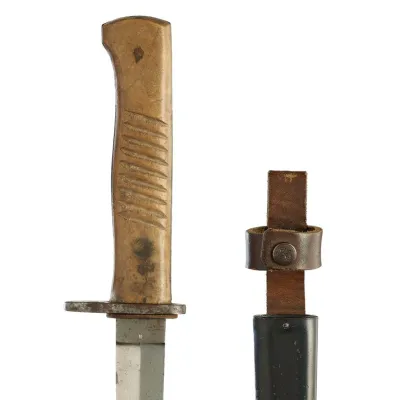

Combination Trench Dagger-Bayonet (Demag-Dolch)
Development
These multi-purpose weapons were officially purchased by the German war ministries and issued to assault troops (Stosstruppen and Sturmtruppen), as Germany recognised the need for a more handy weapon than the Mauser 98/05 bayonet. Available for private purchase, machine gunners often wore them as a side-arm, alongside the Parabellum Pistole 08. Orders from the War Ministry in Berlin saw these weapons gradually issued more widely to standard infantry, in addition to assault troops and machine gunners.
On 8 May 1915, six of these knives were issued per Infantry Company, with this being doubled to 12 on 29 February 1916 and again doubled to 24 on 26 June 1916. This rapid scaling up of official issue of the weapon coincided with increased trench raiding.
Use and effect
It seems that these weapons were issued, and privately purchased, as both bayonets and trench daggers - not just as a substitute for both. Photographs exist of the Demag-Dolch being worn alongside both bayonets and the more common standard German trench dagger. The tradition of combined combat dagger-bayonets persists today, as almost all the bayonets issued with contemporary infantry service rifles fulfil this dual function.
Statistics
- Date entered service - 1915
- Blade length - 13.9 cm (5.47 in)
- Overall length - 25.4 cm (10 in)
- Weight - 220 g (7.7 oz) (without sheath)
- Country of manufacture - Germany
- Manufacturer - Demag, Duisburgh
- Primary operator - Germany
Related Objects

Modell 24 Stielhandgranate, Second Pattern
Development
The Modell 24 Stielhandgranate, or 'stick grenade' was devised in 1915 and developed throughout the War. With its long handle and what resembled a cylindrical metal tin at the end of the handle, the Allies gave it the nickname of 'the potato masher'.
The first pattern of Stielhandgranate had a permanently revealed pull cord protruding from the bottom of the handle. These cords occasionally caught and detonated the grenades whilst being carried, causing severe injuries and occasional fatalities. The German army rectified this design flaw in 1916 with the second pattern by introducing a screw cap on the base of the stick. The hook on the tin allows the grenade to be fixed to a belt, which was ideal for raiding parties.
The Stielhandgranate was used throughout the First and Second World Wars, with various refinements taking place. Cold climates could cause the Model 24 to fail to detonate. A special explosive powder was used in those destined for the Eastern Front, and these were marked with 'K' meaning 'Kalt' (which translates as cold) stencilled on the cylindrical tin. Gradually, the Modell 24 was superseded by the Modell 43 in 1943 and eventually replaced in 1945.
Use and effect
Like the British Mills bomb, the stick grenade's fuses were inserted prior to action, usually at a safe distance from others. A reminder for the user to insert his detonator was written on the cylindrical tin which contained the explosive charge. It read 'Vor Gebrauch Sprengkapsel einsetzen', which translates to 'Before use insert detonator'. Once the detonator was in place the grenade was ready to take into combat. In order to detonate the grenade, the base cap was unscrewed revealing the cord weighted down with a porcelain ball. Once the cord was pulled, a friction wire was dragged through a chemical mixture, igniting the grenade.
The second pattern has a delay of 5.5 seconds before exploding. This gave the thrower ample time to produce sufficient distance. Most German bombers could throw a distance of around 35 yards (32 m), although from the prone position this range would be reduced. In the case of a 'dud' throw, the design of the stick grenade reduced the risk of it rolling back, like a mills bomb would on slightly angled ground. The flaw in this design was the relative size of the grenade, which made it easier for the Allies to spot and throw back.
Statistics
- Date entered service - 1915
- Overall length - 35.4 cm (13.9 in)
- Weight - 350 g (12.3 oz)
- Country of manufacture - Germany
- Manufacturer - Unknown
- Primary operator - Germany
Related Objects

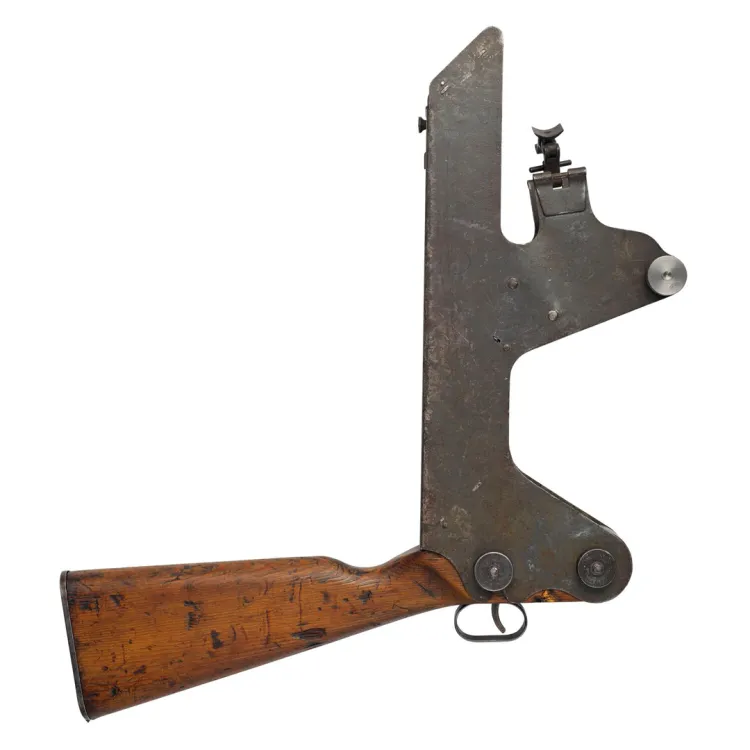
Trench periscope (Spiegelkolben)
Development
The threat of succumbing to a sniper's bullet was a reality for all who inhabited the trenches of the First World War. Keeping one's head below the line of sight was essential. In order to see out of a trench, loopholes were constructed into the parapets. These might be a simple gap in the sandbags or a steel plate, however with the increased use of armour piercing bullets different solutions needed to be explored.
The trench periscope was a device by which soldiers could fire their rifles from the safety of the trench. All sides developed various types of periscope, the simplest being a stick with two angled pieces of mirror at the top and bottom. By 1915, more advanced types were being manufactured. British born William Beech, veteran of the Second South African War enlisted with the Australian Imperial Force in 1914 and was the inventor of a type of trench periscope.
The Beech periscope was a simple design on which the main body of the periscope was attached to the butt of the rifle at a point behind the trigger guard. A cord or wire was then wrapped around the butt in order to secure the rifle to the periscope. Using the mirror at the bottom of the device a view onto the battlefield could be obtained. To fire the rifle, however, one would have to lean far forward in order to the reach the trigger. This could potentially alter the aim of the rifle affecting the accuracy of the shot.
Use and effect
The German made 'Spiegelkolben' was designed with an auxiliary trigger to avoid the firer having to expose any part of himself to enemy fire. As with the Beech design, the butt of the rifle was secured into the periscope by a catch, strapping the rifle securely in place. A second wooden stock was positioned below the real rifle's stock, minimising the need for extra training.
The resulting contraption was heavy and poorly balanced, and had to be rested on the parapet of the trench for any kind of accurate fire. The auxiliary trigger was attached to the actual trigger with a chain which ran on a roller through the centre of the periscope. The user would then look through the periscope and be able to line up their shot through the iron sights of the rifle. Once the shot was taken, the rifle and device would have to be lowered back down into the trench in order to chamber a new round.
By 1915-1916 more technologically advanced versions of the 'Spiegelkolben' were developed, allowing the user to adjust the height of the periscope for an enhanced sight picture. An auxiliary bolt mechanism with a series of connecting rods was clamped to the rifle's bolt handle, permitting reloading from the safety of the trench.
Statistics
- Date entered service - 1916
- Height - 70 cm (28 in)
- Overall length - 1.68 m (67 in)
- Weight - 3.86 kg (8 lb 8 oz) (on rifle)
- Country of manufacture - Germany
- Manufacturer - Unknown
- Primary operator - Germany
Related Objects

Ottoman Empire
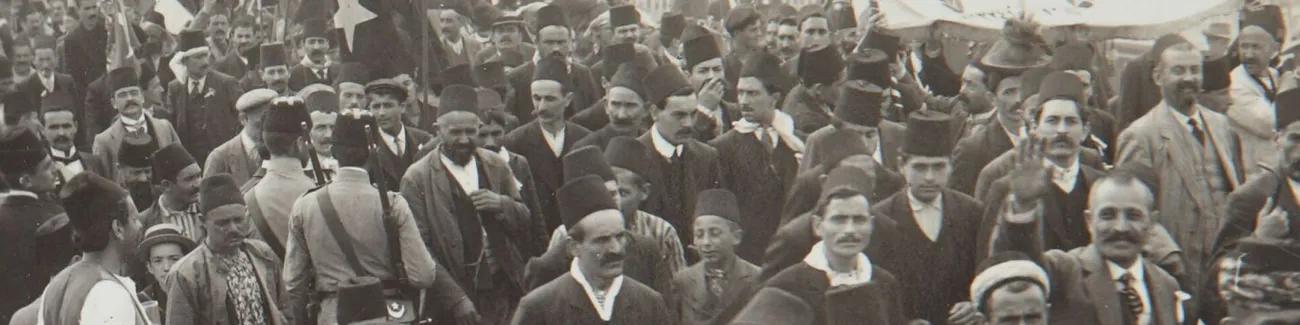
Mauser Model 1889 Rifle
Development
German brothers Wilhelm and Peter Paul Mauser produced their first bolt-action rifle in 1871, and were restless in their efforts to improve upon it. Even when their own government failed to recognise the potential of their labours, other nations paid close attention. The Model 1889 was produced after Wilhelm's death, in response to a requirement by the Belgian government for a modern infantry rifle.
Like Britain, Belgium had adopted a lever-actuated single-shot rifle just before the bolt-action came into its own. The same year Belgium adopted its M1870 'Comblain' rifle, it found itself with ringside seats to the clash between neighbours Prussia and France. Both sides were equipped with bolt-action rifles. These early weapons lacked a magazine and were actually slower to operate than lever-actuated equivalents. With the introduction of bolt-action magazine rifles like the French Lebel in 1886, single-shot designs like the Comblain were rendered obsolete overnight.
Trials were held in 1888 to determine a replacement, and with specified modifications, the Mauser offering was adopted the following year. The rifle was built by the Belgian state arsenal (Manufacture D'Armes de L'Etat), but to increase the rate of production, a private company was formed specifically to manufacture the new rifle. This was Fabrique Nationale Armes de Guerre, who built their new factory in Herstal near Liège. German company Loewe & Co. had a 50% stake in this new company.
Use and effect
The Belgian Mauser was a truly modern design in 1889, though it did include a thin metal reinforcing shroud around the barrel that proved to be unnecessary and invited corrosion from trapped moisture. Otherwise, the Belgian Mauser, with its one-piece bolt design, became the first of a series of designs that made the Mauser a world standard rifle, adopted by over 20 nations.
In July 1914, Belgium was invaded by Germany, the country that had supplied its service rifle. The Germans carried the Mauser 1898, itself an improvement upon the Belgian 1889 version. Belgium had not made the changeover to the higher velocity pointed bullet, and its rifle was therefore less powerful and less accurate. If their rifles gave them a slight edge, Germany's army was much better equipped in terms of machine guns and other weapons, and far larger in size.
Though Belgian troops significantly delayed the German advance and were able to hold part of the Western Front until the end of the war, most of the country would remain under German occupation until 1918. The Belgian Mauser continued to be produced outside the country by the W.W. Greener company in Britain and by Hopkins & Allen in the United States.
Perhaps the most important legacy of the rifle is as the first product to be manufactured by Fabrique Nationale d'Herstal or FN Herstal, who today are Europe's largest exporters of firearms. The M1889 rifle itself continued to be built until 1925, and was finally upgraded to accept modern ammunition in 1936. The old rifles served until 1949, when they were replaced by another FN rifle, the self-loading FN-49.
Statistics
- Date entered service - 1889
- Action / Operating system - Bolt
- Barrel length - 78 cm (30.7 in)
- Overall length - 1.27 m (50 in)
- Weight - 3.68 kg (8.1 lb)
- Effective range - 500 m (547 yd)
- Feed - Internal magazine
- Capacity (rounds) - 5
- Calibre / Bore - 7.65x53mm (.30 in)
- Muzzle velocity - 640 m/s (2100 fps)
- Rate of fire (rounds per minute) - about 15
- Country of manufacture - Belgium
- Manufacturer - Fabrique Nationale (FN)
- Manufacturer - Mauser
- Primary operator - Belgium
- Other operators - Germany (captured)
- Other operators - Ottoman Empire
Related Objects
Mauser Gewehr 98 Rifle and Bayonet
Development
The German tradition of bolt-action rifles was second only to that of the French. Prussia and France had clashed in 1870, and the cultural memory of that war was strong throughout the First World War. German fears of civilian insurgency was the cause of much brutality in Belgium and France, and France for her part sought revenge for her defeat. This bitter rivalry was reflected in a small arms race between the two nations.
The Prussian army adopted the original single-shot bolt-action Mauser immediately after the Franco-Prussian War, and this was developed by the Mauser brothers, Peter Paul and Wilhelm, into what became a world standard rifle, rather like the Kalashnikov today. The ultimate variant was the Gewehr 98; the culmination of a series of commercially successful rifles that began with the Model 93 sold to Spain in 1893. The rifle's ammunition was designed for the Gewehr 88, an otherwise unsuccessful German military rifle not part of the Mauser family.
Germany was the first to introduce the pointed 'spitzer' (spire-shaped) or 'S' bullet. Unlike the flat-based British .303, this was a truly modern design with an aerodynamically shaped 'boat' tail. The 7.92mm round was also powerful enough to project the special armour-piercing 'K' bullet through the side of the early British tanks.
A range of bayonets were issued for the G98, the most common being the S84/98 with 25.3 cm (10") blade. Yet the most famous today is the 'saw-back' variant of the S98/05 sword bayonet. This was demonised in British propaganda as the 'butcher blade', implied to have been designed to cause needlessly horrific wounds. In fact, bayonet blades with serrated backs had been commonly used for more than a century by both Britain and Germany. They were actually intended for issue to pioneer and engineer troops who might have a need to cut wood.
Use and effect
The robust, reliable, powerful and accurate Mauser had excelled against the British in the hands of Boer guerrillas, but did not provide an edge in 1914. Though very large and well-equipped, the German army lacked experience of modern warfare. The much smaller British Expeditionary Force had recent combat experience in South Africa and the North West Frontier (present-day Afghanistan). As a result, whilst it forced the BEF into fighting retreat, it suffered disproportionately heavy casualties against the less accurate Lee-Enfield rifle in these early battles.
Any advantage in terms of rifle technology, therefore, was with the ten-round magazine capacity and rapid action of the SMLE. As for the 'butcher blade', in practice this would not have caused any more severe a wound than the smooth S98/05. Both were broad cutting blades that created correspondingly wide wound channels. This assumes that the blade would reliably penetrate the layers of cloth and leather that an enemy soldier would be wearing, as a great deal more force would be required to push the blade home than a spike blade like that of the French Lebel.
Statistics
- Date entered service - 1898
- Action / Operating system - Bolt
- Barrel length - 74 cm (29.1 in)
- Overall length - 1.25 m (49.2 in)
- Weight - 4.09 kg (9 lb)
- Effective range - 550 m (600 yd)
- Feed - Internal magazine
- Capacity (rounds) - 5
- Calibre / Bore - 7.92x57mm (.31 in)
- Muzzle velocity - 878 m/s (2881 fps)
- Rate of fire (rounds per minute) - about 15
- Country of manufacture - Germany
- Manufacturer - Amberg arsenal
- Manufacturer - Danzig arsenal
- Manufacturer - Deutsche Waffen und Munitionsfabriken
- Manufacturer - Erfurt arsenal
- Manufacturer - Haenel Sauer & Sohn
- Manufacturer - Leipzig arsenal
- Manufacturer - Mauser
- Manufacturer - Simson Manufacturer - Spandau arsenal
- Manufacturer - V. Chr. Schilling Co.
- Manufacturer - Waffenwerke Oberspree
- Primary operator - Germany
- Other operators - Ottoman Empire
Related Objects

Mauser Model 1903 Rifle
Development
The Ottoman Empire maintained a keen interest in rifle technology. In 1890, they opted to break from their original contract with Mauser for the now obsolete 9.5mm Model 1887 rifle with its tube magazine and black powder cartridge. Instead, they purchased a slightly modified version of the new small calibre Mauser adopted by the Belgians in 1889. This had a modern vertical-feed box magazine and chambered a small calibre smokeless cartridge.
The Turkish Model 1890 did away with the sheet steel barrel shroud of the Belgian version but was otherwise identical. When another improved version was produced by Mauser, the Turks placed an order for that as well. This was the Model 1893 rifle, designed for the Spanish military with an improved bolt and a new, short magazine. Both of these models were still in use when war broke out in 1914.
At this time, however, Turkey was again re-equipping with the improved Model 1903. This was closely based on Germany's own military rifle, the definitive Mauser Gewehr 98. Model 1905 carbines were also purchased to equip the Turkish cavalry, which had fallen behind the infantry in rifle equipment.
Use and effect
The Model 1903 was closer than the original M1889 to the German Model 1898. It was chambered for a lower powered cartridge with a round-nosed bullet. This would have affected power and accuracy at range. Otherwise it differed only in detail, having a different nose-cap designed to accommodate existing Turkish bayonet fittings.
The proportions were also slightly different, and the barrel was of the older, slimmer profile. The short, integral box magazine was protected from damage, but as with the German rifle, compromised on round capacity - five rounds to the British Lee rifle's ten.
Ironically, Turkish Mausers were chambered in the 7.65x53mm cartridge of their Belgian enemy, rather than the 7.92x57mm of their German allies. This would have made sharing of ammunition between the allies difficult. Luckily, much of Turkey's ammunition supply had been made by German firm DWM prior to the war, so resupply was not a problem.
After the Central Powers were defeated in 1918, some Turks experimented with Mauser parts and captured British Enfield rifles, producing a bizarre hybrid of the two former adversaries.
Statistics
- Date entered service - 1903
- Action / Operating system - bolt
- Barrel length - 74 cm (29.1 in)
- Overall length - 1.24 m (49 in)
- Weight - 4.17 kg (9 lb 3 oz)
- Effective range - 500 m (547 yd)
- Feed - Internal magazine
- Capacity (rounds) - 5
- Calibre / Bore - 7.65x53mm (.30 in)
- Muzzle velocity - 640 m/s (2100 fps)
- Rate of fire (rounds per minute) - about 15
- Country of manufacture - Germany
- Manufacturer - Mauser
- Primary operator - Ottoman Empire
Related Objects


Schwarzlose Modell 1907/12 Machine Gun
Development
Like France, the Austro-Hungarian Empire opted to develop its own machine gun design rather than adopt a variant of the world-beating Maxim gun. In common with Maxim's more famous design, Andreas Schwarzlose's gun featured a large water cooling jacket around the barrel. It also used the 'toggle' style bolt that Maxim had borrowed from the Winchester and Henry rifles (as well as seen on the Luger pistol).
It diverged wildly from its recoil or gas-operated contemporaries by operating on the 'delayed blowback' principle. Variations on this system were to become common in submachine guns and are still used today in some rifles. It was a very unusual choice for a full-sized machine gun. Schwarzlose dispensed with the usual complex system of locking barrel and bolt together to contain the pressure of firing and then reload the weapon. Rather, he made use of a heavy bolt and powerful spring matched against the power of the cartridge to be fired. The toggle bolt only delays the movement of these parts and does not lock. This has advantages but requires great care to prevent the bolt from opening too soon and causing a stoppage, potentially damaging either weapon or operator. Schwarzlose was the first designer to solve these problems in a machine gun design.
His gun was also unusual in using a rotating wheel to convey cartridges from belt to chamber. This was similar to an early idea abandoned by Maxim. The finished design was built by the Austrian company Steyr, to whom Schwarzlose had sold the patents in 1905. An improved stronger and more reliable version of the gun was introduced in 1912 in time for service in the First World War.
Use and effect
Schwarzlose's gamble on delayed blowback paid off, resulting in a much simpler design than Maxim's. With fewer and less complicated moving parts, it was easier, quicker and less costly to produce. These were vital attributes for a mass-produced weapon as global conflict loomed. This mechanical simplicity also made it easier for soldiers to learn how to operate and maintain in the field. The gun as designed, however, did feature one complexity not found in other guns. This was an integral oiling port and pump device that lubricated the next cartridge with each shot. Being blowback-operated, fired cases might otherwise get stuck in the chamber.
Reliability was superb, although the gun did require very consistent ammunition to operate. Where a slightly weak or overpowered cartridge might cause a recoil-operated gun like the Maxim to 'stutter', the Schwarzlose might stop firing entirely. Quality control in ammunition manufacture was therefore essential, but that was hard to ensure in a time of war. The gun also had a relatively low rate of fire, which can be a disadvantage in some situations.
Where the design really suffered was in the shortened gun barrel. This was necessitated by the blowback mechanism but reduced velocity, range, and accuracy. It also increased muzzle flash. All of these factors became increasingly important as machine gun design and tactics evolved towards offensive operations from around 1916 onwards. The Schwarzlose was therefore an excellent defensive weapon but did not have the flexibility and longevity of the Maxim designs.
By the time of the Second World War, it was relegated to use away from the front line with reserve forces or installed in fortifications.
Statistics
- Date entered service - 1912
- Action / Operating system - Blowback
- Barrel length - 52.7 cm (20.7 in)
- Overall length - 1.067 m (42 in)
- Weight - 50 kg (111 lb) (with mount)
- Effective range - 1000 m (1094 yd)
- Feed - Belt
- Capacity (rounds) - 250
- Calibre / Bore - 6.5x55mm Swedish
- Calibre / Bore - 6.5×53mmR Dutch Mannlicher
- Calibre / Bore - 7.92×57mm Mauser Calibre / Bore - 8x50mmR Mannlicher (.31 in)
- Calibre / Bore - 8×50mmR Mannlicher
- Calibre / Bore - 8×56mmR Steyr (Hungarian)
- Muzzle velocity - 579 m/s (1900 fps)
- Country of manufacture - Austria-Hungary
- Manufacturer - Steyr
- Primary operator - Ottoman Empire
- Other operators - Bulgaria
- Other operators - Czechoslovakia
- Other operators - Italy (captured)
- Other operators - Netherlands
- Other operators - Romania
- Other operators - Serbia
- Other operators - Sweden
Related Objects

Maxim MG08 Machine Gun
Development
In 1888, Kaiser Wilhelm II fired a Maxim gun. He was so impressed that he ordered that his Dragoon Guards to be equipped with a number of these early guns. By 1892, a formal contract had been signed with the British-based Maxim Nordenfelt Company for the first German Maxim guns. Standing on the side lines of the Russo-Japanese War in 1902, Germany was among the first countries to recognise the potential of the machine gun in modern warfare. The firm Deutsche Waffen und Munitionsfabriken (DWM) was commissioned to develop an improved gun.
As with the Vickers gun, the British equivalent, the biggest concern was weight and all efforts went into reducing this by using lightweight materials. This resulted in the MG 08, which despite some claims to the contrary, was only 3 kilograms heavier than the more comprehensively redesigned British Vickers. It did, however, retain the bigger, boxier receiver of the original Maxim gun as well as its mechanical complexity.
The MG 08 comprised of 235 individual parts compared to the 144 of the Vickers. What drastically increased the total weight of the package was the gun's mount. Instead of the typical tripod, a four-legged collapsible sledge mount (the 'Schlitten' 08) was developed. This was extremely stable but was even larger and heavier than the solid brass tripod of the Vickers. It was designed to be dragged into position, but the churned muddy ground of the Western Front made this difficult.
Finally, a veritable suit of armour was produced for the MG 08, including shields shaped to fit the water jacket. Gun crews were sometimes also issued the 'Sappenpanzer' steel body armour and 'Stirnpanzer' brow plate for their helmets adding yet more weight to carry.
Use and effect
The fact that Germany was content to persist with a more complex and heavier system reflects adherence to tactics developed prior to the First World War. These emphasised the strength of the machine gun as a short range, defensive weapon. Over two thirds of German small arms ammunition was expended by their machine guns, which primarily operated in this defensive role.
Even where guns were supplied with optical sights and men trained in offensive tactics, they were taught to use direct fire when the enemy was visible. Little effort was expended developing the advanced long-range firing techniques that would later help to win the war for the Allies.
Historians have tended to blame the high number of Allied casualties seen during the Allied counter-attack of August 1914 upon the numerical superiority of German machine guns. In fact, many of those guns were not deployed at the front line, and the successful use of the MG 08 in the defence was much more important. The more complicated MG 08 and its heavier mount did give a slight edge to the more portable and easier to produce Vickers gun as the war came down to a duel between machine guns.
Britain was able to catch up with Germany in production rates and pioneered the development of more dynamic machine gun tactics from 1915. In response, lightweight trench mounts were invented for the MG 08. These consisted of a simple block of wood which seriously compromised the gun's effective range. The introduction of the MG 08/15 light variant gave the infantry mobile firepower but was also inaccurate at long distances. The MG 08 and 'Schlitten' 08 remained essential therefore.
Nonetheless, it is easy to overstate these minor technical disadvantages. Any edge that the British Vickers had over the MG 08 seems to have been overcome by effective training. The MG 08 deployed with only a four man crew, two less than the Vickers. All told there was little between the two guns and differences in tactics proved far more important. Improved German tactics and new guns were in development by 1917 - the same year the United States entered the war, bringing decisive industrial resources and manpower with her.
Statistics
- Date entered service - 1908
- Action / Operating system - Recoil
- Barrel length - 72 cm (28 in)
- Overall length - 1.175 m (46 in)
- Weight - 62.2 kg (137 lb) (with water & mount; another 6 kg with armour shields)
- Effective range - 2286 m (2500 yd)
- Maximum range - 3658 m (4000 yd)
- Feed - Belt
- Capacity (rounds) - 250
- Calibre / Bore - 7.92x57mm (.31 in)
- Muzzle velocity - 900 m/s (2953 fps)
- Rate of fire (rounds per minute) - 450
- Crew - 4
- Country of manufacture - Germany
- Manufacturer - Deutsche Waffen und Munitionsfabriken
- Manufacturer - Erfurt arsenal
- Manufacturer - Spandau arsenal
- Primary operator - Germany
- Other operators - Austria-Hungary
- Other operators - Britain (captured)
- Other operators - China
- Other operators - Ottoman Empire
Related Objects
Bergmann MG15 nA Light Machine Gun
Development
The MG 15, not to be confused with the 1930s weapon of the same designation, was a German answer to the American Lewis light machine gun. Like the similarly named but entirely different MG08/15 (based on the Maxim gun), it was a compromise redesign derived from a heavy machine gun. Unlike the 08/15, it did away with a heavy water cooling system in favour of a slotted barrel jacket.
The weapon's designer was Louis Schmeisser, father of the famous Hugo Schmeisser, known for creating the first submachine gun ever issued (the MP 18,1), amongst other designs. Machine guns are almost always designed to fire with an open bolt, allowing cold air to cool the mechanism and prevent overheating. Unusually, the MG 15 was redesigned to fire when its mechanism was closed, creating the MG 15nA (neue Art - new Model). This change of approach was necessitated by the unreliability of the open bolt version.
Both versions were also developed as aircraft machine guns, where cold air at altitude negated cooling problems. For air service, the rate of fire was boosted to 800 rounds per minute, increasing the probability of a hit on an enemy aircraft.
Use and effect
Though substantially lighter (5 kg / 11 lbs) than the MG 08/15, the MG 15 did not replace it in service, and saw relatively little German use on the ground, being more successful as an aircraft machine gun. A number were also issued to the Asia Korps sent to assist the Ottoman army, and may also have been supplied directly. The closed bolt redesign solved inherent reliability problems with the design, but would have made for a less effective machine gun that required periodic cooling.
The primary advantage of the Bergmann aside from low weight was that it could be fed from various standard lengths of belt. This included a 100-round belt inside a 'Kurbel' drum holder clipped to the side of the weapon. This was more convenient than a long dangling belt, but gave more than twice the capacity of the enemy Lewis gun. The weapon also pioneered the use of disintegrating metal links, which later replaced cloth belts and are now a standard feature. These are clipped together with rounds of ammunition, and break apart on firing, being ejected from the weapon along with the empty cases. When necessary, new lengths of belt can easily be created by collecting the used links and clipping them together with fresh rounds.
Statistics
- Date entered service - 1915
- Action / Operating system - Recoil
- Barrel length - 71.6 cm (28.2 in)
- Overall length - 1.12 m (44.1 in)
- Weight - 12.9 kg (28.4 lb) (with bipod)
- Effective range - 400 m
- Feed - Belt
- Capacity (rounds) - 100, 200, or 250
- Calibre / Bore - 7.92x57mm (.31 in)
- Muzzle velocity - 892 m/s (2925 fps)
- Rate of fire (rounds per minute) - 500
- Crew - 1
- Country of manufacture - Germany
- Manufacturer - Bergmann Industriewerke
- Primary operator - Germany
- Other operators - Austria-Hungary
- Other operators - Ottoman Empire
Related Objects

Ottoman Cavalry Sword
Development
Following the German led reforms of the Ottoman military in 1908, Ottoman regular cavalry were reequipped with a sword of German design and manufacture. With a pipe-back and quill point, it had an almost identical blade to the German Kavalerie Degen 89 sword. The slightly curved, flexible blade, however, made it a combination cut and thrust weapon, keeping alive the long Eastern tradition of curved cavalry swords.
On the back of the grip is a chequered thumb depression, to provide a secure position when thrusting. Unlike the Kavalerie Degen 89 sword, the lack of a forefinger protrusion and straight, rather than cocked, grip meant the sword could also be held in a manner conducive to cutting.
Produced in Solingen by the sword manufacture Carl Eickhorn, over 10,000 of these swords were shipped to reequip the 24 regular cavalry regiments of the Ottoman army between 1909-1914.
Use and effect
Despite the success of a divisional level cavalry charge against Bulgarian infantry in the otherwise disastrous battle of Lule-Bargas of the 1912 Balkan War, little evidence exists for the use of this weapon. The story of Ottoman cavalry in the First World War is one of them avoiding combat with the vastly superior numbers of British cavalry that opposed them, whilst bringing back valuable intelligence on their surefooted Arab horses.
When Ottoman cavalry was deployed in strength at Buqqar Ridge on 27 October 1917, seven hours of bitter fighting and repeated mounted charges against a Commonwealth garrison left only three British survivors.
Statistics
- Date entered service - 1908
- Blade length - 83.8 cm (33 in)
- Overall length - 95.3 cm (38.5 in)
- Weight - 1.2 kg (2 lb 3 oz) (without scabbard)
- Country of manufacture - Germany
- Manufacturer - Carl Eickhorn, Solingen
- Primary operator - Ottoman Empire
Related Objects

Austria-Hungary
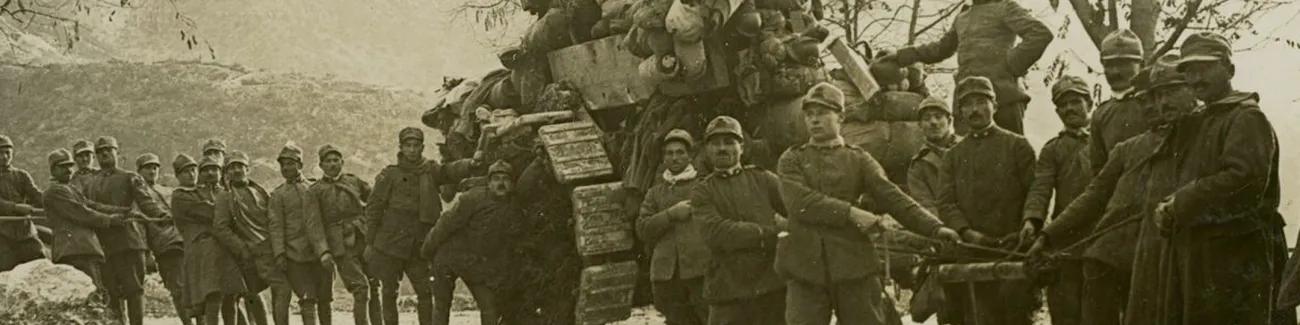

Steyr-Mannlicher Modell 1895 Rifle
Development
In 1884, just as the conventional bolt-action magazine rifle was being adopted around the world, Austrian inventor Ferdinand Ritter Von Mannlicher was pushing the technology still further. Conventional bolt-actions had a handle that had to be rotated through 60 or 90 degrees before the bolt could be pulled back. This ensured that the bolt remained closed during firing and that hot, pressurised gas did not escape and harm accuracy, the fabric of the weapon, or the shooter.
Mannlicher came up with a mechanical system to convert forward and backward motion into the rotary motion needed to lock the bolt. For the 1895 version of his rifle, Mannlicher borrowed the locking arrangement of the Mauser rifle. This meant adding two large locking lugs at the front of the bolt, making it stronger and the rifle more reliable and accurate. He had also devised an 'en bloc' clip system that held several rounds within the rifle, ready to fire, and ejected the clip automatically when empty.
Carbines and short rifles for non-infantry roles, such as the 'Stutzen short rifle variant, were also designed based on the full-length rifle.
Use and effect
Mannlicher's design was indeed faster to operate, requiring only that the soldier pull back and forth on the bolt handle between shots. It could in theory reach a rate of fire faster than any bolt-action, and was still more reliable than the unproven self-loading rifles of the time. In practice, however, it could be difficult to get the bolt moving to the rear because of the heat, friction, and dirt produced on firing. This could reduce the rate of fire to that of a conventional rifle, or even lead to a serious jam. Turning bolt designs overcame this problem by providing greater leverage.
Like all straight-pull designs, the M1895 required more moving parts in order to reduce the number of motions the shooter had to perform to operate the bolt. Increased mechanical complexity inevitably made the weapon more likely to jam than a simple turn-bolt design and harder to get back into the fight when it did. Factoring in the mud of the trenches and accumulated dirt from heavy firing, it was a less reliable weapon than the bolt-action rifles of the day.
Its clips had to be inserted the right way up to reload, and whilst it was impossible to insert one upside-down, attempting to do so could cost precious time in a firefight. The 'en bloc' clip system also had pros and cons. If kept clean, it was faster than any other loading system then in use. In fact, it is quicker than many modern rifles.
A similar system was used on the later self-loading American M1 Garand. Unlike the Garand though, it ejected out of the bottom of the rifle, meaning that mud could get into the action. It also meant that having fired part of his clip, a soldier had to make do with whatever rounds he had left, or eject the whole clip and insert a fresh one. Single rounds were useless unless collected and loaded into a clip, which had to be full for insertion. In close-quarter battle, this could be disastrous for individual soldiers. Austro-Hungary did seek to replace the rifle, but was unable to do so amidst the economic pressure of the War.
Statistics
- Date entered service - 1895
- Action / Operating system - Straight-pull bolt
- Barrel length - 1.272 m (50 in)
- Overall length - 76.5 cm (30 in)
- Weight - 3.8 kg (8 lb 6 oz)
- Effective range - 550 m (600 yd)
- Feed - En bloc clip
- Capacity (rounds) - 5
- Calibre / Bore - 8×50mmR Mannlicher
- Muzzle velocity - 620 m/s (2030 fps)
- Rate of fire (rounds per minute) - about 35
- Country of manufacture - Austria-Hungary
- Manufacturer - Steyr
- Primary operator - Austria-Hungary
Related Objects


Mannlicher Repetier Stutzen Modell 1895 Rifle
Development
Ferdinand Ritter von Mannlicher (1848-1904), a designer with the Austrian railway corporation, was inspired to build his own rifle by a visit to the International Exhibition in Philadelphia in 1876. From 1880, he designed a variety of such rifles, however his breakthrough came when he proposed a rifle with a magazine positioned in the centre of the stock. This rifle was introduced into the Austro-Hungarian Army in 1886.
The Modell 1895 was originally intended to be manufactured by Steyr, as were many of Mannlicher's previous designs. Instead, it was manufactured in Budapest by Fegyver és Gépgyár R.T (F.G.GY), from 1897-1918. Based on Mannlicher's original straight-pull bolt-action infantry rifles, the Stutzen is often confused with its rarer cousin the Mannlicher Kavaliere Repetier-Carabiner Modell 1895 (Cavalry Carbine).
The Mannlicher design meant that through opening the base of the magazine, the empty clip could be ejected. Later Mannlicher rifles allowed the empty clip to be ejected through the open receiver by depressing the clip catch inside the trigger guard. The 'en-bloc' clip has a dedicated bottom and top, meaning that the rounds can only be loaded the correct way up due to the rimmed ammunition used. This system meant that the magazine could not be fed with single rounds, resulting in the Mannlicher 'en-bloc' clip system eventually being replaced by Mauser type stripper clips.
Use and effect
Designed for Austro-Hungarian special troops such as the Engineers, the Stutzen Mannlicher Modell 1895 is often confused with Mannlicher Modell 1895 Cavalry Carbine. The difference between the two being that the Stutzen is fitted with a bayonet lug and has sling swivels attached to the underside of the weapon. The Cavalry Carbine has side slings, making it easier to carry whilst mounted and has no bayonet lug.
After the Austrio-Hungarian defeat in 1918, many were given to other Balkan states as war reparations.
Statistics
- Date entered service - 1897
- Action / Operating system - Bolt-action
- Barrel length - 50 cm (19.7 in)
- Overall length - 1 m (39.5 in)
- Weight - 3.09 kg (6 lb 13 oz)
- Effective range - 450 m (492 yd)
- Feed - En-bloc clip
- Capacity (rounds) - 5
- Calibre / Bore - 8x50mmR Mannlicher
- Muzzle velocity - 580 m/s (1900 fps)
- Rate of fire (rounds per minute) - about 35
- Country of manufacture - Austria-Hungary
- Manufacturer - Fegyver és Gépgyár R.T (F.G.GY)
- Primary operator - Austria-Hungary
Related Objects


Roth-Steyr Modell 1907 Pistol
Development
Austria began replacing its outdated Rast-Gasser revolvers with this self loading short recoil pistol. Designed by Georg Roth and Karel Krnka, the Roth Steyr Modell 1907 was the first self-loading pistol to be adopted by any military in any country.
Krnka is an interesting figure in the history of firearms. Son of Sylvester Krnka, with whom he had designed a repeating Russian army rifle, Krnka left the Austrian Army in 1887 to become chief engineer at the Gatling Gun and Ammunition Works in Birmingham. By 1898, he became a designer and manager of the G.Roth ammunition factory, where he remained until 1908.
All of Roth's patents from this period originate from his inventions, with the most successful of all being this pistol. Since Roth was an ammunition factory and had no weapons production capabilities, these pistols were manufactured elsewhere. Around 60,000 of these pistols were manufactured at Österreichische Waffenfabriksgesellschaft Gesellschaft (Steyr) and 30,000 at Fegyvergyr.
Chambering the relatively weak 8mm Roth-Steyr cartridge, the results from making a hit with this weapon were not that phenomenal. Yet when compared to the pistols of Austria's rivals, such as the Italian Glisenti Modello 1910 pistol, although it had a slightly larger heavier round, the muzzle velocity of the Roth-Steyr provided the Austrians with slightly more penetrative power.
This pistol has a strange reloading system. Although the action of the breech mechanism reloads the pistol, it does not cock the striker. This is done by the trigger mechanism, which is double-action and requires a heavy trigger pull to cock the pistol.
Use and effect
Initially intended for cavalry use, this is perhaps the reason why the pistol requires a heavy trigger pull. As there is no safety feature on this pistol, this reduces the chance of accidental discharge. The pistol found its way into both the infantry and the air force, becoming known as 'Flieger-Pistole' (Flyer Pistol). It was also used by the Australian air service.
The pistol's fixed magazine meant that stripper clips of ten rounds were needed to be carried in order to reload the pistol. The clips had a useful thumb guide at the top of the clip in order to reload quickly and efficiently. Interestingly, the striker-fired system adapted by this pistol is still seen in most Glock pistols today.
Statistics
- Date entered service - 1909
- Action / Operating system - Recoil
- Barrel length - 13 cm (5.1 in)
- Overall length - 23 cm (9.1 in)
- Weight - 1 kg (2 lb 2 oz)
- Effective range - 50 m (55 yd)
- Feed - Internal magazine
- Capacity (rounds) - 10
- Calibre / Bore - 8 mm Roth-Steyr (0.31 in)
- Muzzle velocity - 332 m/s (1090 fps)
- Country of manufacture - Austria-Hungary
- Manufacturer - Fegyver és Gépgyár R.T (F.G.GY)
- Manufacturer - Österreichischen Waffenfabriks-Gesellschaft (Steyr)
- Primary operator - Austria-Hungary

Join the conversation