The Line of Kings - Part 4

1868 - 2013

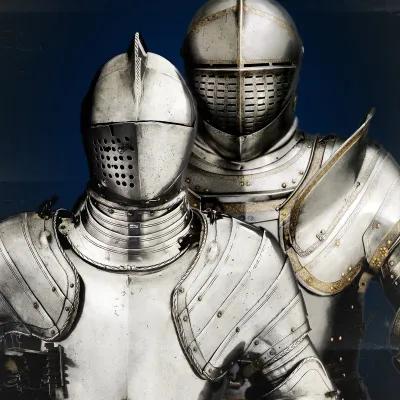
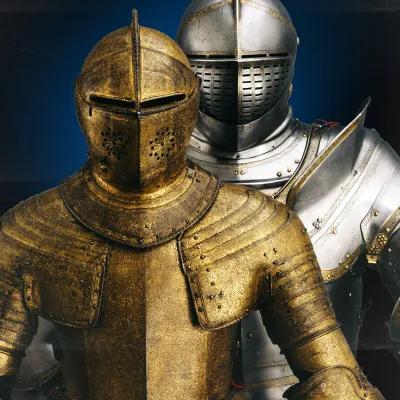
A colour photo of a row of high medieval armour under purple and warm lighting against a stone wall

Despite popular appeal, by the late 19th century the Horse Armoury was no longer fit for purpose. The premises were in a state of disrepair, and the displays in the armoury still had inaccuracies. It would take the work of two curators to correct these problems and install the Line of Kings in their current home in the White Tower. 

0
No votes yet
Login or register to rate this

A New Home

By the late 1860s, the Horse Armoury had become incredibly popular. Yet despite the great public appeal, the attraction was causing the War Office no end of problems. Built in 1826, the New Horse Armoury was beginning to show its age. The roof leaked badly, with water pouring onto the objects below, and the building was suffering subsidence. Attempts to repair the problems in 1869 failed, and there was no desire to construct another armoury. It was time to find the ‘Line’ a new home. 

In 1882-3, the wooden horses and their riders were placed for the first time inside the White Tower. The room chosen to house the display was a large room on the top floor known as the Council Chamber. Meanwhile, the future of the New Horse Armoury was uncertain. Plans were made to demolish the old attraction, which would reveal the south side of the Norman White Tower and evoke the feeling of a medieval castle. The demolition of the New Horse Armoury building, which had housed the ‘Line of Kings’ from 1827 to 1882, was completed in about 1885.

A sepia tone photograph of the interior of the New Horse Armoury, showing a line of armour mannequins on either side of a narrow aisle.
The New Horse Armoury, London, 1870.

The White Tower

A sepia tone engraving of the Council Chamber in the White Tower of the Tower of London. People in Victorian dress are walking around.
The Council Chamber in the White Tower served as the main function room when monarchs held court at the Tower. Later, the room was lined with firearms before the arrival of the Horse Armoury. The Council Chamber, London, 1863.

The Council Chamber in the White Tower, soon known as the Horse Armoury, was not entirely suited to the display. Space was limited, and the figures could no longer be displayed in a single line as before. This floor of the White Tower had large light wells at this time, allowing daylight into the rooms below. The Horse Armoury was laid out around these features, which had distinctive railings made from real swords and pistols. Not long after the Horse Armoury was moved into the Council Chamber, electric lighting was introduced to improve the visitor experience.

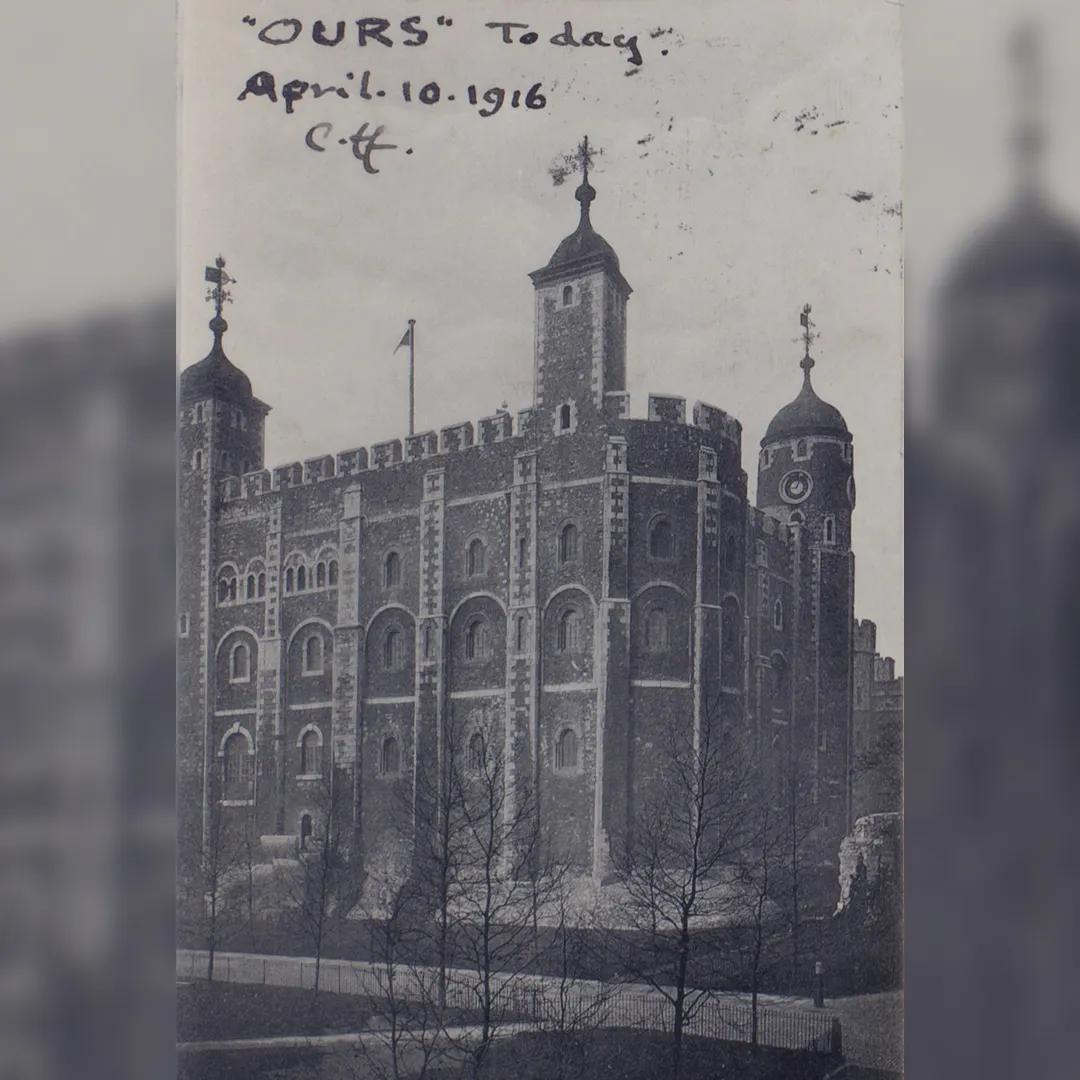
The popularity of the new display is reflected in the variety of picture postcards. From about 1900 these provided many different views of the objects. The Yeoman Warders no longer led visitors around the Horse Armoury. Yet they had the right to sell postcards of the Tower which many visitors bought as souvenirs or posted for friends and family to see.
Viscount Dillon

As well as continuing to develop as a very popular visitor attraction, the Tower Armouries was gradually emerging as the national centre for the study of arms and armour. After decades of unsuccessful attempts, a curator with in-depth knowledge of the subject was at last appointed in 1895. Viscount Dillon was the author of many books and articles. He set about carefully researching the collection, which had previously been in the care of the War Office Storekeeper and his assistants. The task was challenging as: 

...a huge mass of rubbish and spurious armour were allowed even then to remain amongst the historic and genuine specimens. It is only since Lord Dillon undertook the great task, on which he is still engaged, of re-arranging and re-cataloguing the arms and armour in the White Tower, that it can be properly studied and appreciated. 

A black and white photo of a grey haired and bearded man in military uniform sat against a dark background
An ancestor of Dillon, Sir Henry Lee, also served as Master of the Armouries under Elizabeth I. According to ffoulkes, Dillion enjoyed putting on his and other sets of armour to see how the rivets and joints worked. Viscount Dillon, London, 1913.

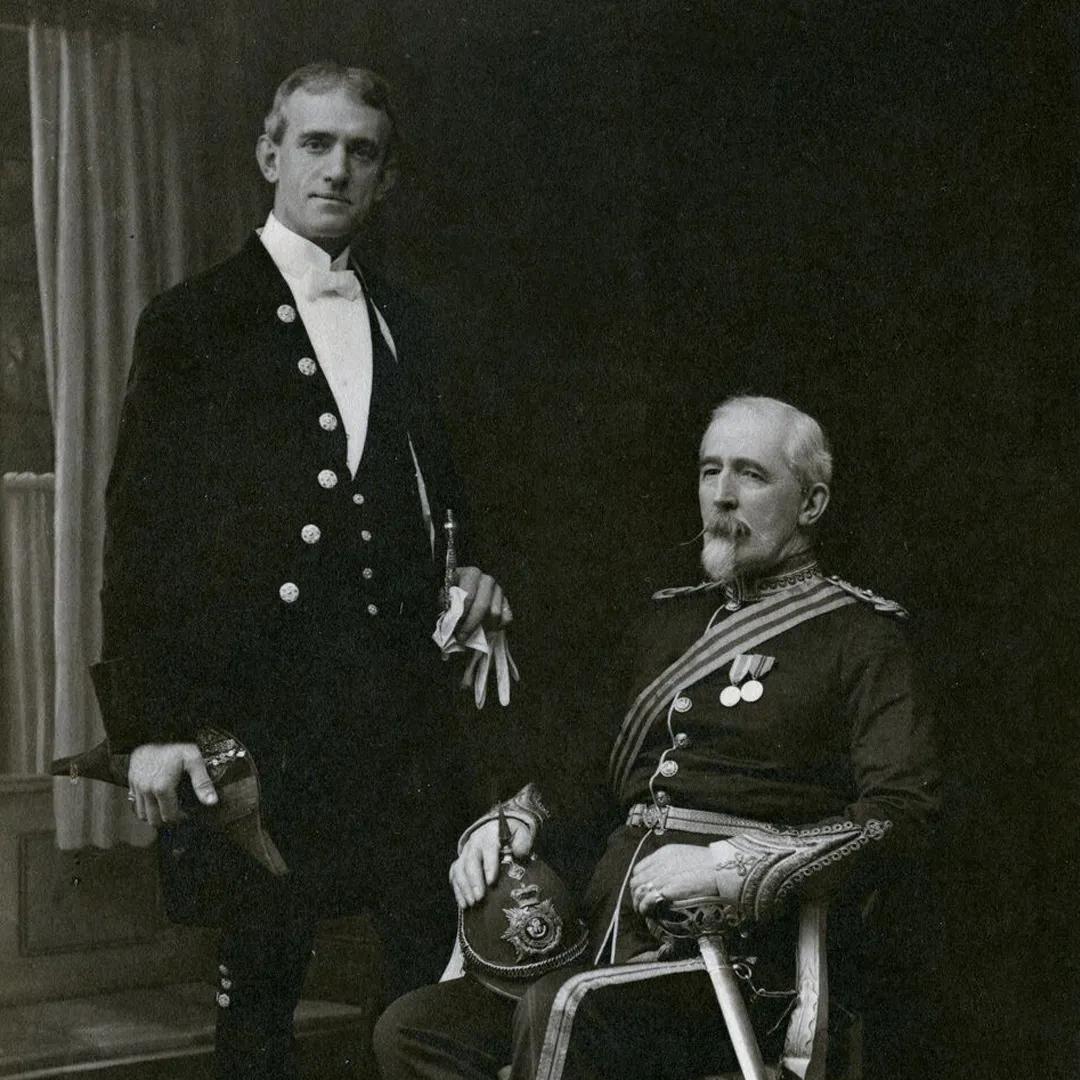
Charles ffoulkes

A black and white photograph of a man in white tie stood posing in front of a dark, curtain type background.
Dillon's 'Official Inventory of the Armouries' of 1909 was annotated with ffoulkes's numbering in 1916, which is largely the same numbering system the Armouries uses today. Charles ffoulkes, London, 1913.

Dillon retired in 1913 and was replaced by another armour scholar, Charles ffoulkes. By the start of the First World War in 1914, almost the entire White Tower was filled with displays of arms and armour.

The displays were improved by combining popular visitor appeal with better research into the history of arms and armour. New catalogues and guidebooks were also published. The royal armours and the carved horses remained important attractions, sometimes arranged like a procession, sometimes in a row along the walls. Some were even placed in different rooms. Occasionally it was necessary to replace one or two of the 17th century wooden horses which had become rotten, with modern replacements.

Timeline of European History

1870
An engraving showing Prussian soldiers in military uniform including mostly black battle dress, pickelhaube helmets, and backpack.
The Franco-Prussian War
1880 - 1902
A black and white illustration of a British colonial soldier with a bandage around his head, standing tall while reloading.
The Boer Wars
1884
A black and white cartoon depicting the German chancellor Otto von Bismarck hovering over a cake called Afrique (Africa), ready to carve it up for the other European men at the table.
The Berlin Conference
1886
A black and white photo of Tower Bridge under construction, complete with scaffolding, cranes, and boats running underneath on the river
Construction begins on Tower Bridge
1887
A book cover of the Sherlock Holmes mystery A Study in Scarlet
Sherlock Holmes First Appears in Print
1888
A sepia tone engraving of a man in Victorian garb running down a set of stairs to find a woman lying murdered at the bottom.
Jack the Ripper
1901
A black and white etching of Edward VII of England in imperial robes and various orders
Edward VII
1910
A black and white illustration of George V in crown and robe sweeping away other crowns in a dust cloud that reads 'Made in Germany'.
George V
1912
A black and white photograph of an ocean liner in mostly black paint being built while surrounded by scaffolding.
Sinking of the Titanic
1914 - 1918
A black and white photograph of a French soldier taking cover in a shallow trench in a wooded area. More soldiers appear behind him, all taking cover.
The First World War
1922
A black and white illustration showing the earliest logo of the BBC.
Founding of the BBC
1928
A black and white photograph of Alexander Fleming, with white hair and a bow tie
Discovery of Penicillin
1936
A black and white photo of three kings, George V, Edward VIII, and George VI bowing their heads at a war memorial
Edward VIII & George VI
1939 - 1945
A black and white photo of a collection of British soldiers during the Second World War monitoring the skies for signs of German aircraft.
The Second World War
1947
A black and white photograph of Mohandas Gandhi standing outside No.10 Downing Street wearing his familiar white robes.
Indian Independence
1950 - 1953
A black and white photograph of a collection of Chinese and North Korean prisoners huddled in blankets, waiting in line.
The Korean War
1952
A colour illustration of a young Queen Elizabeth II in a crown
Elizabeth II
1954 - 1975
A black and white photo of an American soldier in Vietnam burning a collection of items belonging to villagers in My Lai
The Vietnam War
1982
A colour photograph of a large pile of discarded weapons left by Argentine conscripts after the recapture of the Falklands
The Falklands War
1989
A black and white photo of people on top of a concrete wall helping each other up to stand or cross the barrier.
Fall of the Berlin Wall
1999
A colour photograph of the debating chamber of the Scottish Parliament
Devolution & The Good Friday Agreement
2001
A colour photograph of the New York skyline on 11th September 2001. A plume of smoke and dust rises from where the World Trade Centre used to be.
9/11
2008
A black screen with red and green numbers separated by orange bars denoting rising and falling stock values.
Financial Crash of 2008
1870
The Franco-Prussian War

France under Napoleon III declares war on Prussia in July 1870, beginning the Franco-Prussian War. The war is disastrous for France as the highly organised Prussians defeat and capture Napoleon at the Battle of Sedan. Without a leader, Paris descends into anarchy, resulting in the Paris Commune; an early Communist state which is bloodily destroyed after two months. For Prussia, it was the final war that convinced the German states to unify in 1871, creating the German Empire. 

An engraving showing Prussian soldiers in military uniform including mostly black battle dress, pickelhaube helmets, and backpack.
Prussian infantry from the Franco-Prussian War. The Illustrated London News, 1870
Close
1880 - 1902
The Boer Wars

In 1880, the British Army enters into a series of wars with the South African Boers. This is a result of British efforts to unite disparate colonies in the region under one banner. During the First Boer War (1880 - 1881), the Boers engage in a campaign of guerrilla warfare against the British and initially secure some important victories. During the Second Boer War (1899 - 1902), the British however begin a policy of burning farms and building concentration camps for Boer civilians. These policies are quickly reversed due to a public backlash. The Boers are eventually defeated, and the Union of South Africa is established in 1910. 

A black and white illustration of a British colonial soldier with a bandage around his head, standing tall while reloading.
A British soldier reloads during a skirmish in South Africa, from With the flag to Pretoria a history of the Boer War of 1899-1900 by H. W. Wilson London, 1900.
Close
1884
The Berlin Conference

In response to the colonisation of large sections of Africa, the European powers meet for the Berlin Conference. The purpose is to avoid colonial conflicts that could spark a larger war. In practice, the conference establishes a blueprint for the division of the continent of Africa among the powers, regardless of existing peoples living there.

A black and white cartoon depicting the German chancellor Otto von Bismarck hovering over a cake called Afrique (Africa), ready to carve it up for the other European men at the table.
A cartoon of the Berlin Conference from the French magazine L'illustration, 1885, Wikimedia/Jackinthelight
Close
1886
Construction begins on Tower Bridge

Work begins on Tower Bridge; the iconic London landmark near the Tower of London. During the 19th century, London’s population booms, leading to calls for additional routes across the river. However, the capital is also a major port, and any bridge needs to allow for tall-masted shipping. The result is a towered bascule bridge with a walkway for passengers spanning the Thames. 

A black and white photo of Tower Bridge under construction, complete with scaffolding, cranes, and boats running underneath on the river
Tower Bridge under construction, September 28th 1892, Wikimedia
Close
1887
Sherlock Holmes First Appears in Print

The first entry in the Sherlock Holmes series, “A Study in Scarlet”, is published by Arthur Conan Doyle in 1887. Initially published in ‘Beeton’s Christmas Annual’, the story becomes highly popular and is the beginning of a series of over 50 works featuring the detective. 

A book cover of the Sherlock Holmes mystery A Study in Scarlet
Book cover for A Study in Scarlet, published by Ward, Lock & Co. 1887
Close
1888
Jack the Ripper

In the autumn of 1888, five women are brutally murdered in Whitechapel, London. The manhunt for the killer becomes one of the most high-profile cases in British history. During the investigation, police receive a high number of letters allegedly from the murderer. Some of the letters were signed ‘Jack the Ripper’ – a name picked up by the press. The cases were never solved, although they have continued to generate interest. 

A sepia tone engraving of a man in Victorian garb running down a set of stairs to find a woman lying murdered at the bottom.
Cover of Famous Crimes, Past and Present: The Discovery of Jack the Ripper's First Murder, London, 1903. Wikimedia.
Close
1901
Edward VII

In 1901, Queen Victoria dies after 63 years on the throne. She is the longest reigning monarch in British history until Elizabeth II. Her son, Edward VII takes the throne. His reign is marked by forming good relations with other nations, including France and Japan. 

A black and white etching of Edward VII of England in imperial robes and various orders
Edward VII, King of England, by Franz Raubicheck, from U.S. Library of Congress
Close
1910
George V

Edward VII dies after several years of poor health. He is succeeded by his son, George V. The most important change under George was the abandonment of the Royal Family’s German connections, changing their name from Saxe-Coburg and Gotha to Windsor. During his reign, the First World War and Irish independence marked a change in Britain’s position in the world. 

A black and white illustration of George V in crown and robe sweeping away other crowns in a dust cloud that reads 'Made in Germany'.
George V sweeps away his German titles. Cartoon from Punch, or the London Charivari, by Leonard Raven-Hill, 1917
Close
1912
Sinking of the Titanic

In April 1912, the ocean liner RMS Titanic sinks in the North Atlantic after striking an iceberg. Despite carrying over 2,000 people on board, the ship only has lifeboat space for 1,178. More than 1,500 people die in the sinking, either from drowning or exposure in the cold Atlantic water. The first International Conference for Safety of Life at Sea is established in London in 1913 to prevent further incidents.

A black and white photograph of an ocean liner in mostly black paint being built while surrounded by scaffolding.
The building of the Titanic while in drydock in Belfast, by Bain News Service, 1912, from U.S. Library of Congress
Close
1914 - 1918
The First World War

In June 1914, a Serbian nationalist called Gavrilo Princip assassinates Austrian Archduke Franz Ferdinand and his wife. The act sparks over four years of bloody war as European empires are dragged into conflict through a system of alliances. Over 15 million people die through disease, hunger, or violence. Four empires, Russia, Ottoman, Austro-Hungary, and Germany, fall in the aftermath. The victorious nations of Britain, France, United States, Belgium, and Italy enact harsh terms on Germany in the Treaty of Versailles in 1919. 

A black and white photograph of a French soldier taking cover in a shallow trench in a wooded area. More soldiers appear behind him, all taking cover.
French infantryman armed with a Lebel rifle, Zillebeke, Belgium, 1915. Taken from a photograph album compiled by Captain F.D.R. Milne.
Close
1922
Founding of the BBC

The British Broadcasting Company (changed to Corporation in 1927) was formed on 18th October 1922. The General Post Office establishes two successful radio stations in 1922, leading to a growth in applications for broadcasting licenses. To prevent a rash of unregulated radio stations, a single broadcast license is issued to unify these stations under one banner, known as the BBC. 

A black and white illustration showing the earliest logo of the BBC.
The logo of the British Broadcasting Company, founded in 1922. Wikimedia.
Close
1928
Discovery of Penicillin

Scottish bacteriologist Alexander Fleming discovers penicillin in 1928 in St. Mary’s Hospital in London. The discovery is almost an accident, as Fleming notes how mould growing in discarded petri dishes are killing cultivated bacteria colonies. It would be another thirteen years before British scientists find a way to produce practical amounts of antibiotics, saving potentially millions of lives. 

A black and white photograph of Alexander Fleming, with white hair and a bow tie
Alexander Fleming, the discoverer of Penicillin. 1945, Nobel Foundation.
Close
1936
Edward VIII & George VI

On 20th January 1936, George V dies after being euthanised by his doctor. He is succeeded by his son, Edward VIII. Edward’s relationship with an American divorcee, Wallis Simpson, puts pressure on the king to either leave her or abdicate. He chooses to abdicate less than a year into his reign. With no heir, the crown passes to his younger brother, George VI. 

A black and white photo of three kings, George V, Edward VIII, and George VI bowing their heads at a war memorial
Three kings, George V (front left), Edward VIII (back), and George VI (front right), pay their respects at the Cenotaph. London, 1927. Source gallica.bnf_.fr/BnF
Close
1939 - 1945
The Second World War

In September 1939, Nazi Germany invades Poland. Britain and France, Poland's allies, declare war on Germany shortly after, starting the Second World War in Europe. The U.S. and Soviet Union join the war in 1941 after being attacked by Japan and Germany respectively. Estimates put the death toll for the Second World War between 70 and 85 million people, across battlefields in Europe, Asia, and Africa. Britain loses approximately 450,000 soldiers and civilians over six years. The war ends in an Allied victory, but Europe is devastated and a Cold War develops between the Soviet Union and United States. 

A black and white photo of a collection of British soldiers during the Second World War monitoring the skies for signs of German aircraft.
The Watch on the Skies Around Britain's Shores from Picture Post Illustrations, Britain, 1939-1945
Close
1947
Indian Independence

The British Raj gains independence from the United Kingdom on 15 August 1947. It is the result of a decades long campaign of political agitation and protest, most notably by Mohandas Gandhi. To prevent religious violence, Britain partitions the former colony into two new nations – majority Muslim Pakistan and majority Hindu India. Partition is highly damaging, with an estimated 1 million people thought to die in the process. 

A black and white photograph of Mohandas Gandhi standing outside No.10 Downing Street wearing his familiar white robes.
Mohandas Gandhi outside No.10 Downing Street for a roundtable on Indian constitutional reform, London, 1931 - Wikimedia
Close
1950 - 1953
The Korean War

In June 1950, Korean Communist forces under Kim Il-Sung invades their Western-aligned Korean neighbours to the south. The Korean War is the first in a series of hostile proxy-wars throughout the latter half of the 20th century in which Soviet or Chinese backed revolutionaries clash with U.S. and NATO. Over 3 years, the frontline shifts across the peninsula several times, killing 2.5 million people in the process. A ceasefire between north and south is agreed to in July 1953, but peace is never signed. A state of hostility between North and South Korea still technically exists to this day. 

A black and white photograph of a collection of Chinese and North Korean prisoners huddled in blankets, waiting in line.
Chinese and North Korean prisoners of war by Werner Bischof, South Korea, 1952, from Rijksmuseum
Close
1952
Elizabeth II

King George VI dies from a heart attack related to lung cancer in 1952, leaving behind his eldest daughter Elizabeth II to inherit the throne. Elizabeth reigns for 70 years. During this time, the British Empire ends as anti-colonial movements in Kenya, Uganda, Zimbabwe, Malaysia, and Jamaica as well as many others campaign for independence. Yet also during this time, Britain develops a booming cultural scene in music, fashion, art, literature, and film. 

A colour illustration of a young Queen Elizabeth II in a crown
Elizabeth II from Picture Post Magazine, June 1953, Rijksmuseum
Close
1954 - 1975
The Vietnam War

After 8 years of conflict with Communist forces, the French withdraw from Vietnam (formerly French Indochina) in 1954. As a response, America installs the Saigon Military Mission to combat Communist influence with paramilitary and psychological warfare. This marks the beginning of the Vietnam War; a 20-year conflict in which more American troops are committed to contain the Communists. The war ends in American defeat when Saigon falls in 1975.

A black and white photo of an American soldier in Vietnam burning a collection of items belonging to villagers in My Lai
An American soldier in Vietnam takes part in the burning of My Lai village, taken by Ronald L Haeberle, 1968. from Wikimedia.
Close
1982
The Falklands War

Argentine dictator Leopoldo Galtieri seizes the Falkland Islands (otherwise known as Las Malvinas) from Britain in April 1982. In response, Britain launches a taskforce to retake the islands. The war is brief and ends in the recapture of the Falklands by British forces. Galtieri is blamed for the loss and ousted in June 1982. 

A colour photograph of a large pile of discarded weapons left by Argentine conscripts after the recapture of the Falklands
A pile of discarded weapons left by Argentine conscripts following the recapture of the Falklands by British troops by Ken Griffiths, June 1982, from Wikimedia.
Close
1989
Fall of the Berlin Wall

In November 1989, a misunderstanding inadvertently leads to the fall of the Berlin Wall. In place since 1961, the Berlin Wall divides the city and is a physical emblem of the Cold War that divided Germany. In 1989, popular sentiment turns against the ruling Communist East German government resulting in protests and promises of emigration reform. A misinformed spokesman suggests an open border will be put into effect between East and West Berlin, prompting thousands to flock to the wall and begin crossing and destroying the barrier. The fall of the wall starts the journey towards German unification in 1990, and precedes the eventual collapse of the Soviet Union in 1991. 

A black and white photo of people on top of a concrete wall helping each other up to stand or cross the barrier.
The Fall of the Berlin Wall, Vincent Samuel Mentzel, Nov 1989, Rijksmuseum
Close
1999
Devolution & The Good Friday Agreement

For the first time in over 200 years, Scotland opens its first parliament in 1999. At the same time, the Welsh Assembly is also opened, marking a devolution of power in the United Kingdom. The British Government and the IRA also broker a tenuous peace called the Good Friday Agreement, ending over 3 decades of violence known as The Troubles in Northern Ireland. 

A colour photograph of the debating chamber of the Scottish Parliament
Scottish Parliament Debating Chamber by Colin via Wikimedia, Edinburgh, 2013
Close
2001
9/11

On 11 September 2001, four planes are hijacked on their way to the United States. One careens into the Pentagon. One crashes in a field in Pennsylvania. Two planes however collide with two towers of the World Trade Centre in New York. The resulting inferno causes the towers to collapse, killing over 3,000 people in the deadliest terrorist attack in history. The culprits are believed to have been financed by the Islamist group Al Qaeda. America and their NATO allies invade Afghanistan to prosecute Al Qaeda. 

A colour photograph of the New York skyline on 11th September 2001. A plume of smoke and dust rises from where the World Trade Centre used to be.
New York skyline on 11th September 2001 shortly after the collapse of the World Trade Centre towers. U.S. National Park Service.
Close
2008
Financial Crash of 2008

Stock markets crash in 2008, sparking a worldwide financial crisis. Relaxed financial regulations in the U.S. spurs an increase in the lending of credit to high-risk customers. These customers use the credit to buy or mortgage houses, causing a bubble where the price of the houses outpace their value. These mortgages are then traded between banks. When the bubble eventually bursts and customers have no way of paying back the mortgages, banks face huge losses. Large investment firms such as Bear Stearns and Lehman Brothers file for bankruptcy. Countries suffer from high unemployment and social unrest. 

A black screen with red and green numbers separated by orange bars denoting rising and falling stock values.
The financial crisis led to several years of uncertainty and austerity for many. Image by James Smith via Wikimedia.
Close

The Oldest Visitor Attraction

In the 1970s and 1980s restoration work on selected 17th century horses provided opportunities for research into their materials and construction. This showed that they differed internally and were rare survivals of carving by leading craftsmen at that time. At the same time, research by Dr Alan Borg at The National Archives identified orders and invoices of their commissioning, early visitor accounts and printed guides.
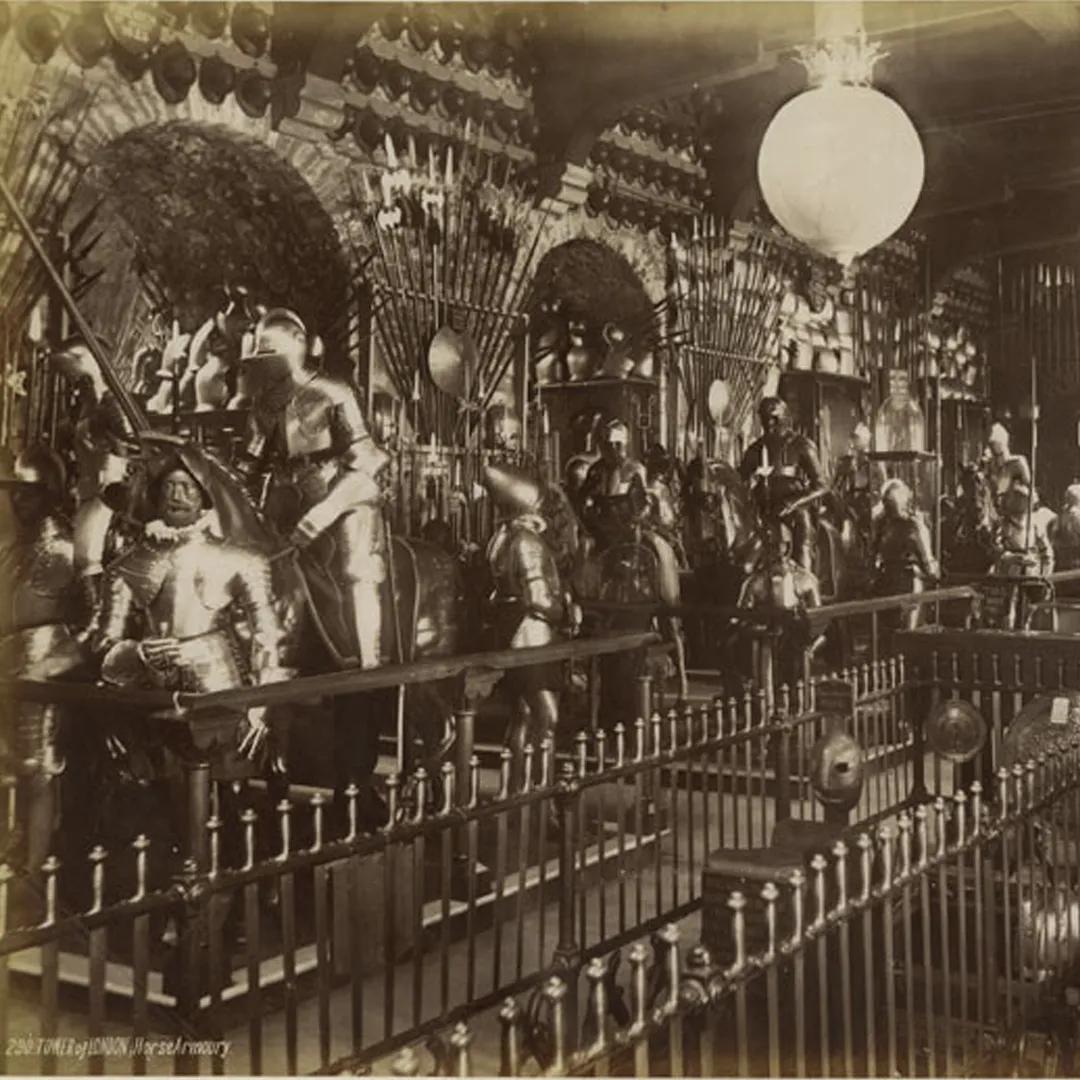
Research into the history of the ‘Line of Kings’ using archives, historic photographs and surviving objects had revealed the unusual and fascinating story of a display at the Tower that had been attracting paying visitors since the late 17th century.

A black and white photograph of the interior of the White Tower with the Line of Kings processing through
The Line of Kings installed in the Council Chamber of the White Tower, London, mid-20th century.

Into the 21st Century

A colour photograph of a building site next to a dock, the future site for the Royal Armouries in Leeds
Aerial photograph of the site of the Royal Armouries Museum, Leeds, 1994.

Following the establishment during the 1990s of two new Royal Armouries museums, one at Fort Nelson, Hampshire for the artillery collection and the other in a purpose-built Royal Armouries Museum in Leeds, it was possible for the Royal Armouries displays at the Tower to focus on the history of that site. The time was now right for a re-display of all the galleries of the White Tower. This included one representing the Horse Armoury or ‘Line of Kings’ by giving an impression of how it had once looked.

This posed several problems for the curators to deal with. One difficulty was that not all the objects that had once formed the display in the Horse Armoury could be identified in the collection. In addition, some of the most important pieces of the surviving arms and armour were now displayed at the Royal Armouries Museum, Leeds. It was therefore decided that:

There is neither the space nor enough surviving horses to reconstruct the entire Line. Moreover, its composition changed during the centuries of display…The Line today [1998], therefore seeks to give a modern interpretation of this unusual exhibition.

Fit for Royalty

This reinterpretation of the ‘Line’ also faced challenges. Research over the last 200 years had revealed that many of the kings were not wearing their actual armour. This would have made things very confusing for visitors if medieval kings were shown wearing Elizabethan armour.  Eventually, the mounted figures in armour were represented wearing a plain early 17th century Greenwich armour of the type known to have been used in the Line. The recreated display was seen by millions, including the Queen and Prince of Wales. 

Find out more about the Line of Kings in our online collection

A colour photograph of two men look at a row of wooden horses
In 2013, the then Prince Charles was given a personal tour of the Line of Kings following the display's renovation.

From a display of royal power to a historic attraction in the heart of London, the Line of Kings has endured for over 400 years. In the 5th and final part of our look at the display, we explore how new research continues to shape the look of the Line, and why it looks as it does today. 
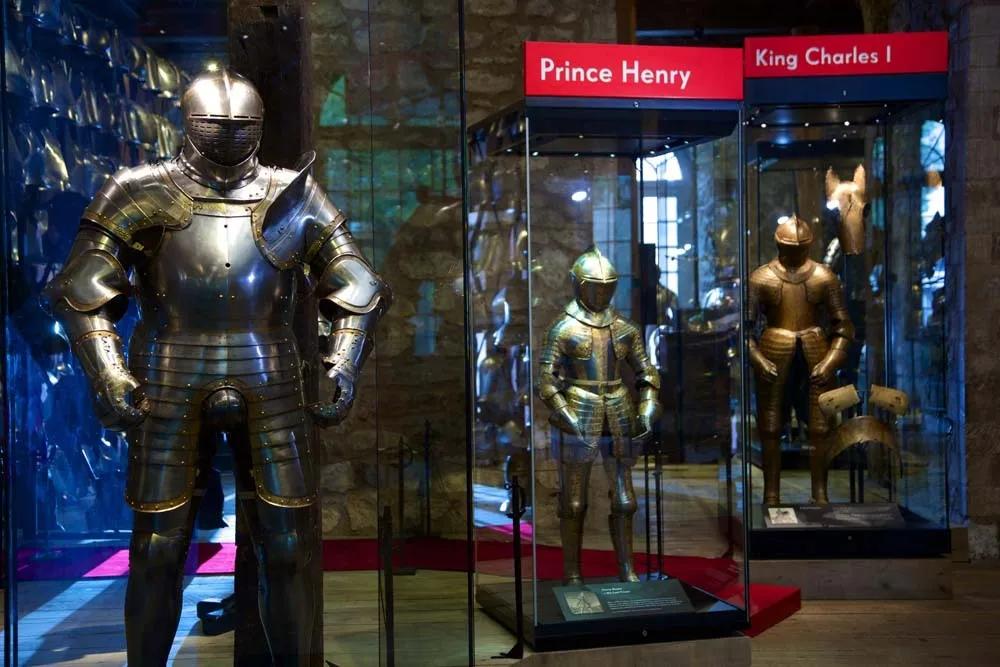
A colour photo of three suits of metal armour in descending rows. All three are held in three glass cases.

Visit the Line of Kings

The Line of Kings is one of the oldest visitor attractions in the UK, displaying the arms and armour of monarchs throughout English and British history. From suits of armour designed for young princes to chest plates engraved with declarations of love and union, the Line of Kings is a fascinating look into not only strength of arms but the projection of power etched into metal. The Line of Kings is currently located in the White Tower. Admission is free to visitors with their Tower of London ticket.
Plan your visit to the Tower of London

Comments

Join the conversation

Log in or register to post comments
0 comments