The Line of Kings - Part 2

1685 - 1785

A colour photo of a row of high medieval armour under purple and warm lighting against a stone wall

By the late 17th century, the Line of Kings, then known as the Horse Armoury, was becoming popular with the great and good of Stuart London. Charles II introduced a series of changes to the display, including renovated horse mannequins and new suits of armour. In 1685, however, Charles died and the throne passed to his younger brother, James. Over the next century, a young United Kingdom faced a series of succession crises that would leave its mark on the Line of Kings.

0
No votes yet
Login or register to rate this
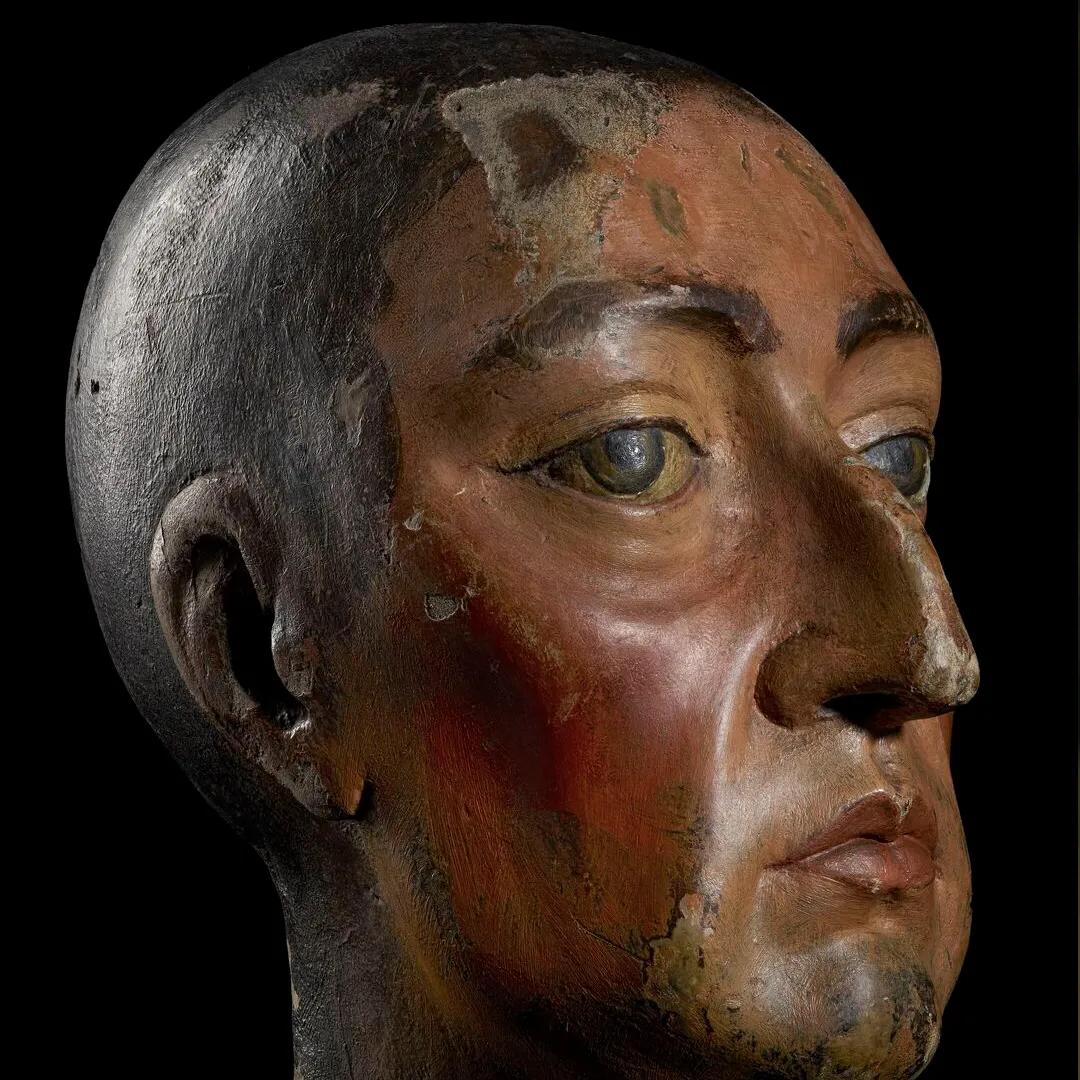
A carved wooden head of a man with a neat beard and short curly hair
Charles I was a firm believer in the 'Divine Right of Kings', where he was chosen by God to rule. The political crisis that engulfed his son, James II, would play a large role in limiting the power of kings. Wooden head of Charles II, England, 1660s.

The Coronation of James II

Since 1377, the Tower of London held a special significance in the coronation of kings and queens of England. Traditionally, the monarch would make a procession through London from the Tower to Westminster Abbey. James II broke with tradition by starting his procession from Westminster Hall – coincidentally where his father, Charles I, was condemned by Parliament. The Tower did feature in James’ plans in other ways. 

With the passing of Charles II, the Board of Ordnance decided that the late king should be commemorated in the Horse Armoury at the Tower. In June 1685, George Frankline, Deputy Keeper of the Armoury, contacted Grinling Gibbons, one of the leading sculptors in England. The commission was for one wooden head and one wooden horse. 

Six months later Gibbons’ workshop delivered the head and horse for the princely sum of £40. This was 8 times the price of the horse made by Thomas Cass in 1669. The Board must have been pleased with the results though because in 1686, they placed a second order with Gibbons. This order was for a head of Charles I, James’ father, and another horse. This latest addition took the display to 11 mounted figures.

A black and white version of an engraving of a large stone citadel
This engraving provides a view of the Tower of London from the early 1700s. The text describes the Tower as the ‘Chief repository of the Kingdom for all manner of Arms which are disposed in convenient Rooms in an elegant & beautiful Order.

New Developments

As the display continued to grow, the decision was made to replace the old Ordnance Storehouse with a new Grand Storehouse. Thomas Cass moved the wooden horses into storage in the White Tower in preparation for the building works. However, as the Storehouse was being built, plans seemed to change. Instead of cramming the existing display into the new storehouse, the idea was to create a larger, improved Horse Armoury elsewhere. 

The Board of Ordnance commissioned more carved horses and heads from workshops across the country. Prominent craftsmen were employed, such as William Emmett, William Morgan, John Nost, Thomas Quellin, and Marmaduke Townson, each charging £20 per carving. The contracts were issued in the summer of 1688 and the first carvings started arriving by the autumn. The Horse Armoury was on the brink of expansion and widespread popularity. That was until another war broke out.

Timeline of British History 1685 - 1785

1685
A sepia tone etching of a man with long, curled hair and a breast plate.
James II
1688
A black and white engraving of a man in a long frock coat and wide brimmed hat on top of a horse in a battle
The Glorious Revolution
1694
A sepia etching of a collection of men in long curled wigs and robes signing a document
Bank of England Established
1698
A colour portrait of a steam engine, featuring two brick kilns and two metal kettles connected with pipes
The Industrial Age
1701 - 1714
A colour painting of the aftermath of an early 18th century battle, with a man sat on a horse in a long curled wig and frock coat signing a document
War of Spanish Succession
1702
A sepia portrait of a woman with long, curled hair and a crown
Queen Anne
1707
A single yellowing document with the words "Articles of Union" written in elaborate handwriting at the top
Act of Union
1714
A sepia tone engraving of an aging man with long, curly hair in a plated armour cuirass
George I
1715
A red tinted engraving of a collection of men in early 18th century clothing and wigs disembarking a sailing ship
First Jacobite Uprising
1718
A black and white engraving of a bearded pirate holding a sword upright with lit matches in his beard.
Blackbeard Killed in North Carolina
1720
A black and white etching of a crowd punishing people, either through tying to a wheel or atop a gibbet
South Sea Bubble
1727
A sepia tone engraving of a man in a light coloured long, curled wig, frock coat, and sash in an oval cartouche, flanked by two gentlemen in frock coats and tights.
George II
1739
An engraving of a battle scene in which cavalrymen on both sides, dressed in long frock coats, attempt to cut and unhorse each other in a large melee.
War of Jenkins' Ear
1745
A black and white engraving of a British officer on horseback being shot at point blank range by a Scottish soldier in tartan
Second Jacobite Uprising
1755
A sepia tone engraving of a man in a robe in front of a stack of books on a desk
Dictionary of the English Language
1756 - 1763
A colour painting of a man in a frockcoat and tricorn hat carrying a large black and white flag and leading soldiers into battle.
Seven Years War
1760
A sepia tone engraving of a man dressed in impressive, fur lined robes of state, leaning nonchalantly against a table
George III
1769 - 1770
A black and white engraving of a serious looking man in a white periwinkle wig and British naval uniform from the 18th century
British Exploration of New Zealand and Australia
1775 - 1783
A sepia tone engraving of a battle scene, with the cavalry and cannon in the foreground and columns of 18th century infantry in the background
American War of Independence
1685
James II

James II came to the throne on the death of his brother, Charles II. Considered a hellraiser in his youth, James caused some alarm when he converted to Catholicism in 1668. James’ promotion of Catholics to prominent military positions and proroguing of Parliament caused tension between the king and his largely Anglican subjects. When the queen, Mary of Modena, gave birth to a male heir in 1688, a group of English politicians invited William of Orange to depose James in favour of a less Catholic heir.

A sepia tone etching of a man with long, curled hair and a breast plate.
James II by James Sangster. London, 1864
Close
1688
The Glorious Revolution

William of Orange lands with an army of 21,000 Dutch soldiers at Torbay in Devon in November 1688. Despite outnumbering the Orangists, the unpopular James suffers a number of desertions and chooses not to engage William in pitched battle. The final blow comes when his own daughter, Anne, defects to William. As it becomes clear that defeat is inevitable, James flees to France on 23rd December 1688. Parliament declares James as having abdicated the throne and offers the crown to William and his wife Mary. 

A black and white engraving of a man in a long frock coat and wide brimmed hat on top of a horse in a battle
William III. Dutch, late 17th century
Close
1694
Bank of England Established

In 1694, the Bank of England is granted a royal charter by William and Mary. At first, the Bank of England is a private bank used to finance the ongoing wars with France. The institution also offers regular banking services such as mortgages, loans, and issuing bank notes. In 1844, the Bank Charter Act restricts the power of national banks, granting the Bank of England the sole licence to print bank notes. The move effectively turns the Bank of England into a central bank for the United Kingdom. 

A sepia etching of a collection of men in long curled wigs and robes signing a document
Signing of the Charter of the Bank of England - Lady Jane Lindsay, British, via Wikimedia Commons
Close
1698
The Industrial Age

In 1698, English inventor Thomas Savery patents an early steam-powered pump in a paper called 'The Miner's Friend'. The machine is intended to pump water from mines. The engine however is flawed due to imprecise parts allowing pressure to escape, making the pump inefficient. The design is greatly improved on over the next century by other inventors such as Thomas Newcomen and James Watt. The application of steam engines in mines, mills, and for transport significantly contributes to the Industrial Revolution. British society becomes increasingly industrialised, influencing 18th and 19th century politics and driving the spread of empire.

A colour portrait of a steam engine, featuring two brick kilns and two metal kettles connected with pipes
Savery Engine, Institute of Human Thermodynamics and IoHT Publishing Ltd. via Wikimedia Commons
Close
1701 - 1714
War of Spanish Succession

In January 1700, Charles II of Spain dies without an heir, leading to a succession crisis. Louis XIV of France declares his grandson, Philip of Anjou, as heir to Spain. Holy Roman Emperor Leopold I however recognises his son Archduke Charles as the new king. In 1701, the growing conflict between the two European powers draws England in on the side of the Holy Roman Empire. The war is best remembered today in the United Kingdom for the victories of John Churchill, ancestor of Winston Churchill. During this war, England also captures Gibraltar which remains a British overseas territory today. 

A colour painting of the aftermath of an early 18th century battle, with a man sat on a horse in a long curled wig and frock coat signing a document
Duke of Marlborough signing the Dispatch at Blenheim, Robert Alexander Hillingford, British, late 19th century
Close
1702
Queen Anne

Queen Mary II dies without children in 1694, leading to the Act of Settlement in 1701. The bill places Mary’s sister Anne as the next in line to the throne. This is intended to secure the Protestant succession and avoid James Stuart’s Catholic heirs returning to England. William dies the following year, and Anne is crowned Queen. Anne is plagued by ill-health and relies on her close confidant Sarah Churchill for advice. She falls pregnant 18 times over the course of 17 years, but none survive into adulthood. 

A sepia portrait of a woman with long, curled hair and a crown
Queen Anne by James S.Virtue, London, 19th century
Close
1707
Act of Union

In 1707, the Act of Union is passed by both Scottish and English Parliaments. This leads to the economic and political union of the two countries into the United Kingdom of Great Britain. Both countries see benefits in the union. After a disastrous colonial expedition to the Darién Gap in the 1690s, many Scottish politicians and merchants want the economic security England provides. England however wants to secure Scotland against possible French invasions. The union is met with protests in Glasgow, Edinburgh, and Dumfries. 

A single yellowing document with the words "Articles of Union" written in elaborate handwriting at the top
Articles of Union 1707, UK Parliamentary Archives via Wikimedia Commons
Close
1714
George I

The 1701 Act of Settlement not only established Anne as heir to William and Mary, but also nominated George, Elector of Hanover, as Anne’s successor. Queen Anne dies in 1714, and George is crowned as the first Hanoverian king of Great Britain. He does not enjoy a lot of public support. His lack of English and intense dislike of his son makes him unpopular with his subjects. During George’s reign, the country faced threats from the old Stuart line led by James II’s son, James (The ‘Old Pretender’), but continued to expand their global empire. 

A sepia tone engraving of an aging man with long, curly hair in a plated armour cuirass
George I by Simon Francois Ravenet, Britain, 1757
Close
1715
First Jacobite Uprising

John Erskine, Earl of Mar in Scotland, launches a rebellion against George I in August 1715. The uprising is in support of James Stuart, the ‘Old Pretender’, and attracts thousands of Scots unhappy with the Union. These supporters are named ‘Jacobites’ after the Latin ‘Jacobus’, meaning James. Jacobite forces quickly seize Inverness and Dundee. When Mar crosses the border into England however, he encounters resistance from the local populace. Jacobite and Government forces meet at the Battles of Preston (9-14 November 1715) and Sheriffmuir (13 November 1715). Both armies exhaust the Jacobite cause, and Mar is forced to flee to Europe. 

A red tinted engraving of a collection of men in early 18th century clothing and wigs disembarking a sailing ship
The Old Pretender Arrives in Peterhead, National Library of Scotland
Close
1718
Blackbeard Killed in North Carolina

Notorious pirate Edward Teach, otherwise known as Blackbeard, is killed in an engagement outside North Carolina in November 1718. The early 18th century is known as the Golden Age of Piracy, due to the large numbers of privateers employed by Spain, France, and Britain. After Blackbeard turns on the Carolinas, Lieutenant Robert Maynard is sent to deal with piracy in the region. On 22nd November, Maynard corners and kills Blackbeard. The body is decapitated, and the head is mounted on the front of the ship.  

A black and white engraving of a bearded pirate holding a sword upright with lit matches in his beard.
Blackbeard the Pirate, Britain, 1725, via U.S. Library of Congress
Close
1720
South Sea Bubble

Throughout 1719, the South Sea Company based in London sought to purchase government debt in return for company shares. This created an air of trust, which was then used to inflate the value of the company and sell more shares. The financial bubble bursts in late 1720, as the South Sea Company sees their stock price plummet from £950 a share in July to £185 a share in December. It is the world’s first international stock market crash. Many lose everything and face bankruptcy. Politicians and bankers who profited from the scheme are fired and imprisoned. 

A black and white etching of a crowd punishing people, either through tying to a wheel or atop a gibbet
The South Sea Scheme by William Hogarth, Britain, 18th century, via Wikimedia Commons
Close
1727
George II

George I dies in June 1727, and is succeeded by his son, George II. As Prince of Wales, George II became very involved in the world of politics and diplomacy as he openly opposed his father’s policies. George continues this keen interest into his reign. He is also fascinated by the army and joins the British army on campaign during the War of Austrian Succession. He becomes the last British monarch to lead troops into battle. 

A sepia tone engraving of a man in a light coloured long, curled wig, frock coat, and sash in an oval cartouche, flanked by two gentlemen in frock coats and tights.
King George II by James S.Virtue, London, 19th century
Close
1739
War of Jenkins' Ear

In April 1731, a British ship carrying Captain Robert Jenkins is boarded by Spanish coastguards in the West Indies. The Spanish pillage the ship and cut off Jenkins’ ear, exacerbating already tense relations between the two countries. The British Parliament use the incident and other attacks on British shipping to declare war on Spain in 1739. The War of Jenkins’ Ear is soon absorbed into the wider War of Austrian Succession in 1740. This war is mostly fought in Italy, The Netherlands, and Germany, although Britain and France also attempt to secure positions in the Americas. The war ends inconclusively in 1748. 

An engraving of a battle scene in which cavalrymen on both sides, dressed in long frock coats, attempt to cut and unhorse each other in a large melee.
Battle of Lauvelt Gagnee by King Louis XV, London, 1771
Close
1745
Second Jacobite Uprising

Charles Stuart, otherwise known as Bonnie Prince Charlie, launches a second Jacobite rebellion against Hanoverian England. In July 1745, Charles, the ‘Young Pretender’, lands in Scotland and rallies many of the Highland clans to his cause. In September, the Jacobites seize Edinburgh and defeat a Government army at Prestonpans. Charles takes his victorious army into England but a lack of popular support and looming winter causes the Jacobites to return to Scotland by 1746. In April 1746, the Jacobites and Hanoverians meet at the Battle of Culloden, where Charles’ army is decisively defeated. Bonnie Prince Charlie is forced to flee to Europe, while several of his supporters are executed or exiled. The Highland Clearances, a brutal repression of Jacobite clans, follows soon after.

A black and white engraving of a British officer on horseback being shot at point blank range by a Scottish soldier in tartan
From the cartoon Rebell Gratitude, London, 1747
Close
1755
Dictionary of the English Language

Samuel Johnson publishes his “Dictionary of the English Language” in April 1755. While not the first English dictionary, it is the first to make use of definitions and quotations. The book cements the English language and is the inspiration for other works such as the Oxford English Dictionary.

A sepia tone engraving of a man in a robe in front of a stack of books on a desk
Samuel Johnson by James Watson after a painting by Joshua Reynolds, London, 1770
Close
1756 - 1763
Seven Years War

In 1756, Austria attempts to reclaim territory lost to Prussia during the War of Austrian Succession. Britain, already at war with France, allies with Prussia. France allies with Austria. In America and India, Britain and France fight for control of each other’s colonies. In Europe, Prussia faces attacks from Sweden and Russia, as well as France and Austria. The war devastates central Europe as large areas of modern-day Poland and Germany are invaded and occupied. In 1763, the major powers tire of war and sign the Treaty of Paris. France cedes land in Canada, India, and Africa to Britain. Britain meanwhile returns Guadeloupe and Martinique to the French. 

A colour painting of a man in a frockcoat and tricorn hat carrying a large black and white flag and leading soldiers into battle.
Frederick the Great at the Battle of Zorndorf by Carl Rochling, France, 1904, via Wikimedia Commons
Close
1760
George III

George III succeeds his grandfather as king in 1760. He is the first of the Hanoverian line to be born in England and have English as his first language. His reign is mostly known for the loss of the American colonies and his poor mental health in his later years. George is an enthusiastic patron of the arts and agriculture, earning the nickname “Farmer George”. He is also unique among Hanoverian kings in that he seemed to genuinely love his wife, Charlotte of Mecklenburg, and did not have mistresses. Towards the end of his reign, Britain became involved in wars with Revolutionary and Napoleonic France.

A sepia tone engraving of a man dressed in impressive, fur lined robes of state, leaning nonchalantly against a table
George III by William Wynne Ryland, London, 1767
Close
1769 - 1770
British Exploration of New Zealand and Australia

Captain James Cook undertakes a survey of the landmasses known as New Zealand and Australia. His voyages with HMS Endeavour, Resolution, and Adventure also take him around the Antipodes and on to Tahiti, Tonga, and Hawaii. A controversial figure, Cook is celebrated by some as a great explorer but condemned by others for his treatment of islanders. In February 1779, Cook was killed by Hawaii islanders after relations broke down. 

A black and white engraving of a serious looking man in a white periwinkle wig and British naval uniform from the 18th century
Captain James Cook by Francois Pigeot, France, early 19th century
Close
1775 - 1783
American War of Independence

Following victory in the Seven Years’ War, Britain sought to recoup the cost by levying taxes against the American population. Tolls on tea and other imported goods appeared uneven and calls for more representation within British Parliament grew. As a result, the 13 British colonies in America sign the Declaration of Independence in 1776. With monetary and military assistance from France, Spain, and The Netherlands, the American Continental Army is able to repeatedly ambush and defeat British columns. Preferring to maintain their more profitable colonies in Canada and the Caribbean, Britain finally granted the 13 Colonies of America independence in the Treaty of Paris in 1783. 

A sepia tone engraving of a battle scene, with the cavalry and cannon in the foreground and columns of 18th century infantry in the background
The Battle of Brandywine Creek by Johann Martin Will, Germany, late 18th century, via U.S. Library of Congress
Close
A colour photograph of an ornate helmet in steel
This is James II's Harqubusier's armour from the 17th century. Note the faceguard decorated with the Royal arms held by the lion and the unicorn representing England and Scotland. Armour by Richard Hoden, Tower of London.

The Glorious Revolution

By 1688, James II had grown increasingly unpopular. The largely Anglican nobility felt threatened by the king’s pro-Catholic policies and sought foreign aid to rid themselves of James. In June 1688, they sent a letter to James’ son-in-law, William of Orange, inviting him to invade England. When William’s largely Dutch army landed in November 1688 at Torbay, James soon fled abroad. Parliament declared that James had abdicated in favour of his daughter, Mary, and William. 

Throughout this crisis, the Horse Armoury remained closed to visitors. The decline hit George Frankline the most as his income was provided by visitors’ admission fees. To compensate the unfortunate Frankline, the Board of Ordnance paid him the considerable sum of £70 per year. These payments continued until 1692. During 1689, the wooden horses and figures ordered the previous summer were delivered to the Tower. These were to go into a new display on the first floor of the New Storehouse (now called the New Armouries).

This time there were no princes or noblemen in the display. The exhibition focused on monarchs, with fourteen kings in a line from William the Conqueror to Charles II. This was political as well as historical. James had been replaced by William and Mary, so a clear line linking the co-monarchs to their ancestors was a key issue - a true ‘Line of Kings’.

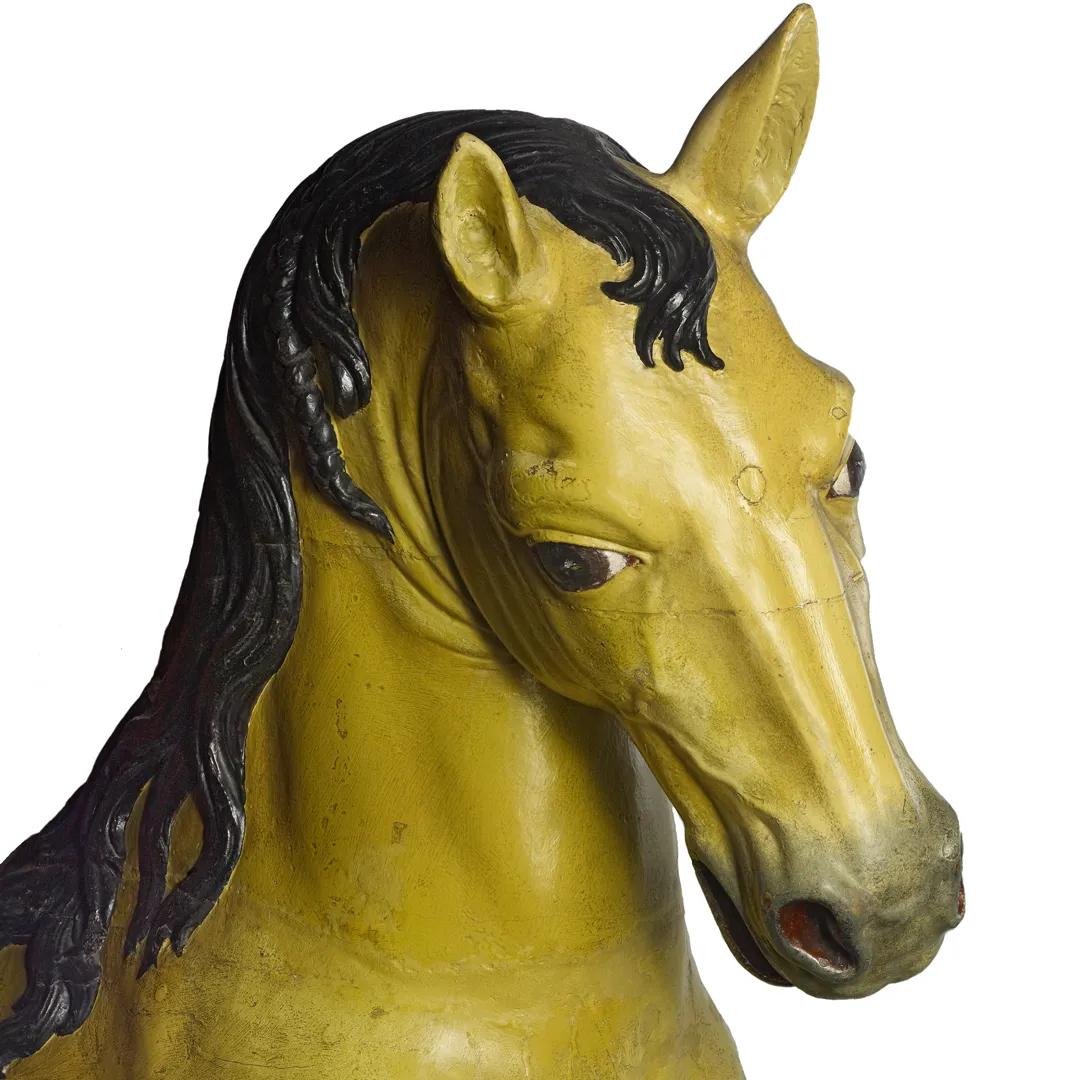
A carved wooden horse's head with brown hair and a black mane
By 1682, the Line of Kings changed subtly. Prince Henry Stuart and Charles I were removed, leaving nine horses in the line with one left riderless. Carved wooden horse, late-17th Century, London.

Popular Opinions

To create this ‘Line of Kings’, the exhibition’s organisers ignored the history of some of the armours. For example, the armour worn by the Earl of Leicester was now assigned to a king instead. The earliest known account of the new display is an extraordinary one, written after an earthquake which shook London on 8 September 1692. In a letter of 24 September, George Follett wrote of the tremors at the Tower:

… there above stairs all the heroes and their horses are set forth in armour. Suffering such a shock it was great prowess in them to stand their ground…

As its fame spread, the Horse Armoury began to feature in guidebooks for visitors to London. In 1693, Francois Colsoni wrote:

… you will be led to the upper area where you will be shown many Kings on Horseback and the Armour of both the Cavalry and Infantry which are kept there in good condition.

An engraving of an elderly looking man in a long, curly, white wig and larger frock coat, surrounded by a cartouche with an inscription dedicated to him below.
Ned Ward was an early 18th century satirist who frequently documented aspects of the British capital in his publication The London Spy between 1698 and 1700. Portrait of Ned Ward, London, 1710

Visitors paid an admission fee and were escorted, either as part of a small group or individually for an additional cost, by a guide. By 1699, the Horse Armoury featured in one of Ned Ward’s monthly humorous accounts of London life:

As we gently mov’d along and viewed the princely scarecrows, he told us to whom each suit of armour did belong originally, adding some memorandums out of history to every empty iron-side; some true, some false, supplying that with invention which he wanted in memory. …From thence we pass’d by several princes’ armour, of which nothing was deliver’d but a bare name, till we had completed our round and came again to the door. This being the conclusion of this warlike opera, we paid our money and made our exit.

A carved wooden head against a black background
According to an inventory taken in the early-19th century, the William III mannequin was wearing a 'black and gold suit of Henry VIII's time'. Wooden head of William III, Nicholas Alcock, early-18th century.

A Matter of Class

When William III died on 3 March 1702, an armoured figure of this warrior king on horseback was soon added to the Line. Nicholas Alcock carved the wooden head of William. Uniquely, some of the original furnishings for his horse survive.

Meanwhile the Line of Kings continued to flourish. Visitors to the Tower came from across Britain, mainland Europe, and as far away as India and America. The display featured as a visitor attraction in London guidebooks such as Hatton’s ‘New View of London’, published in 1708. Unfortunately, the high admission price meant that access was restricted to the wealthy or to well-connected people who could arrange free entry. 

A colour portrait of a grim looking man in black frock coat and green waistcoat sat behind a desk with books, parchment and quill
William Hutton by Robert Kirkup Dent, England, 1894

If you were poor, or at least appeared poor, you were out of luck. In 1749, a Derby man called William Hutton attempted to visit the Tower and recalled his:

...Derbyshire accent quickly brought the warders out of their lodge; who, on seeing the dust abound on my shoes wisely concluded that money could not abound in my pocket; and, with the voice of authority, ordered me back.

Nearly 40 years later, in 1785, William returned to the Tower. Now a successful businessman and enthusiastic historian, he was judged worthy and allowed entry to the display. Was the wait worth it?

In the Horse Armoury … the royal regiment of kings, drawn up in battalia, and shown to strangers, fell short of expectation. They seemed bigger than life, which is an unpardonable error in the statuary. 

You can’t please them all.

Find out more about the Line of Kings in our online collection

Throughout the 18th century, the understanding of the history of arms and armour changed. Armed with research into the armour on display, a new generation of experts arrived at the Tower of London to renovate the exhibition. In part 3, we explore how publicity and accuracy turned the Line of Kings from royal propaganda into historical tourist attraction. 
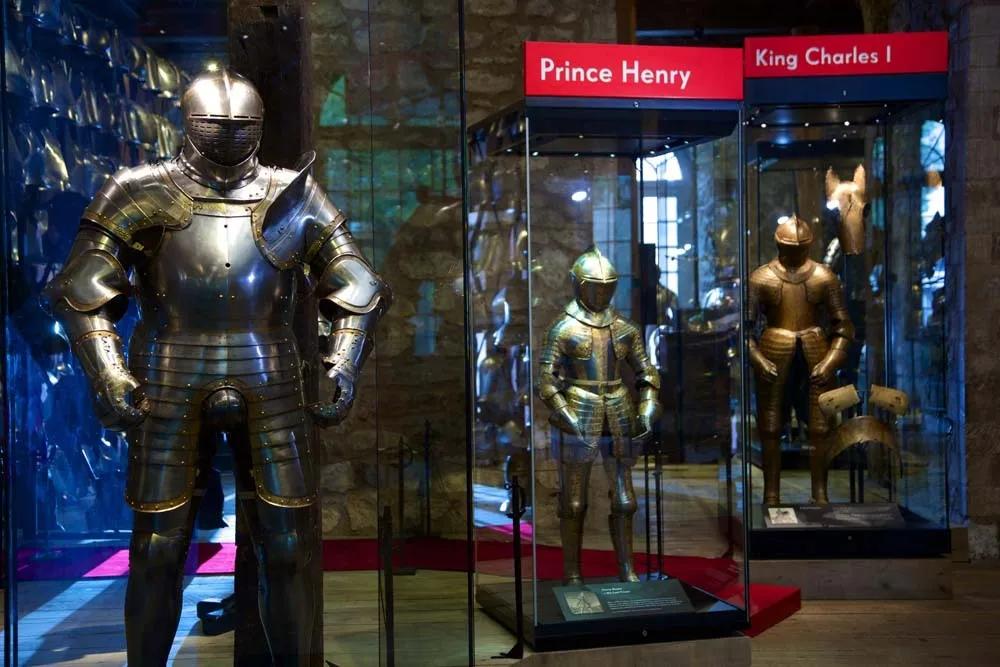
A colour photo of three suits of metal armour in descending rows. All three are held in three glass cases.

Visit the Line of Kings

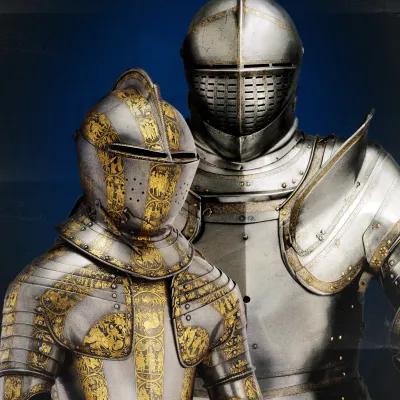
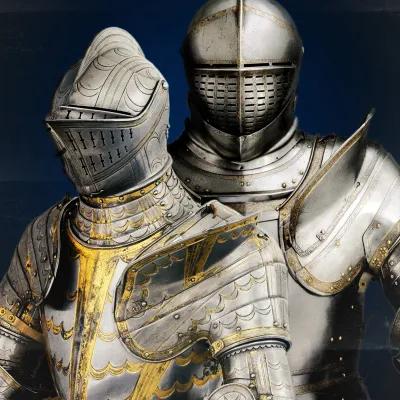
The Line of Kings is one of the oldest visitor attractions in the UK, displaying the arms and armour of monarchs throughout English and British history. From suits of armour designed for young princes to chest plates engraved with declarations of love and union, the Line of Kings is a fascinating look into not only strength of arms but the projection of power etched into metal. The Line of Kings is currently located in the White Tower. Admission is free to visitors with their Tower of London ticket.
Plan your visit to the Tower of London

Comments

Join the conversation

Log in or register to post comments
0 comments