The Line of Kings - Part 3

1785 - 1868

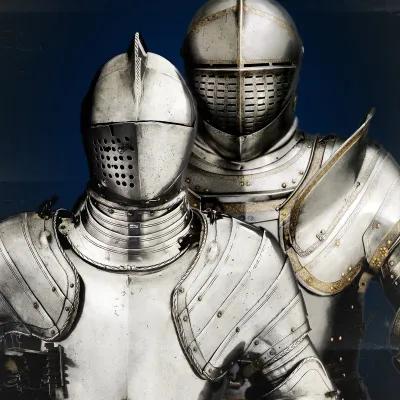
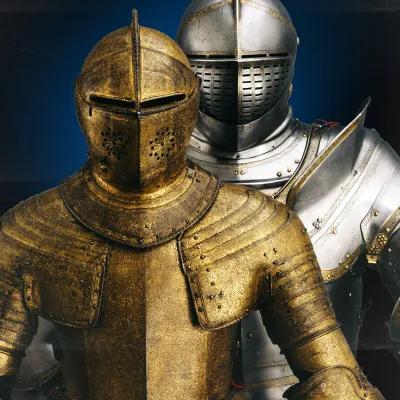
A colour photo of a row of high medieval armour under purple and warm lighting against a stone wall

The union of England and Scotland in the early 18th century began a period of development for Britain. The Kingdom of Great Britain expanded across the globe, frequently clashing with old and new rivals alike. The role of the monarchy changed, evolving from a singular ruler to a politically neutral figurehead for the nation. The Line of Kings also developed to reflect this change. The attraction gradually shifted from royal propaganda to the more historically accurate display of armour seen today. 

0
No votes yet
Login or register to rate this

A New Dynasty

With the death of Queen Anne in 1714, the newly formed Great Britain faced a crisis of succession. In the ensuing politics, the crown was offered to George, elector of Hanover. The Hanoverian dynasty ruled over a Britain that steadily became one of the most powerful countries in the world. Through trade and conflict, often at the expense of indigenous populations, British power spread across the globe. 

One of those conflicts, the War of Austrian Succession, saw George II become the last British monarch to lead his forces into battle. After his death, George II was honoured as the seventeenth and final equestrian figure to be added to the Line of Kings in 1768. This might have been because the need for an exhibition popularising warlike kings was no longer considered necessary. Despite this, the Horse Armoury remained a highlight for visitors to London.

A black and white portrait of a man in a sash, long coat, and wig.
George II was the last British king to lead troops into battle at the Battle of Dettingen against the French. The battle resulted in a French rout, earning George much popularity with the British public. George II by James Virtue, London, 19th century
A watercolour of a line of mannequins on horseback. A small collection of visitors in late 18th century dress are being escorted down the line by an overweight porter in gaudy military dress.
Thomas Rowlandson was a British satirist whose caricatures of high and low society proved popular with late 18th and early 19th century London. The Horse Armoury in the Tower, Rowlandson, 1800.

In 1786, Sophie von La Roche recorded in her diary seeing the royal figures on horseback:

It is a fine sight and looks very much more warlike than the modern uniform.

By the late 18th century, the study of the history of arms and armour had developed greatly. The understanding of new techniques and styles over time improved. Francis Grose published a study illustrating many objects from the Tower Armouries. He wrote that:

…many of the figures of our kings…are the work of some of the best sculptors of the time in which they were set up.

Increased Scrutiny

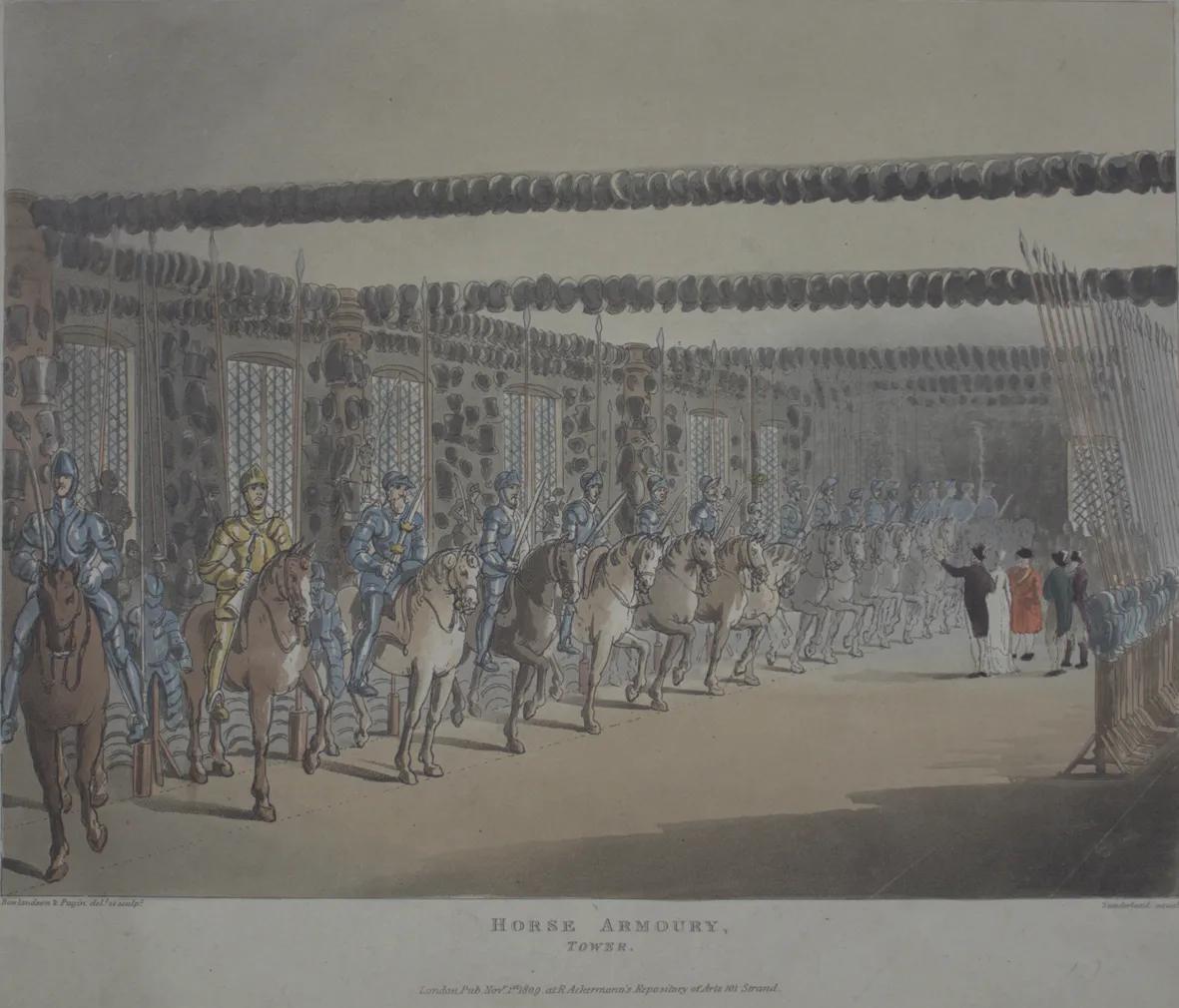
As impressive as they were, historical research highlighted that the ‘Line’ was more fantasy and propaganda than fact. The earliest known images of the display date from this period and suggest how it may have been viewed. Groups of visitors were led behind the horse mannequins and then paraded past a row of royal figures in the centre of the room. It was beginning to resemble a line of kings, from William the Conqueror to George II.

Thomas Rowlandson’s pictures also show the mass displays of armour on the walls and ceiling with a Yeoman Warder guiding a party of visitors. Rudolph Ackermann published an engraving of the display by Rowlandson and Augustus Pugin in 1809 with William Combe’s description of the royal figures as: 

…large as life and some of them appear in the suits which those sovereigns actually wore. This room presents a very striking spectacle.

A colour engraving of a long line of mounted armoured mannequins on horse back. A small group of visitors in early 19th century dress are being escorted down the line by a yeoman warder.
This engraving of the Horse Armoury is a collaboration between Thomas Rowlandson and Augustus Pugin. 22 years later after publication, the Horse Armoury would be criticised as an ‘incongruous mass of discordant materials’. London, 1809.

Divided Opinions

A poorly put together mannequin wearing Elizabethan and early 17th century armour
An example of a mannequin associated with the Horse Armoury since at least 1809. The model itself is believed to have been made in England between 1575 and 1600.

By the 1820s opinions about the display were divided. John Whitcomb Bayley wrote that the royal figures:

…are in fine armour, on horseback and have altogether a grand and most imposing effect.

Yet Polish visitor Krystyn Lach-Szyrma was unimpressed. She said: 

...there is little art in them and they look like horrible monsters, blank and in poor taste, not worth looking at unless by children or the rabble.

Timeline of History - 1785 - 1868

1788
A colour painting of a tall masted sailing ship displaying British naval colours approaching an outcrop of land
Australia's Founding Year
1789 - 1799
A black and white illustration of a woman in a long skirt and bonnet stood on top of a scaffold waiting for the guillotine to be readied.
The French Revolution
1796
A sepia tone portrait of a man in a black jack and white neckerchief holding an illustration of a cow
Smallpox Vaccinations
1801
A black and white illustration of the redesigned union flag of 1800 incorporating the Irish cross of St. Patrick into the existing flag of St. George and St. Andrew.
Act of Union 1800
1805
A black and white illustration of a naval captain dying on the deck of a tall masted wooden ship. Surrounding him are his loyal officers and other sailors.
Battle of Trafalgar
1807
A sepia tone engraving of a seated man with long, white hair, a black coat and waistcoat, and white neckerchief, holding a pen by a stack of papers
Abolition of Slave Trade Act
1812 - 1815
A sepia tone engraving of a vivid battle between musket wielding British soldiers and musket wielding American soldiers. In the foreground, a naval battle is raging. In the background, a city is on fire.
War of 1812
1815
The Duke of Wellington orders his soldiers forward, who gleefully march
Battle of Waterloo
1819
A black and white reproduction of a colour painting showing a tall masted sailing ship surfing the waters with a steam powered wheel churning at the side.
First Transatlantic Steamship Crossing
1820
A sepia tone engraving of a greying man with a high necked neckerchief, black coat, and imperial robe
George IV
1825
A sepia tone illustration of an early train engine being guided across a stone bridge by a man on a horse. Riding the train are several men in Victorian dress waving flags.
First Public Railway Opened
1830
A sepia tone portrait of an elderly man in a high necked early 19th century naval uniform
William IV
1837
A sepia tone engraving of a young woman in an early 19th century white dress and crinoline with a crown, large necklace, and imperial sash
Queen Victoria
1840
A black postage stamp costing one penny with the head of Queen Victoria on the front
First Postage Stamps
1845
A black and white engraving of two painfully thin boys scrabbling in the earth trying to find something to eat
Great Irish Famine
1848
A sepia photograph of a large gathering of Victorian gentlemen, some standing in carriages, many waving plackards, in front of a factory
The Year of Revolutions
1853 - 1856
A black and white engraving of a line of cavalrymen charging into a battery of cannon.
The Crimean War
1859
A black and white photograph of a seated man in a black coat, light coloured waistcoat and checked neckerchief, with impressive sideburns
On the Origin of Species
1861 - 1865
A colour illustration of the American Civil War, featuring black soldiers under the stars and stripes storming a Confederate held fortress.
The American Civil War
1863
A black and white photo of a simple train car filled with seated gentlemen in Victorian era dress with large stovepipe hats.
The London Underground
1867
A black and white photograph of a bearded man in profile, seated and leaning one hand against the side of his face.
Invention of Dynamite
1788
Australia's Founding Year

Britain's First Fleet, under the command of Captain Arthur Phillip, sails into Botany Bay on 18th January 1788. The majority of the passengers are convicts sent 15,000 miles to found a penal colony in Australia. Captain Phillip finds the environment unsatisfactory for a settlement and sails the fleet up the coast to a place he names Sydney Cove. The subsequent settlement is named Sydney.

A colour painting of a tall masted sailing ship displaying British naval colours approaching an outcrop of land
Botany Bay by Charles Gore, New South Wales, 1789. New South Wales State Library.
Close
1789 - 1799
The French Revolution

After a series of expensive wars and poor harvests, the French populace revolt against the old order, the 'Ancien Régime'. Inspired by humanist ideas of the Enlightenment, the Monarchy is slowly stripped of power until in 1793, Louis XVI is executed. The "Reign of Terror" followed; nine months where 17,000 "enemies" of the Revolution were executed by guillotine. Political instability and a strong army saw the rise of a corporal named Napoleon Bonaparte to eventually seize power in 1799.

A black and white illustration of a woman in a long skirt and bonnet stood on top of a scaffold waiting for the guillotine to be readied.
Marie Antoinette arrives at the scaffold, France, 1793, Louvre Museum.
Close
1796
Smallpox Vaccinations

English scientist Edward Jenner successfully develops the first smallpox vaccine. Smallpox was a persistent threat to humans, and thought to have killed millions before the 18th century. Jenner noticed that those who worked with cattle and contracted a weaker disease called cowpox rarely caught smallpox. To prove this theory, Jenner gave a boy called James Phipps cowpox and allowed him to recover, before exposing him to smallpox material. Phipps never developed smallpox, becoming the first person to be deliberately vaccinated against the disease. 

A sepia tone portrait of a man in a black jack and white neckerchief holding an illustration of a cow
Edward Jenner by Alphonse Léon Noël, France, early 19th century, Rijksmuseum.
Close
1801
Act of Union 1800

Following an Irish uprising in 1798, parliament drafts the Act of Union between the Kingdoms of Great Britain and the Kingdom of Ireland. The act is designed to reinforced Britain's 'back door' against French invasion, secure Ireland after the 1798 rebellion, and reduce Catholic nationalism. The act goes into effect on 1st January 1801 and leads to a prolonged economic depression and over a century of protests, rebellions, and deprivation.

A black and white illustration of the redesigned union flag of 1800 incorporating the Irish cross of St. Patrick into the existing flag of St. George and St. Andrew.
Initial draft of the 1800 Union flag, Complete Guide to Heraldry, Arthur Charles Fox-Davies, 1909.
Close
1805
Battle of Trafalgar

On the 21st October 1805, the British fleet under Admiral Horatio Nelson engages and destroys the combined French and Spanish fleets off the coast of south-west Spain. Instead of forming a single line, Nelson's outnumbered forces approached the enemy in two diagonal columns, splitting the Franco-Spanish navy. During close action with the French ship Redoubtable, Nelson was shot and died after the battle.

A black and white illustration of a naval captain dying on the deck of a tall masted wooden ship. Surrounding him are his loyal officers and other sailors.
The death of Lord Viscount Nelson onboard the Victory. J. Neath, Britain, 1811. Wellcome Collection.
Close
1807
Abolition of Slave Trade Act

On 1st May 1807, British Parliament passes the Abolition of Slave Trade Act. The Act prohibits the trade of slaves between and into British territories. The move also encourages British foreign policy to advocate for the abolition of slavery by other powers and their colonies. Crucially, the Act does not prohibit the practice of slavery. It would take campaigners such as William Wilberforce another 26 years to pass the Slavery Abolition Act in 1833. 

A sepia tone engraving of a seated man with long, white hair, a black coat and waistcoat, and white neckerchief, holding a pen by a stack of papers
William WIlberforce by Charles Howard Hodges, England, 1792. Rijksmuseum.
Close
1812 - 1815
War of 1812

In June 1812, the United States of America declares war on Britain. Relations between the two countries had been deteriorating for some time due to competing priorities. America was aggrieved at British trade restrictions and the impressment of its citizens. Britain was angered at America continuing to trade with Napoleon. The U.S. makes the first move by invading Canada, a move believed easy by President Thomas Jefferson. Canadian, British, and First Nation forces however defeat the Americans and seize Detroit. In 1814, after the first defeat of Napoleon, Britain sends additional reinforcements to the Americas, leading to the capture of Washington D.C. and the burning of the White House. In December 1814, Britain and the U.S. sign the Treaty of Ghent, with neither side achieving victory. 

A sepia tone engraving of a vivid battle between musket wielding British soldiers and musket wielding American soldiers. In the foreground, a naval battle is raging. In the background, a city is on fire.
The taking of the city of Washington in America, London, 1814. U.S. Library of Congress.
Close
1815
Battle of Waterloo

French forces under the command of the recently returned Emperor Napoleon Bonaparte are defeated by an Anglo-Dutch and Prussian army under the Duke of Wellington. The speed of Napoleon's advance from Paris to Belgium takes the Allies by surprise and forces the Duke of Wellington to commit to a stand near the village of Waterloo. On 18th June 1815, Anglo-Dutch forces face repeated French attacks to dislodge them from a ridge blocking the road to Brussels. By 2:30pm, with defeat a possibility, the Prussians under General Blücher finally arrive on the field. After 6 more hours of fighting, Napoleon retreats, leading to his eventual overthrow and final exile to the Atlantic island of St. Helena. 

The Duke of Wellington orders his soldiers forward, who gleefully march
The Duke of Wellington at the Battle of Waterloo. Published in London Illustrated News July - December 1852.
Close
1819
First Transatlantic Steamship Crossing

The American ship SS Savannah becomes the first ship to cross the Atlantic using steam power. Most of the crossing was made under sail but Savannah was the first to demonstrate how steam could be used at sea. The journey took 27 days, and on Savannah's return to the U.S., she was converted back into a sailing ship. In 1821, the ship was wrecked off the coast of Long Island and lost. 

A black and white reproduction of a colour painting showing a tall masted sailing ship surfing the waters with a steam powered wheel churning at the side.
SS Savannah by Hunter Wood, America, early 20th century. Via Wikimedia.
Close
1820
George IV

George III, Britain's longest reigning king, dies, leaving his son George IV to inherit the crown. Having acted as Prince Regent during his father's prolonged bouts of illness, George IV inherits the throne during a period of economic and political upheaval. George is also an unpopular king due in part to his extravagant lifestyle and poor treatment of his wife, Caroline. During his short reign, Parliament passes the Catholic Relief Act in 1829. The move overturns almost two centuries of anti-Catholic restrictions on civil liberties and privileges enjoyed by Anglicans. 

A sepia tone engraving of a greying man with a high necked neckerchief, black coat, and imperial robe
King George IV, Britain, 19th century
Close
1825
First Public Railway Opened

The first steam locomotive public railway is opened between Stockton and Darlington in the north of England in 1825. Horse-drawn carriages have been in use since at least the early 17th century, pulling passenger cars along pre-laid tracks. The Stockton and Darlington railway is different in that it opens with a steam locomotive built by George Stephenson conveying over 500 passengers to multiple stops along the route. This starts a boom in railway expansion across the UK, revolutionising public transport around the world. 

A sepia tone illustration of an early train engine being guided across a stone bridge by a man on a horse. Riding the train are several men in Victorian dress waving flags.
The Opening of the Stockton and Darlington Railway by J. R. Brown. Britain, 1825. Science Museum Group.
Close
1830
William IV

George IV dies on 26 June 1830 without an heir. The throne passes to his brother William IV, the last monarch of the House of Hanover and, at the age of 64, the eldest to succeed until Charles III. In his youth, William joined the Royal Navy and served in New York during the American Revolution, the only British monarch to visit America until that point. The most significant event of his reign is the passing of the Reform Act of 1832. The act redraws electoral districts, making Parliament more representative of growing urban centres. William himself opposed the act. 

A sepia tone portrait of an elderly man in a high necked early 19th century naval uniform
King William the Fourth, Britain, 19th Century
Close
1837
Queen Victoria

William IV dies without an heir at the age of 71, passing the throne to his niece Victoria. Queen Victoria's reign sees the British Empire grow to cover nearly one quarter of the world's population, encompassing India, Australia, Canada, and much of Africa. During the latter half of the 19th century - an era to which she gave her name - technology, literature, and social reform flourished in Britain. It has been argued that Victoria's greatest contribution was to gradually turn the monarchy into an institution with public influence but without political power.

A sepia tone engraving of a young woman in an early 19th century white dress and crinoline with a crown, large necklace, and imperial sash
Queen Victoria by Pierre Joseph Tavernier, Paris, 1840s. Rijksmuseum.
Close
1840
First Postage Stamps

In 1840, Sir Rowland Hill devises the first postage stamp known as the "Penny Black". The move comes as part of a set of reforms proposed by Hill to address the unequal and often insufficient postal service of the early 19th century. Instead of paying to receive a letter, the post would be pre-paid and at an affordable rate to encourage the poor to send letters also. Hill's reforms are initially rejected by the Postmaster General, but after distributing his ideas to the press, the 'Penny Post' found favour with the public and was adopted. By 1860, the invention had spread to over 90 countries.

A black postage stamp costing one penny with the head of Queen Victoria on the front
The first postage stamp, nicknamed the 'Penny Black', Britain, 1840. via Wikimedia.
Close
1845
Great Irish Famine

In 1845, the mould Phytophthora infestans attacks potato crops across Europe, causing a famine across the Continent. This is felt hardest in Ireland where over three million people rely on the tuber as practically their only source of food. The famine is made worse by the laissez-faire attitude of the British Government and Anglo-Irish landowners, whose relief efforts are inadequate in preventing a population decline of nearly 2 million between 1844 and 1851. This is due to starvation but also emigration. 250,000 Irish people moved abroad, to England, Canada, Australia, and the U.S. in 1847 alone. 

A black and white engraving of two painfully thin boys scrabbling in the earth trying to find something to eat
The Great Irish Famine depicted in Skibbereen by James Mahony for Illustrated London News, Ireland, 1847.
Close
1848
The Year of Revolutions

1848 is marked by liberal revolutions and popular protests against monarchies across Europe. Economic hardship, growing nationalism, and repressive regimes cause uprisings in France, Austria, and Italy, resulting in bloodshed. Elsewhere, including Great Britain, popular movements such as The Chartists demand greater democratic reform and political representation in their parliaments. These revolutions are met with mixed success. Belgium and the Netherlands enacted reforms to their institutions, while revolutions in Poland and Austria were brutally crushed. The revolution in France was the most successful, with the overthrow of the monarchy and the establishment of the Second Republic (later the Second Empire). 

A sepia photograph of a large gathering of Victorian gentlemen, some standing in carriages, many waving plackards, in front of a factory
The Great Chartist Meeting on Kennington Common by William Kilburn, London, 10 April 1848.
Close
1853 - 1856
The Crimean War

In 1853, Britain, Austria, and France declare war on Russia, beginning the Crimean War. Following the Napoleonic Wars, the Ottoman Empire grows weaker compared to the European empires. As a result, both France and Russia begin pushing the Ottomans for various religious and territorial concessions. In July 1853, Russian Tsar Nicholas I occupies Ottoman territory in present-day Romania, prompting the Ottomans to declare war in October. Eager to maintain trade with the Ottomans and prevent Russian domination in eastern Europe, Britain declares war soon after. The conflict is best remembered in Britain for the 'Charge of the Light Brigade' - the suicidal cavalry charge against Russian guns that inspired poets from Tennyson to Iron Maiden. 

A black and white engraving of a line of cavalrymen charging into a battery of cannon.
Charge of the Light Brigade, Balaclava from The Illustrated London News. Vol. 25, 23rd December 1854.
Close
1859
On the Origin of Species

Charles Darwin's famous treatise "On the Origin of Species" is published for the first time in November 1859. Darwin first developed his ideas of evolution, or descent as he termed it, following a trip on the HMS Beagle to South America in the 1820s. Over the next 30 years, Darwin discussed the notion of natural selection independent of a creator with other Victorian naturalists studying patterns of evolution in nature. On release, the book causes a stir in the scientific community and general public, gaining support and criticism from different parts of society. "On the Origin of Species" is today considered a core text of modern biology. 

A black and white photograph of a seated man in a black coat, light coloured waistcoat and checked neckerchief, with impressive sideburns
Charles Darwin by Messrs. Maull. And Fox. for Harper's Magazine, October 1884.
Close
1861 - 1865
The American Civil War

On 12 April 1861, soldiers from the Confederacy bombard Fort Sumter in South Carolina, starting the American Civil War. It is the result of decades of disputes between northern, industrial, broadly anti-slavery states and southern, agricultural, pro-slavery states. The war becomes one of the bloodiest in U.S. history, killing an estimated 750,000 Americans. The conflict ends in 1865 with the defeat of the Confederacy and a period of reconstruction. The southern states remain under martial law until 1877 and slavery is abolished nationwide. 


A colour illustration of the American Civil War, featuring black soldiers under the stars and stripes storming a Confederate held fortress.
Storming of Fort Wagner by Kutz and Allison from 'Battles of the American Civil War', about 1865.
Close
1863
The London Underground

The first underground train journey sets off from Farringdon Road in London on 10th January 1863. Work began on the London Underground in 1860 using the cut-and-cover method. A deep trench is dug with brick walls to prevent collapse. Over the top of this trench, a brick arch is added and covered over, providing a length of tunnel. This method of transport proved wildly popular, carrying 9.5 million passengers in its first year. By the end of the 19th century, Chicago, Budapest, Glasgow, and Paris had all adopted underground train networks. 

A black and white photo of a simple train car filled with seated gentlemen in Victorian era dress with large stovepipe hats.
The Metropolitan Railway before its official opening, London, 1862. From Victorian and Edwardian London from Old Photographs by John Betjeman.
Close
1867
Invention of Dynamite

Swedish chemist Alfred Nobel patents dynamite, a form of blasting explosive using nitroglycerin. Nitroglycerin is a clear, soluble, but highly volatile liquid that was believed by its inventor, Italian chemist Ascanio Sobrero, to be too destructive to be of practical use. Nobel, however, mixed nitroglycerin with an absorbent substance making a reliable semi-solid explosive capable of being used in mining. The invention made Nobel extremely wealthy. In his last will, drafted in 1895, Nobel wished for his fortune to be divided in five prizes, awarded to "those who... conferred the greatest benefit to mankind" - The Nobel Prize. 

A black and white photograph of a bearded man in profile, seated and leaning one hand against the side of his face.
Alfred Nobel, 19th Century, via U.S. Library of Congress
Close

Dr Samuel Rush Meyrick

The harshest critic was Britain’s leading authority on the history of armour, Dr Samuel Rush Meyrick, who complained about the displays at the Tower:

Notwithstanding the sneers of interested individuals, the Tower contains some very fine and unique specimens…I cannot help lamenting that, in this enlightened age, persons visiting curiosities intrinsically valuable, as these certainly are, should continue to be deceived by such false representations.

In 1824, Meyrick published ‘A Critical Inquiry into Antient Armour’ in which he criticised the state of the displays at the Tower and offered to rearrange them. This offer was accepted by the Board of Ordnance and the Duke of Wellington in his role as Constable of the Tower. Meyrick set to work in 1826 and began by moving the displays to a purpose-built New Horse Armoury alongside the south wall of the White Tower.

A sepia tone engraving of a man in a 19th century suit wearing a medal and posing with armour
Samuel Rush Meyrick was a keen historian, taking an interest not only in armour, but also Welsh history. His first book, The History and Antiquities of the Country of Cardigan, was illustrated with his own drawings. Sir Samuel Rush Meyrick, London, 1832.

A New Display

A black and white engraving on a sepia tone background displaying a large castle structure with thin turrets with a short, brick built, crenelated built next to it.
This engraving from 1830 shows how the New Horse Armoury was added to the White Tower. The illustration is taken from Britton and Brayley's Memoirs of the Tower of London, detailing the 900 year history of the London fortress.

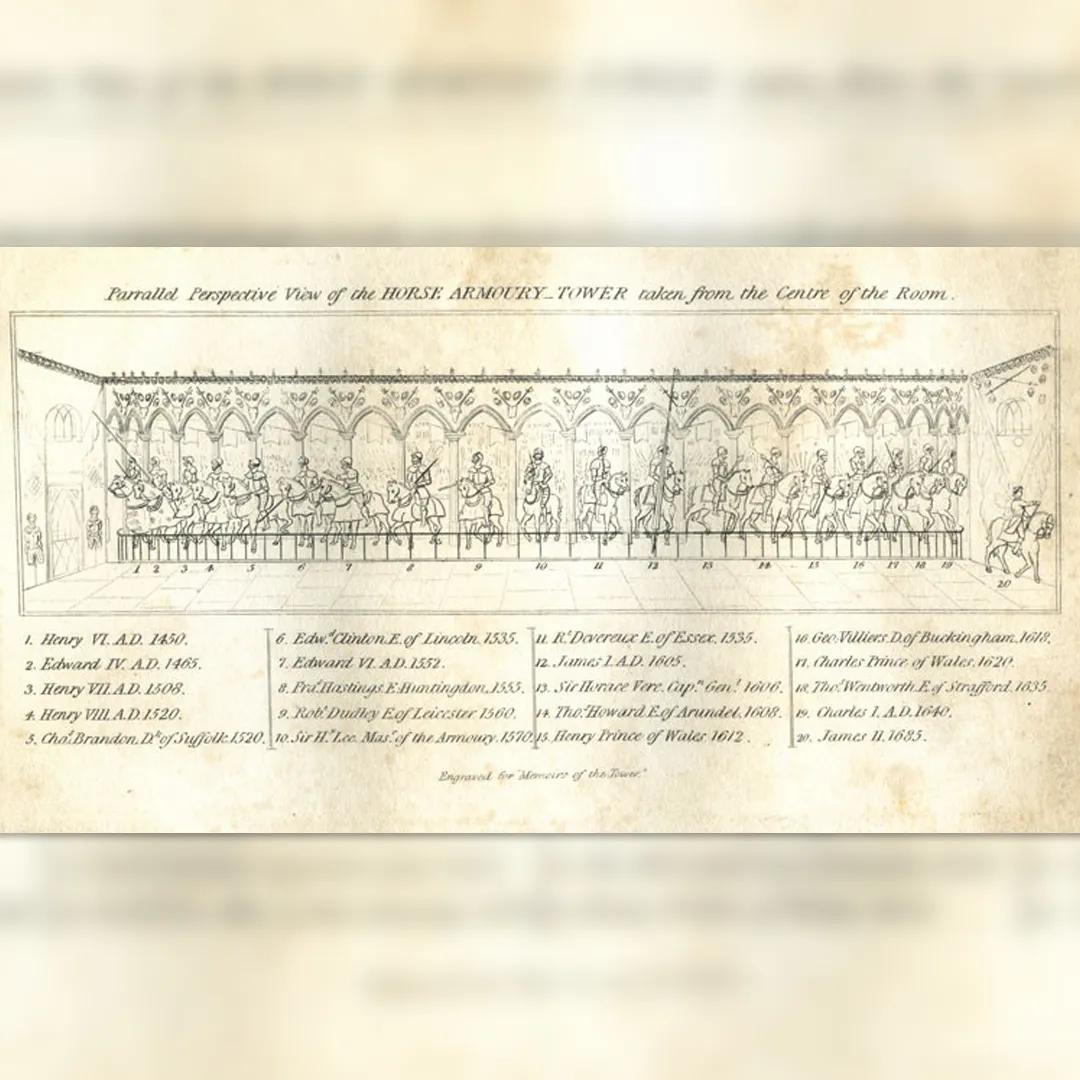
Despite his dislike of the new building, the New Horse Armoury was one of Britain’s earliest purpose-built museum buildings. It had a line of pointed arches running down its centre, in front of which stood the ‘kings’ on their horses. Visitors were led in front and behind to view various standing figures in armour and other objects on the walls and ceiling.

Meyrick’s aim was ‘to make this collection historically useful’ and he chose to arrange the figures and objects chronologically for the first time and ‘founded on the basis of truth.’ In addition to making the display more educational, Meyrick also improved the appearance of the ‘Line’.  

Instead of one position as heretofore for the whole, though there are two and twenty figures on horseback and ten on foot, there are no two attitudes alike, no very easy matter to effect.

To achieve greater accuracy Meyrick changed the display from just monarchs to a line in which kings were once again placed alongside princes and noblemen. He also added a figure of James II for the very first time.
Open to the Public

The new building and exhibition were opened in 1827 to rave reviews. Books and magazines, such as The Penny Magazine, breathlessly described the Horse Armoury with detailed images. Many publications stressed that this was an attraction not to be missed:

Few who have not actually seen the Horse Armoury can appreciate its strikingly picturesque character; that is certainly a pleasure which even the most hurried visitor cannot be deprived of.

Good publicity and a reduction in visitor entry prices in the late 1830s, from two shillings to six pence per person, increased visitor numbers even more. Now the attraction was not just the preserve of the wealthy and well-connected. In fact, the displays almost became too busy, with complaints that visitors were taken around so quickly that it was impossible to see the armour properly.

An engraving on yellowing paper of a line of mannequins on horses in full armour
The earliest illustration of the Line of Kings following Meyrick's redisplay was published in John Britton's Memoirs of the Tower of London in 1830. Engraving of the Line of Kings in the Horse Armoury at the Tower of London, John Britton, 1830.
A black and white engraving of workers polishing armour on mannequins in the Tower of London
Maintaining metal armour in damp conditions poses a number of problems. This illustration of the polishing of the Line of Kings points to the manual labour required. Illustration from The Graphic newspaper, England, 1893.

The first official guidebook to the Tower and Armouries was written by John Hewitt in 1841, followed by his Official Catalogue of the Arms and Armour in 1859. By the mid-19th century, it became clear that the display was in need of another change. New additions were made to improve the collection, but the task of keeping it up to date based on current scholarship proved difficult. By 1866 Baron de Ros wrote:

...it is beginning to require a fresh inspection and arrangement, similar to that made by the late Dr Meyrick.

From the Stage to the Tower: James Robinson Planché

In 1869 James Robinson Planché was invited by the War Office to re-arrange the New Horse Armoury. Planché was a playwright, historian, and Herald at the College of Arms. He was also an expert on arms and armour and had recently organised an armour exhibition at the South Kensington Museum (now the Victoria and Albert Museum). He accepted, hoping to allow: 

...the general visitor to form, even at a rapid and passing glance, some idea of the progress of art and gradual change of fashion, from the 12th to the 18th century.

Planché improved the presentation of the line of figures and grouped the arms and armour by date. He also removed the large banners above the riders created by Dr Meyrick in 1826–7. Instead, he added informative labels so visitors would not have to rely on descriptions given by the guides.

A sepia tone photograph of a balding man in a 19th century suit, glancing to one side and holding their pons nez.
Planché had an interest in historical accuracy long before his role at the Tower. His first major work, History of British Costume from the Earliest Period to the Close of the 18th Century, was published in 1823. James R. Planché, New York Public Library.
A sepia tone photograph in portrait showing a line of armoured mannequins with additional pieces lining the wall behind.
This postcard of the interior of the Horse Armoury is part of a set of 24 photographs taken within the Tower of London around 1870 by James Davis Burton. It is among the earliest known photographs of the fortress.

For people unable to visit in person, books and magazines were an important way to picture the Horse Armoury. Technological developments in the late 1860s meant photographers could now produce pictures inside the New Horse Armoury. These provided a more accurate picture of the display than many engravings and comparing photographs at different dates shows that further slight changes continued regularly.

Some photographs were sold for viewing through 3-D devices, as souvenirs to be kept in albums, and as glass slides for projecting onto a screen. After a lot of debate, the entry charge was removed in 1875 on certain ‘free days’. This allowed entry to the Horse Armoury for those on low incomes who were willing to queue on a Monday or Saturday. 

By the 1880s, the Horse Armoury had become so popular that the display would have to be moved again – this time inside the White Tower itself. 

Find out more about the Line of Kings in our online collection

As the 20th century dawned, the Line of Kings was moved to the White Tower to better accommodate the increase in popularity. Yet, as plans were made to move the Royal Armouries to a new location for a new millennium, the mannequins were beginning to show their age. In part 4, we explore how the line was reinterpreted to suit modern audiences. 
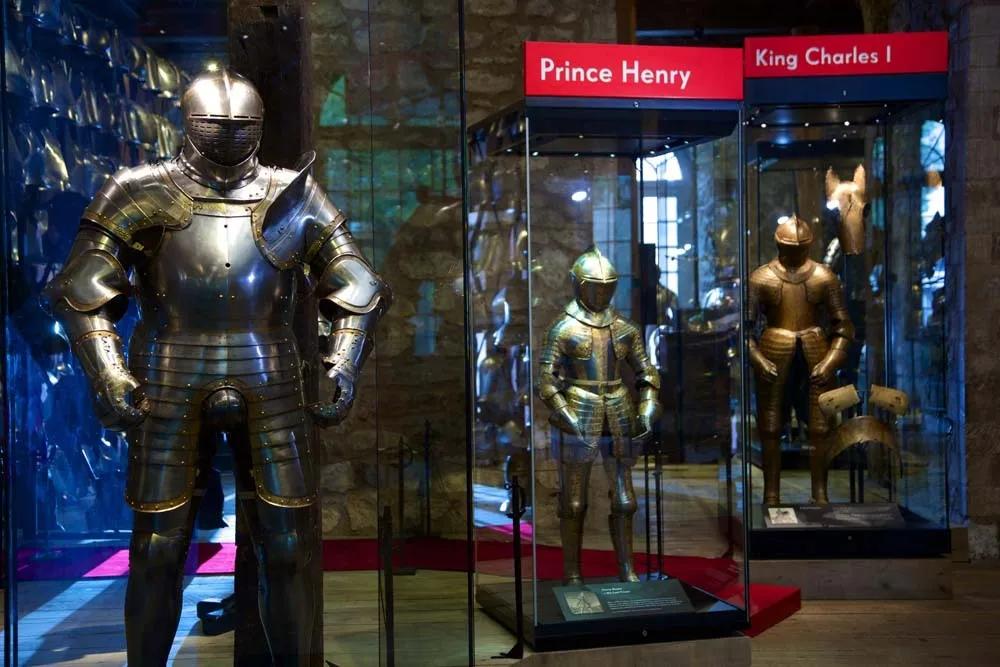
A colour photo of three suits of metal armour in descending rows. All three are held in three glass cases.

Visit the Line of Kings

The Line of Kings is one of the oldest visitor attractions in the UK, displaying the arms and armour of monarchs throughout English and British history. From suits of armour designed for young princes to chest plates engraved with declarations of love and union, the Line of Kings is a fascinating look into not only strength of arms but the projection of power etched into metal. The Line of Kings is currently located in the White Tower. Admission is free to visitors with their Tower of London ticket.
Plan your visit to the Tower of London

Comments

Join the conversation

Log in or register to post comments
0 comments